| Piú viste - Mars Reconnaissance Orbiter (MRO) |
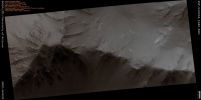
ESP_020958_1680_RED_abrowse-PCF-LXTT.jpgMassif in Coprates Chasma (Absolute Natural Colors; credits for the additional process. and color.: Dr Paolo C. Fienga - Lunexit Team)90 visitenessun commentoMareKromium
|
|
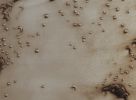
ESP_025118_2570_RED-PCF-LXTT-00B.jpgDefrosting Northern Dunes (CTX Frame "B" - Absolute Natural Colors; credits for the additional process. and color.: Dr Paolo C. Fienga - Lunexit Team)90 visiteMars Local Time: 13:58 (early afternoon)
Coord. (centered): 76,6° North Lat. and 104,1° East Long.
Spacecraft altitude: 317,7 Km (such as about 198,6 miles)
Original image scale range: 31,8 cm/pixel (with 1 x 1 binning) so objects ~ 95,0 cm across are resolved
Map projected scale: 25 cm/pixel
Map projection: POLAR STEREOGRAPHIC
Emission Angle: 0,8°
Sun - Mars - MRO (or "Phase") Angle: 63,5°
Solar Incidence Angle: 63° (meaning that the Sun is about 27° above the Local Horizon)
Solar Longitude: 39,2° (Northern Spring)
Credits: NASA/JPL/University of Arizona
Additional process. and coloring: Lunar Explorer ItaliaMareKromium
|
|

ESP_024956_1900_RED-PCF-LXTT.jpgUnnamed Crater (Absolute Natural Colors; credits for the additional process. and color.: Dr Paolo C. Fienga - Lunexit Team)90 visiteMars Local Time: 14:38 (early afternoon)
Coord. (centered): 9,8° North Lat. and 223,2° East Long.
Spacecraft altitude: 273,8 Km (such as about 171,1 miles)
Original image scale range: 54,8 cm/pixel (with 2 x 2 binning) so objects ~ 1 mt and 64 cm across are resolved
Map projected scale: 50 cm/pixel
Map projection: EQUIRECTANGULAR
Emission Angle: 0,1°
Sun - Mars - MRO (or "Phase") Angle: 39,0°
Solar Incidence Angle: 39° (meaning that the Sun is about 51° above the Local Horizon)
Solar Longitude: 33,5° (Northern Spring)
Credits: NASA/JPL/University of Arizona
Additional process. and coloring: Lunar Explorer ItaliaMareKromium
|
|

ESP_027758_1530-1-PCF-LXTT-IPF.jpgWater-Ice in a Chlorite-bearing Escarpment in North/Western Hellas Planitia (CTX Fframe and EDM - Absolute Natural Colors; credits for the additional process. and color.: Dr Paolo C. Fienga/Lunar Explorer Italia/Italian Planetary Foundation)90 visiteA South-facing Escarpment located in the North/Western part of the Martian Region known as Hellas Planitia (a target that was chosen for the research of Phyllosilicates) showed us the presence, inside the Rocks (---> mostly in their horizontal cracks) forming it, of a pale bluish Material, barely visible in this Absolute Natural Color image. The CRISM Spectra of such Material showed that it consists of a combination of Chlorite and Water Ice. This image was captured by the NASA - Mars Reconnaissance Orbiter during the Southern Martian Winter, such as in the time period when the Southern Hemisphere's South-facing Escarpments (just like this one) of the Red Planet retain Water Ice Deposits that formed during that dark, long and extremely cold Season.
Mars Local Time: 15:36 (Middle Afternoon)
Coord. (centered): 26,501° South Lat. and 55,094° East Long.
Spacecraft altitude: 268,2 Km (such as about 166,552 miles)
Original image scale range: 26,8 cm/pixel (with 1 x 1 binning) so objects ~ 80 cm across are resolved
Map projected scale: 25 cm/pixel
Map projection: EQUIRECTANGULAR
Emission Angle: 18,0°
Phase Angle: 56,7°
Solar Incidence Angle: 69° (meaning that the Sun was about 21° above the Local Horizon at the time the picture was taken)
Solar Longitude: 131,4° (Northern Summer - Southern Winter)
Credits: NASA/JPL/University of Arizona
Additional process. and coloring: Lunar Explorer Italia
This picture (which is a NASA - Original Mars Reconnaissance Orbiter NON-Map Projected false color EDM frame identified by the serial n. ESP_027758_1530-1) has been additionally processed, magnified to aid the visibility of the details, contrast enhanced and then re-colorized in Absolute Natural Colors (such as the colors that a human eye would actually perceive if someone were onboard the NASA - Mars Reconnaissance Orbiter and then looked down, towards the Surface of Mars), by using an original technique created - and, in time, dramatically improved - by the Lunar Explorer Italia Team.MareKromium
|
|
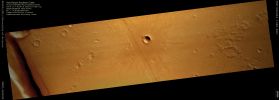
PSP_006681_1580_RED_abrowse~0.jpgFresh Southern Crater (natural colors; credits: Lunexit)89 visiteThis image features a very fresh crater in the Southern Hemisphere. The crater is termed fresh because it is well-preserved with steep walls and obvious small-scale ejecta.
The crater has a set of dark rays extending from it; these rays are ejecta that sprayed out when the crater formed. Boulders ejected during the impact surround the crater.
MareKromium
|
|

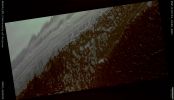
ESP_011631_1515_RED_abrowse.jpgInside Hellas Basin (Natural Colors; credits: Lunar Explorer Italia)89 visiteThis image shows part of the floor of an impact crater on the Northern Rim of the giant Hellas Basin.
Hellas includes the lowest elevations on Mars, and may have once held lakes or seas; layered rock outcrops occur around much of the edge of the basin. At this site, a large impact crater (about 90 kM across) was partly filled by layered rocks. These rocks on the crater floor are now eroding and forming strange pits.
Here, the layers are mostly exposed on a steep slope which cuts across much of the image. On this slope, they crop out as rocky stripes, some continuous and others not. The material between the stripes is mostly covered by debris, but some areas of exposed rock are visible. The slope is capped by a thick, continuous layer that armors it against erosion; once this cap is gone, the lower material is removed rapidly, forming the steep slope. At the base of this slope, rocks on the floor of the pit appear bright and heavily fragmented by cracks known as joints. The variation in rock types suggests that the rocks here were deposited by multiple processes or in different environments. Sites like this may preserve a record of conditions on early Mars.
Mars Local Time: 15:55 (middle afternoon)
Coord. (centered): 28,4° South Lat. and 57,1° East Long.
Spacecraft altitude: 256,9 Km (such as about 160,6 miles)
Original image scale range: 25,7 cm/pixel (with 1 x 1 binning) so objects ~51,4 cm across are resolved
Map projected scale: 25 cm/pixel
Map projection: EQUIRECTANGULAR
Emission Angle: 0,3°
Phase Angle: 60,1°
Solar Incidence Angle: 60° (meaning that the Sun is about 30° above the Local Horizon)
Solar Longitude: 193,8° (Northern Autumn)
Credits: NASA/JPL/University of Arizona
Additional process. and coloring: Lunar Explorer ItaliaMareKromium
|
|
PSP_010716_2640_RED_abrowse.jpgNorth Polar Cavi Scarp with Unconformity (Natural Colors; credits: Lunar Explorer Italia)89 visiteMars Local Time: 14:14 (early afternoon)
Coord. (centered): 83,9° North Lat. and 165,7° East Long.
Spacecraft altitude: 322,0 Km (such as about 201,3 miles)
Original image scale range: 64,4 cm/pixel (with 1 x 1 binning) so objects ~ 1,93 mt across are resolved
Map projected scale: 50 cm/pixel
Map projection: EQUIRECTANGULAR
Emission Angle: 3,5°
Phase Angle: 71,4°
Solar Incidence Angle: 74° (meaning that the Sun is about 16° above the Local Horizon)
Solar Longitude: 154,4° (Northern Summer)
Credits: NASA/JPL/University of Arizona
Additional process. and coloring: Lunar Explorer ItaliaMareKromium
|
|
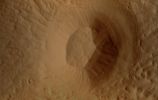
PSP_010630_2115_RED_abrowse-01.jpgCraters and possible "Pingo" in Mamers Vallis (edm - Natural Colors; credits: Lunar Explorer Italia)89 visite"At first this resembles a cinder cone volcano on Earth. However, when magnified, it reveals a feature [found in Arctic regions] on Earth called "Pingo". These are caused by ice protruding through the soil creating a positive-relief geologic feature. If you examine the smaller craters in the surrounding terrain you'll see a checkerboard pattern in each one. These closely resemble melted Pingos on Earth, again suggesting an area of Mars that was once rich with water."
While the student's suggestion that the mound-like structure is a Pingo is reasonable, there is yet no scientific consensus for the origin of these interesting structures.
Nota Lunexit: con tutto il rispetto per le brillanti intuizioni dei ragazzini "sponsorizzati" dalla NASA, l'idea del "Pingo" non stà - davvero - nè in cielo, nè in Terra. Eppure, come leggete, anche a queste boutades (perchè provengono da fanciulli - probabilmente - "quotati" a tutti i livelli), viene dato spazio. Poi però, se chiedi ai Signori di Pasadena o della University of Arizona, ad esempio, cosa potrebbe essere la Silver Sphere (o altri rilievi anomali simili, a parer nostro - e NON SOLO nostro - MOLTO più intriganti dello "pseudo Pingo")...Ecco che cala il silenzio più totale.
Che tristezza...MareKromium
|
|
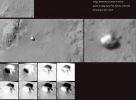
Mars3-MF.jpgIs this "CCCP-Mapc 3" or just a Boulder? (an Image-Mosaic by Dr Marco Faccin)89 visitenessun commentoMareKromium
|
|
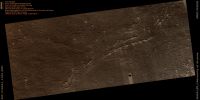
ESP_018665_1920_RED_abrowse.jpgLava Channel (Natural Colors; credits for the additional process. and color.: Dr Paolo C. Fienga - Lunexit Team)89 visitenessun commentoMareKromium
|
|

ESP_019186_1525_RED_abrowse.jpgThe Central Structure of Jorn Crater (Absolute Natural Colors; credits for the additional process. and color.: Dr Paolo C. Fienga - Lunexit Team:)89 visitenessun commentoMareKromium
|
|

ESP_019372_2300_RED_abrowse-00.jpgFeatures of Lyot Crater (Absolute Natural Colors; credits for the additional process. and color.: Dr Paolo C. Fienga - Lunexit Team)89 visitenessun commentoMareKromium
|
|
| 2237 immagini su 187 pagina(e) |
 |
|
|
|
|
72 | |
|
|
|
|





