| Piú viste - Mars Reconnaissance Orbiter (MRO) |
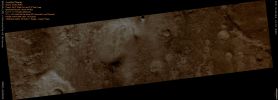
ESP_018384_2270_RED_abrowse-00.jpgAcidalia Planitia (Natural Colors; credits for the additional process. and color.: Dr Paolo C. Fienga - Lunexit Team)91 visitenessun commentoMareKromium
|
|

PSP_004006_1900_RED_abrowse-PCF-LXTT.jpgFissure in Cerberus Fossae (Absolute Natural Colors; credits for the additional process. and color.: Dr Paolo C. Fienga - Lunexit Team)91 visitenessun commentoMareKromium
|
|

PSP_004052_2045_RED_abrowse-00.jpgUnnamed Crater with Layers near Mawrth Vallis (Absolute Natural Colors; credits for the additional process. and color.: Dr Paolo C. Fienga - Lunexit Team)91 visitenessun commentoMareKromium
|
|

ESP_020683_2010_RED_abrowse-PCF-LXTT.jpgTharsis Plateau (Absolute Natural Colors; credits for the additional process. and color.: Dr Paolo C. Fienga - Lunexit Team)91 visitenessun commentoMareKromium
|
|

ESP_020245_2190_RED_abrowse.jpgUnnamed Northern Crater with Gullies (Natural Colors; credits for the additional process. and color.: Dr Paolo C. Fienga - Lunexit Team)91 visitenessun commentoMareKromium
|
|
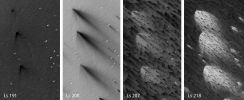
ESP_020953_0925_RED_abrowse-01.jpgEvolution of Southern Fans (an Image-Mosaic by NASA/JPL/University of Arizona)91 visiteThis is a sequence of 4 images acquired in Early Southern Spring over a particular spot in the South Polar Region. The changes in patterns are so great over just half a season that it is difficult to believe that the images cover the same ground. This composite helps by focusing on 3 distinctive Fans as they evolve. The Dark Fans turn into broad Bright Fans, then new small Dark Fans form inside the old Bright Fans. The newer Dark Fans form along cracks forming polygonal or other patterns.
These changes are driven by Sublimation and Condensation of volatiles, primarily CO2. Sunlight passes through the Ice to warm Subsurface Pockets of Gas which escape to form cold jets and the wind blows to form Fans on the Surface, depositing Dark Dust and Bright Frost.
Note: The Martian year is measured by 360° of Areocentric Longitude of the Sun or "Ls", where Ls 180-270 marks Southern Spring and Northern Fall. The Ls of each image is marked in each subframe and covers only 30% of the Spring.MareKromium
|
|
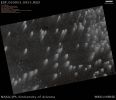
ESP_020953_0925_RED_abrowse-00.jpgSouthern Fans (Absolute Natural Colors; credits for the additional process. and color.: Dr Paolo C. Fienga - Lunexit Team)91 visitenessun commentoMareKromium
|
|

ESP_025396_1915-PCF-LXTT.jpgRelatively recent Unnamed Impact Crater (Enhanced Absolute Natural Colors; credits for the additional process. and color.: Dr Paolo C. Fienga - Lunar Explorer Italia)91 visiteMars Local Time: 14:50 (early afternoon)
Coord. (centered): 11,6° North Lat. and 90,7° East Long.
Spacecraft altitude: 278,0 Km (such as about 173,7 miles)
Original image scale range: 27,8 cm/pixel (with 1 x 1 binning) so objects ~ 83 cm across are resolved
Map projected scale: 25 cm/pixel
Map projection: EQUIRECTANGULAR
Emission Angle: 2,1°
Sun - Mars - MRO (or "Phase") Angle: 39,6°
Solar Incidence Angle: 42° (meaning that the Sun is about 48° above the Local Horizon)
Solar Longitude: 48,9° (Northern Spring)
Credits: NASA/JPL/University of Arizona
Additional process. and coloring: Lunar Explorer ItaliaMareKromium
|
|

PSP_003647_1745_RED_browse-00.jpgCanditate Cavern Entrance (CTX Frame - Absolute Natural Colors; credits for the additional process. and color.: Dr Paolo C. Fienga - Lunexit Team)90 visiteThis image shows a very dark spot on an otherwise relatively bright dusty Lava Plain to the North-East of Arsia Mons, one of the four giant Tharsis volcanoes.
This is NOT an Impact Crater as it lacks a Raised Rim or Ejecta Blanket. What's amazing is that we cannot see any detail in the shadow. The HiRISE camera is very sensitive and we can see details in almost any shadow on Mars, but not here.
We also cannot see the deep walls of the Pit. The best interpretation is that this is a Collapse Pit into a Cavern or at least a pit with Overhanging Walls. We cannot see the Walls because they are either perfectly vertical and extremely dark or, more likely, overhanging.
The Pit must be very deep to prevent detection of the floor from skylight, which is quite bright on Mars.MareKromium
|
|

PSP_001936_1370_RED_abrowse-02.jpgUnnamed Crater in Terra Cimmeria (Absolute Natural Colors; credits for the additional process. and color.: Dr Paolo C. Fienga - Lunexit Team)90 visitenessun commentoMareKromium
|
|

ESP_019191_1750_RED_abrowse.jpgFeatures of Juventae Chasma (Absolute Natural Colors; credits for the additional process. and color.: Dr Paolo C. Fienga - Lunexit Team)90 visitenessun commentoMareKromium
|
|

PSP_005392_0995_RED_abrowse-02~0.jpgImpact Crater on the South Polar Layered Deposits (EDM n.2 - Absolute Natural Colors; credits for the additional process. and color.: Dr Paolo C. Fienga - Lunexit Team)90 visiteOf particular interest is the small, approx. 330 meter (360 yard) diameter Impact Crater. The number of Impact Craters on a Planetary Surface is often used to estimate the age of that Surface (because the older a Surface is, the more time that Surface has had to accumulate Craters, and thus the more Craters that Surface will have on it - assuming, of course, a constant "Cratering Rate" - Nota Lunexit: questa è un'assunzione, a dir poco, azzardata...).
The SPLD on Mars are believed to be very young because there are no large Craters on them and very few small Craters. The high resolution of HiRISE will enable these Craters to be studied in detail, perhaps allowing the number of Craters — and thus the Surface age — to be better constrained.MareKromium
|
|
| 2237 immagini su 187 pagina(e) |
 |
|
|
|
|
71 | |
|
|
|
|





