| Piú viste - Mars Reconnaissance Orbiter (MRO) |

PSP_003234_2210_red.jpgThe "Face" on Mars... (False Colors; credits: NASA/JPL)92 visiteImage PSP_003234_2210 was taken by the High Resolution Imaging Science Experiment (HiRISE) camera onboard the Mars Reconnaissance Orbiter spacecraft on 05-Apr-2007.
The complete image is centered at 40,7° latitude, 350,5° East Longitude. The range to the target site was 299,4 Km (187,1 miles). At this distance the image scale is 29,9 cm/pixel (with 1 x 1 binning) so objects ~90 cm across are resolved.
The image shown here has been map-projected to 25 cm/pixel and north is up.
The image was taken at a local Mars time of 03:28 PM and the scene is illuminated from the West with a solar incidence angle of 73°, thus the Sun was about 17° above the horizon.
At a Solar Longitude of 213,4°, the season on Mars is Northern Autumn.
|
|

Craters-Proctor_Crater-PIA13076.jpgProctor's Dunes (Possible Natural Colors; credits for the additional process. and color.: Dr Paolo C. Fienga - Lunexit Team)92 visiteThis observation shows the edge of a dark Dunefield on the Floor of Proctor Crater, an about 150 Km (approx. 93 miles) diameter crater in the Southern Highlands of Mars.
This subimage is a close-up view of the dark dunes. These dunes are most likely composed of basaltic sand that has collected on the bottom of the crater. Superimposed on their surface are smaller secondary dunes which are commonly seen on terrestrial dunes of this size. Near the crests of the dark dunes are bright patches of frost. Dark spots within the frost patches are areas where defrosting is occurring.
Many smaller and brighter bed forms, most likely small dunes or granule ripples, cover the substrate between the larger dark dunes as well as most of the Floor of Proctor Crater. In many locations, large boulders are seen on the same surfaces as the bright bed forms.
The dark dunes stratigraphically overlie the small bright bed forms indicating that the darker dunes formed more recently.
However in several areas, the dark dunes appear to influence the orientation of the small bright dunes, possibly by wind flowing around the larger dunes, suggesting that both dark and bright bed forms are coeval.MareKromium
|
|
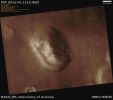
PSP_003234_2210_RED_abrowse.jpgDo You Remember Me? (Absolute Natural Colors; credits for the additional process. and color.: Dr Paolo C. Fienga - Lunexit Team)92 visiteCaption NASA:"HiRISE captured this image (in 2007) of an eroded mesa made famous by its similarity to a human face in a Viking Orbiter image with much lower spatial resolution and a different lighting geometry.
Compared to the original Viking image (dated 1976), HiRISE shows incredible detail, even from about 300 Km above the surface".
Nota Lunexit: una domanda che rivolgiamo, simpaticamente ed ironicamente, al Prof. Richard Hoagland ed ai suoi accoliti: ma la "Faccia" di Marte - e cioè "l'Evidenza Finale - parole di Hoagland - di una pregressa Civiltà Marziana", dov'è andata a finire???...MareKromium
|
|

PSP_003234_2210_RED-MF-PCF-LXTT2~0.jpgThe "Face on Mars" (Absolute Natural Colors; credits for the additional process. and color.: NASA/JPL and Dr Paolo C. Fienga - Lunexit Team)92 visitenessun commentoMareKromium
|
|

Q-U-BosporusPlanum-PCF-LXTT4.jpgFeatures of Bosporus Planum (Natural Colors; credits for the additional process. and color.: Dr Paolo C. Fienga - Lunexit Team)92 visitenessun commentoMareKromium
|
|

ESP_019151_1385_RED_abrowse-01.jpgUnnamed Shallow Craters in Northern Argyre Planitia (EDM n.1 - Absolute Natural Colors; credits for the additional process. and color.: Dr Marco Faccin - Lunexit Team)92 visitenessun commento
MareKromium
|
|

PSP_003077_1530_RED_abrowse-1.jpgThe "White Cliffs" of Holden Crater (Absolute Natural Colors; credits for the additional process. and color.: Dr Paolo C. Fienga - Lunexit Team)92 visitenessun commentoMareKromium
|
|
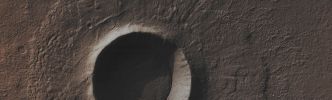
ESP_025680_1350-PCF-LXTT-00a.jpgUnnamed Crater with "Pedestal" in Terra Cimmeria (CTX Frame - Absolute Natural Colors; credits for the additional process. and color.: Dr Paolo C. Fienga - Lunexit Team)92 visiteMars Local Time: 15:08 (Early Afternoon)
Coord. (centered): 44,814° South Lat. and 264,976° East Long.
Spacecraft altitude: 247,7 Km (such as about 154,8 miles)
Original image scale range: 49,6 cm/pixel (with 2 x 2 binning) so objects ~ 1 mt and 49 cm across are resolved (with 4 x 4 binning)
Map projected scale: 50 cm/pixel
Map projection: EQUIRECTANGULAR
Emission Angle: 0,3°
Sun - Mars - MRO (or "Phase") Angle: 79,1°
Solar Incidence Angle: 79° (meaning that the Sun is about 11° above the Local Horizon)
Solar Longitude: 58,6° (Northern Spring/Southern Fall)
Credits: NASA/JPL/University of ArizonaMareKromium
|
|

ESP_027378_2540-PCF-LXTT-IPF-1B.jpgNorthern Dunes (CTX Frame "B" - Absolute Natural Colors; credits for the additional process. and color.: Dr Paolo C. Fienga/Lunexit Team)92 visiteThis Field of crescent-shaped Dunes (located at Lat. 73,62° North and 328,215° East Long.) is located just South of the North Polar Layered Terrain. These Dunes, known as "Barchan Dunes", usually form where there is a moderate supply of Sand and a Prevailing Wind Direction (meaning that they form in Regions where there are Dominant Winds). The "Arms" (or "Horns") of the Barchan Dunes point in the downwind direction and in this case this circumstance indicates that the Dominant Winds blow towards the North/West.
Mars Local Time: 14:42 (Early Afternoon)
Coord. (centered): 73,622° North Lat. and 328,215° East Long.
Spacecraft altitude: 316,7 Km (such as about 198,0 miles)
Original image scale range: 63,4 cm/pixel (with 2 x 2 binning) so objects ~ 1 mt and 90 cm across are resolved
Map projected scale: 50 cm/pixel
Map projection: POLAR STEREOGRAPHIC
Emission Angle: 1,9°
Sun - Mars - MRO (or "Phase") Angle: 57,6°
Solar Incidence Angle: 56° (meaning that the Sun is about 34° above the Local Horizon)
Solar Longitude: 117,4° (Northern Summer - Southern Winter)
Credits: NASA/JPL/University of Arizona
Additional process. and coloring: Lunar Explorer ItaliaMareKromium
|
|
PSP_010446_2675_RED_abrowse.jpgNorth Polar Residual Cap Monitoring (Natural Colors; credits: Lunar Explorer Italia)91 visiteMars Local Time: 09:54 (middle morning)
Coord. (centered): 87,4° North Lat. and 273,0° East Long.
Spacecraft altitude: 316,8 Km (such as about 198,0 miles)
Original image scale range: 63,4 cm/pixel (with 1 x 1 binning) so objects ~ 1,90 mt across are resolved
Map projected scale: 50 cm/pixel
Map projection: EQUIRECTANGULAR
Emission Angle: 0,0°
Phase Angle: 73,2°
Solar Incidence Angle: 73° (meaning that the Sun is about 17° above the Local Horizon)
Solar Longitude: 143,7° (Northern Summer)
Credits: NASA/JPL/University of Arizona
Additional process. and coloring: Lunar Explorer ItaliaMareKromium
|
|
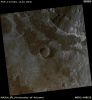
PSP_010580_1630_RED_abrowse.jpgPlains near Valles Marineris (possible Natural Colors; credits: Lunar Explorer Italia)91 visiteMars Local Time: 15:44 (middle afternoon)
Coord. (centered): 17,0° South Lat. and 309,6° East Long.
Spacecraft altitude: 257,0 Km (such as about 160,6 miles)
Original image scale range: 25,7 cm/pixel (with 1 x 1 binning) so objects ~77 cm across are resolved
Map projected scale: 25 cm/pixel
Map projection: EQUIRECTANGULAR
Emission Angle: 0,2°
Phase Angle: 63°
Solar Incidence Angle: 63° (meaning that the Sun is about 27° above the Local Horizon)
Solar Longitude: 149,0° (Northern Summer)
Credits: NASA/JPL/University of Arizona
Additional process. and coloring: Lunar Explorer ItaliaMareKromium
|
|
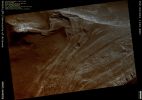
PSP_001662_1520_RED_abrowse.jpgLayered Deposits in Terby Crater (Natural - but enhanced - Colors; credits: Dr Paolo C. Fienga - Lunexit Team)91 visiteTerby Crater is a large (approximately 165 Km), Noachian-aged crater located on the Northern Rim of the Hellas Impact Basin.
Terby hosts a very impressive sequence of predominantly light-toned Layered Deposits, up to 2,5 Km thick that are banked along its Northern Rim and extend toward the center of the Crater.
The full image shows this stack of layered rocks as they are exposed Westward facing scarp. The layered sequence consists of many beds that are repetitive, relatively horizontal and laterally continuous on a kilometer scale. Many beds are strongly jointed and fractured and exhibit evidence of small-scale wind scour.
The light-toned layers are typically at least partially covered with dark mantling material that obscures the layers as well as debris and numerous, meter-scale boulders that have cascaded down slope. The processes responsible for formation of these layers remain a mystery, but could include deposition in water, by the wind, or even volcanic activity.
This HiRISE image is a proposed landing site for the Mars Science Laboratory (MSL) in Terby Crater.MareKromium
|
|
| 2237 immagini su 187 pagina(e) |
 |
|
|
|
|
70 | |
|
|
|
|





