| Piú viste - Mars Reconnaissance Orbiter (MRO) |

ESP_019711_2455_RED_abrowse.jpgUnnamed Crater in Vastitas Borealis (Absolute Natural Colors; credits for the additional process. and color.: Dr Paolo C. Fienga - Lunexit Team)94 visiteThis image covers part of a large Impact Crater located in the Northern Plains of Mars (Vastitas Borealis Region). The Crater is old and has been heavily modified by ground ice processes. The most prominent of these processes is the network of Polygonal Fractures visible throughout the image.
These landforms are created when temperature changes over the course of a year cause ice in the ground to first expand, then contract and, in the end, break. The ground moves fractionally every time this occurs.
At the center of the frame it can be seen that this - repetitive - process has caused the shifting of rocks and boulders through the Surface of the Crater, thus causing them to line up along the Fractures and then form some interesting geometric patterns.MareKromium
|
|
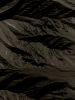
PSP_004060_1440_RED_abrowse-01-PIA13611.jpgUnnamed Southern Crater with deep Gullies (EDM - Absolute Natural Colors; credits for the additional process. and color.: Dr Paolo C. Fienga - Lunexit Team)94 visitenessun commentoMareKromium
|
|
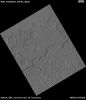
PSP_004000_0945_RED_abrowse-00.jpgChangings... (CTX Frame - credits: NASA/JPL/University of Arizona)94 visiteHiRISE is monitoring the Residual Carbon Dioxide Cap on (or near) the South Pole of Mars to see how it changes over time.
Some of this Terrain contains many Pits, earning it the nickname "Swiss Cheese Terrain". One of our monitoring spots is over what looks like a deranged "Happy Face". If you look closely, you'll see many changes since the first HiRISE image, PSP_004000_0945, was acquired in 2007. The news is that the Pits have grown larger. When this Pit growth was first discovered, it was suggested to be an indication of climate change on Mars. However, we now suspect that the CO2 that sublimates from the Pit Walls recondenses on the nearby surfaces, so there is no net change in the total amount of frozen CO2.
Acquisition date: December, 30th, 2010
Mars Local Time (M.L.T.): 18:03 (Late Afternoon)
Latitude (centered): 85,7° South
Longitude (East): 6,5°
Spacecraft Altitude (or Range to Target Site): 247,6 km (154,8 miles)
Original image scale range: 24,8 cm/pixel (with 1 x 1 binning) so objects ~74 cm across are resolved
Map Projected Scale: 25 cm/pixel
Map Projection: POLAR STEREOGRAPHIC
Emission Angle: 0,2°
Phase Angle: 78,9°
Solar Incidence Angle: 79° (with the Sun about 11° above the Local Horizon)
Solar Longitude: 207,7° (Northern Autumn)MareKromium
|
|

ESP_025118_2570_RED-PCF-LXTT-00C.jpgDefrosting Northern Dunes (EDM - Absolute Natural Colors; credits for the additional process. and color.: Dr Paolo C. Fienga - Lunexit Team)94 visiteMars Local Time: 13:58 (early afternoon)
Coord. (centered): 76,6° North Lat. and 104,1° East Long.
Spacecraft altitude: 317,7 Km (such as about 198,6 miles)
Original image scale range: 31,8 cm/pixel (with 1 x 1 binning) so objects ~ 95,0 cm across are resolved
Map projected scale: 25 cm/pixel
Map projection: POLAR STEREOGRAPHIC
Emission Angle: 0,8°
Sun - Mars - MRO (or "Phase") Angle: 63,5°
Solar Incidence Angle: 63° (meaning that the Sun is about 27° above the Local Horizon)
Solar Longitude: 39,2° (Northern Spring)
Credits: NASA/JPL/University of Arizona
Additional process. and coloring: Lunar Explorer ItaliaMareKromium
|
|

ESP_026394_2160-PCF-LXTT-01.jpgHuge Dust Devil in Amazonis Planitia (EDM - Absolute Natural Colors; credits for the additional process. and color.: Dr Paolo C. Fienga - Lunexit Team) 94 visiteMars Local Time: 15:02 (early afternoon)
Coord. (centered): 35,5° North Lat. and 201,5° East Long.
Spacecraft altitude: 295,8 Km (such as about 184,9 miles)
Original image scale range: 31,9 cm/pixel (with 2 x 2 binning) so objects ~ 1 mt and 18 cm across are resolved (with 4 x 4 binning)
Map projected scale: 50 cm/pixel
Map projection: EQUIRECTANGULAR
Emission Angle: 0,3°
Sun - Mars - MRO (or "Phase") Angle: 40,4°
Solar Incidence Angle: 40° (meaning that the Sun is about 50° above the Local Horizon)
Solar Longitude: 83,0° (Northern Spring)
Credits: NASA/JPL/University of Arizona
Additional process. and coloring: Lunar Explorer ItaliaMareKromium
|
|

ESP_022578_2030_and_ESP_014007_2030.jpgSand-Lakes (3D - Credits for the additional process.: Marco Faccin and Elisabetta Bonora)94 visitenessun commentoMareKromium
|
|
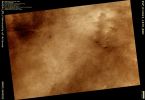
ESP_014423_1870_RED_abrowse.jpgSegment of Corinto Crater (Natural Colors; credits: Lunexit)93 visitenessun commentoMareKromium
|
|
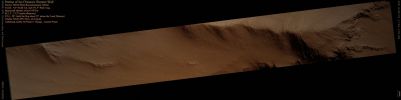
ESP_018770_1730-PCF-LXTT.jpgPortion of Jus Chasma's Wstern Wall (Natural Colors; credits for the additional process. and color.: Dr Paolo C. Fienga - Lunexit Team)93 visitenessun commentoMareKromium
|
|
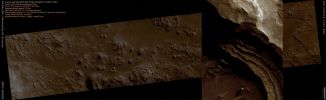
PSP_008338_1525_Erratic_Boulder-EB-LXTT-0.jpgLayers and "Monolith-like" Erratic Boulder in Uzboi Vallis (CTX Frame and EDM - an Image-Mosaic in Absolute Natural Colors by Elisabetta Bonora and Paolo C. Fienga - Lunexit Team)93 visiteMareKromium
|
|

Craters-Rabe_Crater-PIA13728-PCF-LXTT-1.jpgInside Rabe Crater - Summertime (Absolute Natural Colors; credits for the additional process. and color.: Dr Paolo C. Fienga - Lunexit Team)93 visitenessun commentoMareKromium
|
|

PSP_002324_1815_red-PCF-LXTT.jpgNorthern Meridiani Planum (Absolute Natural Colors; credits for the additional process. and color.: Dr Paolo C. Fienga - Lunexit Team)93 visitenessun commentoMareKromium
|
|

ESP_024927_1445-PCF-LXTT-01a.jpgUnnamed Southern Crater with deep incised and colourful Gullies (EDM n.1 - Absolute Natural Colors; credits for the additional process. and color.: Dr Paolo C. Fienga - Lunexit Team)93 visiteMars Local Time: 14:48 (early afternoon)
Coord. (centered): 35,0° South Lat. and 300,9° East Long.
Spacecraft altitude: 251,6 Km (such as about 157,2 miles)
Original image scale range: 25,2 cm/pixel (with 1 x 1 binning) so objects ~ 76,0 cm across are resolved
Map projected scale: 25 cm/pixel
Map projection: EQUIRECTANGULAR
Emission Angle: 4,0°
Sun - Mars - MRO (or "Phase") Angle: 60,2°
Solar Incidence Angle: 63° (meaning that the Sun is about 27° above the Local Horizon)
Solar Longitude: 32,5° (Northern Spring)
Credits: NASA/JPL/University of Arizona
Additional process. and coloring: Lunar Explorer ItaliaMareKromium
|
|
| 2237 immagini su 187 pagina(e) |
 |
|
|
|
|
69 | |
|
|
|
|





