| Piú viste - Mars Reconnaissance Orbiter (MRO) |

PSP_002932_1445_RED_abrowse-00.jpgSection of the Outer Rim of Hale Crater (CTX Frame - Absolute Natural Colors; credits for the additional process. and color.: Dr Paolo C. Fienga - Lunexit Team)97 visiteThis observation shows Hale Crater, a rather large, pristine elliptical crater approximately 125 x 150 Km in diameter. Hale Crater possesses sharp features, impact melt bodies ponded through out the structure and few overprinting Impact Craters. These attributes indicate that it is relatively young and certainly well-preserved - likely the youngest crater of this size on Mars.
Present on the Crater Walls are a large number of Gullies, some with Light-Toned Deposits. The Gullies visible here are very well developed, and many are cut deeply into the Hale's Walls. Several have "Braided Channels" suggestive of repeated flow. Some of the Gullies have Boulders littered throughout their Channels. This could be a result of a fluid preferentially transporting smaller particles and leaving larger rubble behind.
The composition of the Light-Toned Deposits are currently unknown. The CRISM Visible-InfraRed Spectrometer, HiRISE's sister instrument on MRO, may be able to shed some light on the composition of these materials.
In one place along the Crater Rim, Gullies are visible on both sides of the Rim (see the EDM that follows). This has only been seen in a few locations on Mars.MareKromium
|
|

ESP_024927_1445-PCF-LXTT-01b.jpgUnnamed Southern Crater with deep incised and colourful Gullies (EDM n.2 - Absolute Natural Colors; credits for the additional process. and color.: Dr Paolo C. Fienga - Lunexit Team)97 visiteMars Local Time: 14:48 (early afternoon)
Coord. (centered): 35,0° South Lat. and 300,9° East Long.
Spacecraft altitude: 251,6 Km (such as about 157,2 miles)
Original image scale range: 25,2 cm/pixel (with 1 x 1 binning) so objects ~ 76,0 cm across are resolved
Map projected scale: 25 cm/pixel
Map projection: EQUIRECTANGULAR
Emission Angle: 4,0°
Sun - Mars - MRO (or "Phase") Angle: 60,2°
Solar Incidence Angle: 63° (meaning that the Sun is about 27° above the Local Horizon)
Solar Longitude: 32,5° (Northern Spring)
Credits: NASA/JPL/University of Arizona
Additional process. and coloring: Lunar Explorer ItaliaMareKromium
|
|

ESP_024952_2250_RED-PCF-LXTT-00.jpgLow Albedo Surface Features in Acidalia Planitia (CTX Frame "A" - Absolute Natural Colors; credits for the additional process. and color.: Dr Paolo C. Fienga - Lunexit Team)97 visiteMars Local Time: 14:27 (early afternoon)
Coord. (centered): 44,4° North Lat. and 326,8° East Long.
Spacecraft altitude: 304,0 Km (such as about 190,0 miles)
Original image scale range: 60,8 cm/pixel (with 2 x 2 binning) so objects ~ 1 mt and 82 cm across are resolved
Map projected scale: 50 cm/pixel
Map projection: EQUIRECTANGULAR
Emission Angle: 6,9°
Sun - Mars - MRO (or "Phase") Angle: 50,3°
Solar Incidence Angle: 44° (meaning that the Sun is about 46° above the Local Horizon)
Solar Longitude: 33,4° (Northern Spring)
Credits: NASA/JPL/University of Arizona
Additional process. and coloring: Lunar Explorer ItaliaMareKromium
|
|

Psp_009619_1630_red.jpgDouble Impact Crater (natural colors; credits: Lunexit)96 visiteThis image shows a double impact crater in Syria Planum, and probably formed when a binary asteroid pair (two asteroids closely orbiting each other, while also orbiting the Sun) struck the Surface. The asteroids must have been about the same size, on the order of a few hundred meters across, to produce these craters.
How is it possible to say that the double crater is due to a binary asteroid, instead of two independent impacts? Neither crater shows signs of burial by ejecta from the other. More importantly, the ejecta (material thrown out of the craters) shows signs of interacting; the ridges extending to the southeast of the crater probably formed when ejecta from the craters collided in midair, causing more debris to pile up at certain points.
This means that the impacts occurred within moments of each other.
Ejecta interaction features like this can also form in association with “secondary” craters (craters made by debris from other impacts, rather than by asteroids), since many secondary craters form at once. In this case, however, a binary asteroid is the likely cause. The very large size is one indicator (secondary craters are generally much smaller than the “primary” crater), and there is not an obvious nearby source crater. While secondary craters are common, binary impacts are expected to occur as well, since binary asteroid pairs are observed.
This crater pair is also of geologic interest since it exposes a cross-section of the local rocks. Thin, flat layers are visible in the upper walls. Since this region has seen extensive volcanic activity, these may be a mix of old lava flows and other volcanic debris. Exposures like this provide evidence for the extent and thickness of these deposits. MareKromium
|
|

ESP_011648_1730_RED_abrowse-00.jpgOval Mesa on Ganges Mensa (and another "mistery" solved) - Natural Colors; credits: Lunar Explorer Italia96 visiteMars Local Time: 15:56 (middle afternoon)
Coord. (centered): 7,2° South Lat. and 311,5° East Long.
Spacecraft altitude: 277,5 Km (such as about 173,4 miles)
Original image scale range: 27,8 cm/pixel (with 1 x 1 binning) so objects ~83 cm across are resolved
Map projected scale: 25 cm/pixel
Map projection: EQUIRECTANGULAR
Emission Angle: 17,7°
Phase Angle: 41,0°
Solar Incidence Angle: 59° (meaning that the Sun is about 31° above the Local Horizon)
Solar Longitude: 194,6° (Northern Autumn)
Credits: NASA/JPL/University of Arizona
Additional process. and coloring: Lunar Explorer Italia
This Oval Mesa is a remnant of a geological unit that once covered this area, similar to the Mesas and Buttes in Monument Valley, in Arizona and Utah. This is a small remnant of a much larger unit of similar material that caps Ganges Mensa to the West.
As can be seen in the sides of this small Mesa, this remnant consists of a layered stack of rock. Prior to the massive erosion that left this a high-standing Mesa, a more gentle phase of erosion created the small hills and whorls on the upper surface of the Mesa. It seems that this gentle erosion continued even after the Mesa was created, as this pattern of small hills and whorls is visible on the terrain surrounding the Mesa.
Although not visible in the area shown in this HiRISE image, this Mesa actually sits on top of the much larger Ganges Mensa, which is itself a large Mesa within Ganges Chasma.
Nota Lunexit: una diversa ripresa di questo medesimo dettaglio costituì oggetto di una lunga discussione sul Forum degli Amici di "UFO-On Line". La querelle riguardava la presenza di un presunto (ed oggi, come viene ben dimostrato da questa nuova immagine, inesistente) "ingresso" (porta) sul versante Nord-Occidentale della Mesa Ovale che campeggia a centro frame. La discussione, forse innescatasi a seguito delle deliranti asserzioni di un noto Eso-Archeografo Italiano (e relative alla presenza di "evidenti accessi a presidi minerari" sul Pianeta Rosso...) si sviluppò in maniera interessante e costruttiva e ci portò anche al calcolo delle possibili dimensioni della "porta".
Oggi, grazie a questa nuova immagine - che pubblichiamo anche in versione RAW Original b/w - tutti potranno constatare che quella che SEMBRAVA essere una "porta" era, in vero, solo un leggero incavo (indentation) naturale presente sulla parete Nord-Occidentale della Mesa.
Morale: prima di parlare e di lanciarsi in interpretazioni che superano la Fantasia e sconfinano nella Bufala al 100% (e qui, che sia chiaro, NON CI RIFERIAMO agli Amici di "UFO-On Line"!), conviene sempre STUDIARE, DOCUMENTARSI, FARE CONFRONTI FRA DIVERSE IMMAGINI e poi, se proprio si vuol dare aria alla bocca e lavoro alla tastiera, SI SUGGERISCE DI RESTARE SEMPRE POSSIBILISTI - onde evitare di fare delle figure che definirle "meschine" è certamente riduttivo...
Ogni riferimento alle stupidaggini proferite da noti Eso-Archeografi Italici e non, è ASSOLUTAMENTE VOLUTO e NON CASUALE.MareKromium
|
|
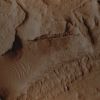
PSP_002478_1770_RED_abrowse-01.jpgEroding Crater Fill (EDM - Natural Colors; credits for the additional process. and color.: Dr Paolo C. Fienga - Lunexit Team)96 visiteThis EDM shows several types of Layers exposed in a Pit. These variations point to a relatively complex geologic history at this site.
Some Layers appear to be fracturing into boulders which roll downslope, while others appear relatively smooth. There are also variations in tone, from light to dark. This diversity may be due to different types of rock, as well as varying strength.
Images such as this one indicate that rocks formed on Mars in a variety of ways, and by careful analysis it may be possible to deduce some of the history that has produced the geology at this site.MareKromium
|
|

ESP_019541_2325_RED_abrowse.jpgNorhern Plains (Absolute Natural Colors; credits for the additional process. and color.: Dr Paolo C. Fienga - Lunexit Team:)96 visitenessun commentoMareKromium
|
|

PSP_002884_1395_RED_abrowse-00.jpgUnnamed Southern Crater with deep Gullies (CTX Frame - Absolute Natural Colors; credits for the additional process. and color.: Dr Paolo C. Fienga - Lunexit Team)96 visiteThis observation shows gullies in a Southern HemisphereUnnamed Crater whose Floor has large Mounds of material that are likely "Slump Blocks" that fell off the Crater Walls during a late stage of formation (---> this is a Gravity Wasting Event). There are also a large number of Dunes of different sizes and facing different directions on the Crater Floor.
A lot of Polygonal Fractures can also be seen on the Walls, inside the Gullies (see the following EDM). In addition, some of the Gullies facing the East were active more recently. They do not have Polygonal Fractures or they have fractures that are less well-developed.
A narrow, primarily unmodified Channel is also visible.
It is unknown over what period of time Gullies formed in individual settings and globally. It is possible that Gully formation continues today.MareKromium
|
|
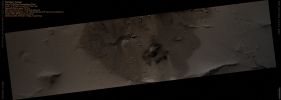
PSP_003450_1975_RED_abrowse-PCF-LXTT.jpgOlympus' Aureole (Absolute Natural Colors; credits for the additional process. and color.: Dr Paolo C. Fienga - Lunexit Team)96 visitenessun commentoMareKromium
|
|

ESP_026394_2160-PCF-LXTT-00.jpgHuge Dust Devil in Amazonis Planitia (CTX Frame - Absolute Natural Colors; credits for the additional process. and color.: Dr Paolo C. Fienga - Lunexit Team) 96 visiteMars Local Time: 15:02 (early afternoon)
Coord. (centered): 35,5° North Lat. and 201,5° East Long.
Spacecraft altitude: 295,8 Km (such as about 184,9 miles)
Original image scale range: 31,9 cm/pixel (with 2 x 2 binning) so objects ~ 1 mt and 18 cm across are resolved (with 4 x 4 binning)
Map projected scale: 50 cm/pixel
Map projection: EQUIRECTANGULAR
Emission Angle: 0,3°
Sun - Mars - MRO (or "Phase") Angle: 40,4°
Solar Incidence Angle: 40° (meaning that the Sun is about 50° above the Local Horizon)
Solar Longitude: 83,0° (Northern Spring)
Credits: NASA/JPL/University of Arizona
Additional process. and coloring: Lunar Explorer ItaliaMareKromium
|
|

Craters-Palos_Crater-PIA12994.jpgDeposits on the Floor of Palos Crater (Possible Natural Colors; credits for the additional process. and color.: Dr Paolo C. Fienga - Lunexit Team)95 visiteThis image shows a portion of the Floor of Palos Crater, on Equatorial Mars.
The High Resolution Imaging Science Experiment (HiRISE) camera on NASA's Mars Reconnaissance Orbiter recorded this image on March 8, 2010.
The target for this HiRISE observation was a suggestion submitted through the camera team's HiWish public-suggestion program. For more information about how to submit target suggestions, see http://uahirise.org/hiwish/.
The Floor appears bumpy with high-standing layered Knobs. Most of the Terrain on the Floor is weathering into meter-size (yard-size) polygonal blocks. The circular structures in the image, many of which are filled with darker wind-blown material, are eroded impact craters.
Palos Crater is breached in the South by the approx. 180-Km-long (about 112-mile-long) Tinto Vallis. Water transported along Tinto Vallis could have could have collected into Palos Crater to form a lake that later drained to the North.
Sediments carried by Tinto Vallis would have also been deposited within Palos Crater, so the layered unit we see along the floor today could represent these fluvial sediments.
This image covers a swath of ground about 1 Km (approx. two-thirds of a mile) wide. It is a portion of HiRISE observation ESP_016943_1775, which is centered at 2,67° South Latitude and 111,13° East Longitude. The season on Mars is southern-hemisphere autumn. Other image products from this observation are available at http://hirise.lpl.arizona.edu/ESP_016943_1775.MareKromium
|
|

PSP_002922_1725_RED_abrowse-03.jpgPossible Volcanic "Mouth", on Arsia Mons' Flank (EDM - Natural Colors - credits for the additional process.: Dr Paolo C. Fienga)95 visitenessun commentoMareKromium
|
|
| 2237 immagini su 187 pagina(e) |
 |
|
|
|
|
67 | |
|
|
|
|





