| Piú viste - Mars Reconnaissance Orbiter (MRO) |
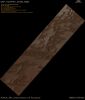
ESP_018445_2600_RED_abrowse.jpgDunes on "Cemented Substrate" (Natural Colors; credits for the additional process. and color.: Dr Paolo C. Fienga - Lunexit Team)98 visitenessun commentoMareKromium
|
|

ESP_019360_1780_RED_abrowse-01.jpgFeatures of Meridiani Planum (EDM n.1 - Natural Colors; credits for the additional process. and color.: Dr Paolo C. Fienga - Lunexit Team)98 visitenessun commentoMareKromium
|
|
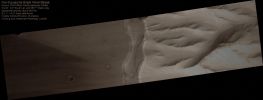
PSP_005109_1770_RED_browse-PCF-LXTT.jpgPeri-Equatorial Canyon and Winstreak (Absolute Natural Colors; credits for the additional process. and color.: Dr Paolo C. Fienga - Lunexit Team) 98 visitenessun commentoMareKromium
|
|
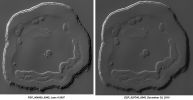
PSP_004000_0945_RED_abrowse-01.jpgChangings... (EDM - credits: NASA/JPL/University of Arizona)98 visitenessun commentoMareKromium
|
|
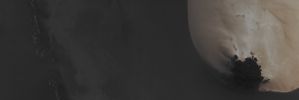
PSP_001700_2505-PCF-LXTT-IPF-01.jpgLouth Crater (CTX Frame - Absolute Natural Colors; credits for the additional process. and color.: Dr Paolo C. Fienga - Lunexit Team)98 visiteThis observation shows a persistent Frost Patch located on a Mound which is inside Louth Crater. The Frost Patch has remained largely stable at least since the Viking era (such as the late 1970s). The bright Frosty Region is bounded by a Dunefield on the North/East and the so-called "Size Classes" of several of the Features forming the Dunefield probably represent generations of Dunes that were created under a variety of Dominant Wind Conditions. The Frost is largely absent over the Dunes, but it is way more stable on the Ground that does not possess Dune-shaped Landforms.
Mars Local Time: 15:14 (Early Afternoon)
Coord. (centered): 70,377° North Lat. and 103,397° East Long.
Spacecraft altitude: 317,5 Km (such as about 198,4 miles)
Original image scale range: 63,5 cm/pixel (with 2 x 2 binning) so objects ~ 1 mt and 91 cm across are resolved
Map projected scale: 50 cm/pixel
Map projection: POLAR STEREOGRAPHIC
Emission Angle: 9,3°
Sun - Mars - MRO (or "Phase") Angle: 56,1°
Solar Incidence Angle: 64° (meaning that the Sun is about 26° above the Local Horizon)
Solar Longitude: 146,4° (Northern Summer - Southern Winter)
Credits: NASA/JPL/University of Arizona
Additional process. and coloring: Lunar Explorer ItaliaMareKromium
|
|
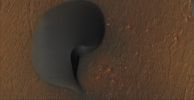
ESP_029660_1350-PCF-LXTT-IPF-2.jpgAsymmetrical Dune (Absolute Natural Colors; credits for the additional process. and color.: Dr Paolo C. Fienga/Lunar Explorer Italia/Italian Planetary Foundation)98 visiteMars Local Time: 15:44 (Middle Afternoon)
Coord. (centered): 44,715° South Lat. and 331,100° East Long.
Spacecraft altitude: 255,8 Km (such as about 159,9 miles)
Map projection: EQUIRECTANGULAR
Emission Angle: 1,1°
Phase Angle: 56,1°
Solar Incidence Angle: 57° (meaning that the Sun was about 33° above the Local Horizon of the imaged Region, at the time that the picture was taken)
Solar Longitude: 212,3° (Northern Autumn - Southern Spring)
Credits: NASA/JPL/University of Arizona
Additional process. and coloring: Lunar Explorer Italia MareKromium
|
|
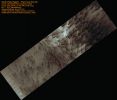
PIA10146-Fans~0.jpgTranslucent Seasonal Ice (MULTISPECTRUM; credits: Lunexit)97 visiteEvery year seasonal CO2 ice, known to us as "dry ice", covers the Poles of Mars. In the South Polar Region this ice is translucent, allowing sunlight to pass through and warm the surface below. The ice then sublimes (evaporates) from the bottom of the ice layer, and carves channels in the surface.
The channels take on many forms. In the image shown here the gas from the dry ice has etched wide shallow channels. This Region is relatively flat, which may be the reason these channels have a different morphology than the "spiders" seen in more hummocky terrain. MareKromium
|
|
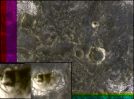
Mawrth_Vallis-The_Pyramid-HSol.jpgThe "Pseudo-Pyramid" of Mawrth Vallis (credits: Dr M. Faccin)97 visiteEd ecco qui, in versione a colori naturali ed extra-magnificata, la pseudo-piramide di Mawrth Vallis.
Opera della Natura? Opera "Artificiale"? Secondo noi, si tratta di un rilievo assolutamente particolare, questo è certo, e quindi da studiare. Ma il fatto di scendere ulteriormente in dettaglio e parlare di "artificialità", visti gli elementi (scarsissimi!) che abbiamo a disposizione, a nostro - onesto - parere, sembra eccessivo (e l'idea di restare colpiti anche noi dalla "Sindrome di' Hoagland", sinceramente, non ci riempie di gioia...).
Sempre complimenti al Dr Faccin per l'elaborazione ed all'ottimo Carlo Contu, per l'individuazione del rilievo.MareKromium
|
|

Psp_009862_2645_red.jpgRound and Black Crater on the North Polar Cap (possible True Colors)97 visiteMars Local Time: 13:50 (early afternoon)
Coord. (centered): 84,4° North Lat. and 77,9° East Long.
Spacecraft altitude: 317,9 Km (such as about 198,7 miles)
Original image scale range: 31,8 cm/pixel (with 1 x 1 binning) so objects ~95 cm across are resolved
Map projected scale: 25 cm/pixel
Map projection: EQUIRECTANGULAR
Emission Angle: 3,2°
Phase Angle: 61,2°
Solar Incidence Angle: 64° (meaning that the Sun is about 26° above the Local Horizon)
Solar Longitude: 121,6° (Northern Summer)
Credits: NASA/JPL/University of Arizona
Additional process. and coloring: Lunar Explorer Italia
Nota Lunexit: la somiglianza fra questo modesto cratere d'impatto (NASA dixit) ed i "Pit Craters" (o crateri a pozzo, correlati a fenomeni di subsidenza e NON a fenomeni meteorici) è, a dir poco, straordinaria! L'incredibile rotondità del rilievo, inoltre, ci lascia supporre che, se si trattasse effettivamente di un "impact crater", allora il bolide che lo ha creato dovrebbe essere precipitato - letteralmente - "a piombo" sulla superficie di Marte (ossìa con un angolo di impatto pari a circa 90°: un evento più unico che raro!...).
Molto bello e marcato il Windstreak che si diparte dal cratere e che ci lascia supporre l'esistenza di un piccolo margine (rim), non visibile nè percepibile a questa risoluzione.MareKromium
|
|

PSP_001390_2290_RED_abrowse.jpgLobate Debris Apron in Tempe Terra/Mareotis Fossae (Natural Colors; credits: Lunexit)97 visiteThis image shows a portion of a large Lobate Debris Apron along the bottom of a hill in the Tempe Terra/Mareotis Fossae Region of Mars.
Debris Aprons were first discovered in Regions of "Fretted Terrain" from analyses of images sent back by the Viking Orbiter Spacecrafts in the 1970s. Features in areas of Fretted Terrain appear "softened" as if some geologic process(es) had smoothed and rounded features that normally would be sharply defined, such the crest of a narrow, steep ridge.
Scientists inferred that the processes causing this degradation must have involved the incorporation and creep of ice in the surface materials. If so, these mixtures of ice and debris could have flowed away from topographically high areas leaving features much less sharply-defined.
The flow behavior described here is similar to slow-moving glacial or permafrost features on Earth. The Debris Apron in this image also has several subtle "ridge" features on its surface from low Sun illumination. The Ridges are roughly parallel to the base of the hill and their shapes mimic one another along their lengths.
Similar Ridges are seen on other Debris Aprons in this Region where the Aprons are located directly below large piles of debris accumulating along the bottom of hillslopes. These observations have led to the hypothesis that Ridges on Debris Aprons are accumulated piles of debris from a period of abnormally high erosion. If this was indeed the case, each Ridge may indicate a change in the climate or local environment that would have implications for our overall understanding of the Martian Climate.MareKromium
|
|
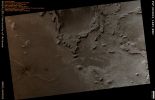
PSP_004091_1845_RED_abrowse.jpgRidges in Terra Meridiani (Absolute Natural Colors; credits for the additional process. and color.: Dr Paolo C. Fienga - Lunexit Team)97 visiteThis HiRISE image shows an arcuate ridge in Terra Meridiani. The ridge is most likely a former streambed, now exposed in inverted relief; the wandering path is not expected for an exhumed fault or volcanic dyke. The stream that formed this ridge must have been ancient as the ridge is buried by brighter rocks, which are themselves very old, having been thickly deposited and then heavily eroded.
The Mars Exploration Rover Opportunity landed in the same region of Mars, and the rocks it has examined are likely part of a sequence similar to that exposed here. The rocks exposed at the Opportunity landing site are mostly aeolian (wind-deposited) sandstone, but show evidence of past water, reaching the surface at times. Opportunity has access to only a few meters of a stack of sediments that is hundreds of meters thick.
Since water was present at times at the Opportunity landing site, surface water elsewhere in the sequence of sediments is perhaps not too surprising. However, evidence like this may indicate that sediments were deposited by a broader range of processes than just those inferred at the Opportunity site. This is important for unraveling the entire history of the region.
A stream channel could become inverted in several ways. Chemicals precipitating from the water could bind the streambed together, lava could fill the channel, or the bed could contain large boulders. In each case, the relatively resistant material of the stream channel could remain as the surrounding rock eroded. Here, the ridge is distant from any volcanic vent, and appears fractured, particularly in the southern portion. This indicates that the ridge material is consolidated and has some strength. Thus, the most likely mechanism for formation of this ridge is deposition of a chemical "cement" which hardened the streambed rock.
The plains surrounding the ridge are also fractured, indicating some degree of consolidation. These cracks could form by desiccation (water loss) from wet sediment or tensile fracturing as the weight of overlying rocks was removed. Cracks like this can also form in permafrost due to seasonal temperature changes; ground ice is unlikely this close to the equator, but it is possible that the cracks are a remnant of different climate conditions from the past.MareKromium
|
|

ESP_019151_1385_RED_abrowse-02.jpgUnnamed Shallow Craters in Northern Argyre Planitia (EDM n.2 - Absolute Natural Colors; credits for the additional process. and color.: Dr Marco Faccin - Lunexit Team)97 visiteMars Local Time: 15:36 (middle afternoon)
Coord. (centered): 41,1° South Lat. and 313,1° East Long.
Spacecraft altitude: 257,6 Km (such as about 161 miles)
Original image scale range: 51,5 cm/pixel (with 2 x 2 binning) so objects ~155 cm across are resolved
Map projected scale: 50 cm/pixel
Map projection: EQUIRECTANGULAR
Emission Angle: 9,2°
Sun-Mars-Spacecraft (or Phase) Angle: 83,0°
Solar Incidence Angle: 76° (meaning that the Sun is about 14° above the Local Horizon)
Solar Longitude: 139,4° (Northern Summer)
Credits: NASA/JPL/University of Arizona
Additional process. and coloring: Dr Marco Faccin - Lunexit TeamMareKromium
|
|
| 2237 immagini su 187 pagina(e) |
 |
|
|
|
|
66 | |
|
|
|
|





