| Piú viste - Mars Reconnaissance Orbiter (MRO) |

Q-U-Bosporus Planum (IR-VIS)-01.jpgBosporus Planum - detail mgnf (1)100 visiteCaption originale NASA, riferita al full-frame:"This is the first color image of Mars from the High Resolution Imaging Science Experiment on NASA's Mars Reconnaissance Orbiter. At the center portion of the camera's array of light detectors there are extra detectors to image in green and near-infrared color bandpasses, to be combined with the black-and-white images (from red-bandpass detectors) to create color images.
This is not natural color as seen by human eyes, but infrared color - shifted to longer wavelengths. This image also has been processed to enhance subtle color variations. The southern half of the scene is brighter and bluer than the northern half, perhaps due to early-morning fog in the atmosphere".
|
|
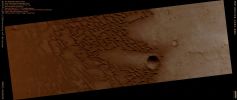
PSP_002728_1645_RED_abrowse.jpgThe Dunes of Herschel Crater (Saturated Natural Colors; credits for the additional process. and color.: Dr Paolo C. Fienga - Lunexit Team)100 visiteThis image shows Dunes on the floor of Herschel Crater. The Steep Faces (a.k.a.: "Slip-Faces") of the Dunes are oriented downwind, in the direction of their motion. One feature of particular interest is the dune-free area downwind of the Crater towards the right side of the frame. Some sand has been trapped in the Crater, but the Crater prevents the Dunes from migrating directly downwind. Sand Dunes form naturally as a result of the transport of sand by the wind.
The Dunes in this image are somewhat crescent-shaped, but are being extended and distorted downwind and merging with nearby Dunes; this complex behavior is common in Dunefields on Earth.
In the left side of the image the sand lies in sheets rather than well-defined Dunes. At high resolution, the Dunes' Surface are covered in small Ripples and Scallops, also shaped by the wind. MareKromium
|
|
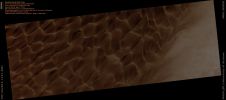
PSP_002824_1355_RED_abrowse-00.jpgDunefield inside Rabe Crater (CTX Frame - Natural Colors; credits for the additional process. and color.: Dr Paolo C. Fienga - Lunexit Team)100 visiteMareKromium
|
|

PSP_004072_1845_RED_abrowse-03.jpgThe "End" of Lethe Vallis (EDM n.2 - Enhanced Absolute Natural Colors; credits for the additional process. and color.: Dr Paolo C. Fienga - Lunexit Team)100 visitenessun commentoMareKromium
|
|

PSP_005069_1670_RED_abrowse-01.jpgExposed Faults and Gravity Wasting Evidence in Coprates Chasma (EDM - Absolute Natural Colors; credits for the additional process. and color.: Dr Paolo C. Fienga - Lunexit Team)100 visitenessun commentoMareKromium
|
|

ESP_025914_2540_RED-PCF-LXTT-00.jpgClouds over Vastitas Borealis (CTX Frame - Absolute Natural Colors; credits for the additional process. and color.: Dr Paolo C. Fienga - Lunexit Team)100 visiteMars Local Time: 14:20 (early afternoon)
Coord. (centered): 73,9° North Lat. and 334,7° East Long.
Spacecraft altitude: 318,4 Km (such as about 199,0 miles)
Original image scale range: 31,9 cm/pixel (with 1 x 1 binning) so objects ~ 96 cm across are resolved
Map projected scale: 25 cm/pixel
Map projection: POLAR STEREOGRAPHIC
Emission Angle: 4,6°
Sun - Mars - MRO (or "Phase") Angle: 58,0°
Solar Incidence Angle: 54° (meaning that the Sun is about 36° above the Local Horizon)
Solar Longitude: 66,6° (Northern Spring)
Credits: NASA/JPL/University of Arizona
Additional process. and coloring: Lunar Explorer ItaliaMareKromium
|
|

Chasma-Echus_Chasma-Fractures-PIA17704-PCF-LXTT-IPF.jpgFeatures of Echus Chasma (EDM - Absolute Natural Colors; credits for the additional process. and color.: Dr Paolo C. Fienga/Lunar Explorer Italia/Italian Planetary Foundation)100 visiteIn this Extra Detail Magnification (or "EDM" for short) - taken from an Original NASA - Mars Reconnaissance Orbiter's False Colors and NON-Map Projected sub-frame -, we can see, with a really great detail, a so-called "Intersection Area" existing between two Fractures (or, perhaps, Fissures and/or Water or Lava-carved narrow Channels) which are both located on the Floor of Echus Chasma (an Equatorial Chasma found in the Lunae Planum High Plateau Region of Mars, slightly to the North of the gigantic Valles Marineris Canyon System, and approx. 100 Km long and 10 Km wide).
Echus Chasma contains several Valleys which range - as far as their depth is concerned - from about 1 to 4 Km, and it is now considered, by Planetary Scientists, to be the Water Source Region that allowed the formation and then the (relevant) water-supply of the Kasei Valles Outflow Channel: a large Valley that extends for thousands of kilometers towards the North of the Red Planet.
Mars Local Time: 14:36 (Early Afternoon)
Coord. (centered): 0,377° North Lat. and 279,483° East Long.
Spacecraft altitude: 269,1 Km (such as about 161,111 miles)
Original image scale range: 53,8 cm/pixel (with 2 x 2 binning) so objects ~ 1 mt and 62 cm across are resolved
Map projected scale: 50 cm/pixel
Map projection: EQUIRECTANGULAR
Emission Angle: 7,7°
Phase Angle: 47,6°
Solar Incidence Angle: 40° (meaning that the Sun was about 50° above the Local Horizon at the time the picture was taken)
Solar Longitude: 27,0° (Northern Spring - Southern Fall)
Credits: NASA/JPL/University of Arizona
Additional process. and coloring: Lunar Explorer Italia
This picture (which is a crop taken from a NASA - Original Mars Reconnaissance Orbiter False Colors and NON-Map Projected sub-frame identified by the serial n. ESP_033591_1805-1) has been additionally processed, magnified, contrast enhanced, Gamma corrected, and then re-colorized in Absolute Natural Colors (such as the colors that a human eye would actually perceive if someone were onboard the NASA - Mars Reconnaissance Orbiter and then looked down, towards the Surface of Mars), by using an original technique created - and, in time, dramatically improved - by the Lunar Explorer Italia Team.MareKromium
|
|
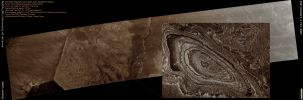
PSP_004423_1755_RED_abrowse-PCF-LXTT.jpgInverted Channels and Layers near Juventae Chasma (an Image-Mosaic in Absolute Natural Colors; credits for the additional process. and color.: Dr Paolo C. Fienga - Lunexit Team:)99 visitePSP_004423_1755 shows Plains North of the South-Western Juventae Chasma, a Canyon belonging to the gigantic Valles Marineris Canyon System.
There are 3 distinct type of Terrains in this image:
1) Plains with possible Inverted Channels,
2) Plains with exposed Layers and
3) Layers on a wall of Juventae Chasma.
The right half of the image contains Plains with Craters and Sinuous Ridge Features that are possibly Inverted Stream Channels.
Inverted relief occurs when a formerly low-lying area becomes high-standing. There are several possible reasons why Channels might stand out in inverted relief. The streambed material may become cemented by precipating minerals, contain larger rocks, or become filled with lava, all which are more resistant to erosion.
Finer-grained, more erodable material surrounding the channel is blown away by the wind or carried away by water, leaving the resistant channel bed high and dry around its environs.
Another example of erosion can be seen in the next Terrain which covers about 2/3 of the left half of the image. Erosion has exposed a beautiful series of light and dark tone Layers (approximately 1 Km across). In the inset, the smallest of the rings is the deepest exposed Layer.
Layers are common in the Martian Canyons, but it is unknown what process formed them. It is likely, though, that the Layers in the Plains here are made of the same material as the Layers in the Canyons. MareKromium
|
|
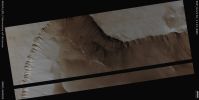
ESP_022156_1115_RED_abrowse-00-PCF-LXTT.jpgSouth Polar "Pit Gullies" (CTX Frame - Absolute Natural Colors; credits for the additional process. and color.: Dr Paolo C. Fienga - Lunexit Team)99 visiteAcquisition date: April, 18th, 2011
Mars Local Time: 15:11 (Early Afternoon)
Latitude (centered): 68,5° South
Longitude (East): 1,3°
Spacecraft Altitude (such as Range to Target Site): 253,2 Km
Original Image Scale Range: 25,3 cm/pixel (with 1 x 1 binning) so objects ~76 cm across are resolved
Map Projected Scale: 25 cm/pixel
Map projection: POLAR STEREOGRAPHIC
Emission Angle: 8,0°
Sun-Target-Spacecraft (such as "Phase") Angle: 46,3°
Solar Incidence Angle: 52° (with the Sun about 38° above the Local Horizon)
Solar Longitude: 276,6° (Northern Winter)MareKromium
|
|

PSP_001700_2505-PCF-LXTT-IPF-02.jpgLouth Crater (EDM - Absolute Natural Colors; credits for the additional process. and color.: Dr Paolo C. Fienga - Lunexit Team)99 visiteThis observation shows a persistent Frost Patch located on a Mound which is inside Louth Crater. The Frost Patch has remained largely stable at least since the Viking era (such as the late 1970s). The bright Frosty Region is bounded by a Dunefield on the North/East and the so-called "Size Classes" of several of the Features forming the Dunefield probably represent generations of Dunes that were created under a variety of Dominant Wind Conditions. The Frost is largely absent over the Dunes, but it is way more stable on the Ground that does not possess Dune-shaped Landforms.
Mars Local Time: 15:14 (Early Afternoon)
Coord. (centered): 70,377° North Lat. and 103,397° East Long.
Spacecraft altitude: 317,5 Km (such as about 198,4 miles)
Original image scale range: 63,5 cm/pixel (with 2 x 2 binning) so objects ~ 1 mt and 91 cm across are resolved
Map projected scale: 50 cm/pixel
Map projection: POLAR STEREOGRAPHIC
Emission Angle: 9,3°
Sun - Mars - MRO (or "Phase") Angle: 56,1°
Solar Incidence Angle: 64° (meaning that the Sun is about 26° above the Local Horizon)
Solar Longitude: 146,4° (Northern Summer - Southern Winter)
Credits: NASA/JPL/University of Arizona
Additional process. and coloring: Lunar Explorer ItaliaMareKromium
|
|
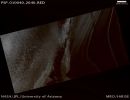
PSP_010040_2640_RED~0.jpgEnds of n. 2 North Polar Troughs (possible True Colors; credits: Lunar Explorer Italia)98 visiteMars Local Time: 14:16 (early afternoon)
Coord. (centered): 83,8° North Lat. and 264,3° East Long.
Spacecraft altitude: 321,4 Km (such as about 200,9 miles)
Original image scale range: 32,2 cm/pixel (with 1 x 1 binning) so objects ~96 cm across are resolved
Map projected scale: 25 cm/pixel
Map projection: EQUIRECTANGULAR
Emission Angle: 7,4°
Phase Angle: 59,4°
Solar Incidence Angle: 65° (meaning that the Sun is about 25° above the Local Horizon)
Solar Longitude: 128,2° (Northern Summer)
Credits: NASA/JPL/University of Arizona
Additional process. and coloring: Lunar Explorer ItaliaMareKromium
|
|

PSP_002419_1675_RED_abrowse-01.jpgLayers and Dark Debris in Melas Chasma (EDM - Natural Colors; credits for the additional process. and color.: Dr Paolo C. Fienga - Lunexit Team)98 visiteThis EDM shows layering in a light-toned deposit in Melas Chasma.
The layers are sedimentary in origin, but there are many processes that could have deposited them, such as volcanic airfall from explosive eruptions, or dust-size particles settling out of the Atmosphere due to cyclic changes, and deposition in standing bodies of water.
By looking at the slopes in the layers and how the layers intersect each other, scientists can rule out various origins. A darker material can be seen covering much of the Layered Deposit.
Some of this dark material is loose and can be seen accumulating as debris aprons at the base of steep slopes. Other dark material appears indurated and has been eroded by the wind to form etched edges with topographic expressions.
The lack of impact craters on the Layered Deposit indicates that it is a relatively young deposit, or the craters have been removed by the wind, or the deposit was quickly buried and is now being exhumed.MareKromium
|
|
| 2237 immagini su 187 pagina(e) |
 |
|
|
|
|
65 | |
|
|
|
|





