| Piú viste - Mars Reconnaissance Orbiter (MRO) |

ESP_024927_1445-PCF-LXTT-00.jpgUnnamed Southern Crater with deep incised and colourful Gullies (CTX Frame - Absolute Natural Colors; credits for the additional process. and color.: Dr Paolo C. Fienga - Lunexit Team)103 visiteMars Local Time: 14:48 (early afternoon)
Coord. (centered): 35,0° South Lat. and 300,9° East Long.
Spacecraft altitude: 251,6 Km (such as about 157,2 miles)
Original image scale range: 25,2 cm/pixel (with 1 x 1 binning) so objects ~ 76,0 cm across are resolved
Map projected scale: 25 cm/pixel
Map projection: EQUIRECTANGULAR
Emission Angle: 4,0°
Sun - Mars - MRO (or "Phase") Angle: 60,2°
Solar Incidence Angle: 63° (meaning that the Sun is about 27° above the Local Horizon)
Solar Longitude: 32,5° (Northern Spring)
Credits: NASA/JPL/University of Arizona
Additional process. and coloring: Lunar Explorer ItaliaMareKromium
|
|
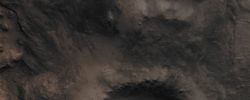
ESP_028957_2085-PCF-LXTT-IPF-00A.jpgFeatures of Nilosyrtis Mensae (CTX Frame "A" - Absolute Natural Colors; credits for the additional process. and color.: Dr Paolo C. Fienga - Lunar Explorer Italia/Italian Planetary Foundation)103 visiteMars Local Time: 15:34 (Middle Afternoon)
Coord. (centered): 28,286° North Lat. and 75,424° East Long.
Spacecraft altitude: 287,8 Km (such as about 179,9 miles)
Original image scale range: 28,8 cm/pixel (with 1 x 1 binning) so objects ~ 86 cm across are resolved
Map projected scale: 25 cm/pixel
Map projection: EQUIRECTANGULAR
Emission Angle: 8,5°
Sun-Mars-MRO (or "Phase") Angle: 50,4°
Solar Incidence Angle: 59° (meaning that the Sun was about 31° above the Local Horizon of the imaged Region, at the time that the picture was taken)
Solar Longitude: 180,1° (Northern Autumn - Southern Spring)
Credits: NASA/JPL/University of Arizona
Additional process. and coloring: Lunar Explorer ItaliaMareKromium
|
|

PSP_003141_1330_RED_abrowse-01-PCF-LXTT.jpgThe Dunes of Kaiser Crater (EDM - Natural Colors; credits for the additional process. and color.: Dr Paolo C. Fienga - Lunexit Team)102 visiteThis EDM reveals smaller Secondary Dunes superimposed on the Surface of the large Dunes and even smaller Ripples that appear between and perpendicular to the Secondary Dunes. Avalanching or mass movement of sand has left deep scars on the Slip-face of the large dune in the upper left portion of the frame. This may indicate that the sand is not loose but is weakly cemented. MareKromium
|
|
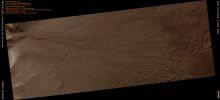
PSP_003269_1600_RED_abrowse.jpgSouthern Alluvial Fan (Natural Colors; credits for the additional process. and color.: Dr Paolo C. Fienga - Lunexit Team)102 visiteHiRISE image PSP_003269_1600 covers an Alluvial Fan along the wall of a large Unnamed Crater in the Mid Latitudes of the Southern Hemisphere of Mars.
The Fan was formed when water and sediments drained down the steep wall of the Crater creating a cone-shaped pile of debris at the base.
As the Fan grew with time, the Channels carrying water and sediment across its Surface changed locations, thus producing a Layered Deposit capped by Channels radiating from the Fan apex along the Crater Wall.
Subsequent stripping of the Fan Surface by the wind has left the coarser Channel Deposits in relief and exposed the fine scale layering within the Fan in many locations.
While is it is not known whether the source of the water responsible for creating the Fan was related runoff from precipitation or groundwater or perhaps both, Alluvial Fans of broadly similar form are observed in many locations on Earth and are usually formed by runoff from precipitation. MareKromium
|
|

PSP_005409_1530_RED_abrowse-01.jpgUnnamed Southern Crater with Central Peak (EDM - Enhanced Natural Colors; credits for the additional process. and color.: Dr Paolo C. Fienga - Lunexit Team)102 visitenessun commentoMareKromium
|
|

Proctor_Crater_Dunes-Psp_001558_1325_red-PCF-LXTT.jpgThe Frozen "Pseudo-Dunes" of Proctor Crater (Enhanced Natural Colors; credits: Dr Paolo C. Fienga - Lunexit Team)102 visitenessun commentoMareKromium
|
|
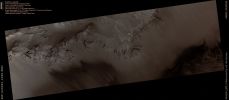
ESP_020945_1690_RED_abrowse-PCF-LXTT.jpgSouthern Landslide (Absolute Natural Colors; credits: Dr Paolo C. Fienga - Lunexit Team)102 visitenessun commentoMareKromium
|
|
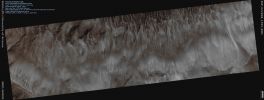
ESP_022848_1595_RED_abrowse-PCF-LXTT-00.jpgLike Waterfalls... (CTX Frame - Absolute Natural Colors; credits for the additional process. and color.: Dr Paolo C. Fienga - Lunexit Team)102 visitenessun commentoMareKromium
|
|

ESP_027451_2635_RED-PCF-LXTT-IPF.jpgFeatures of the North Polar Regions (Absolute Natural Colors; credits for the additional process. and color.: Dr Paolo C. Fienga/Lunexit Team)102 visiteThere is an Ice-Sheet at the North Pole of Mars that is a few miles thick at its center. At some places (like in this image) it ends in steep Cliffs that can be about 800 meters (2600 feet) high.
The Slopes of these Cliffs are almost vertical, which causes "Slab-like Blocks" of Ice to periodically (and, actually, quite often) break off and crash down onto the Surrounding Plains.
A dense Network of Cracks covers these Icy Cliff faces, thus making it easier for these Blocks to break free. New piles of Debris (located at the base of many of these Cliffs) have appeared in successive HiRISE images, and so the MRO Team shall regularly monitor sites like this in order to check for new Blocks that might have fallen. Understanding how these Cliffs are formed can help Scientists to better understand the "Climatic Record" which are stored in the Ice-Sheet itself.
Mars Local Time: 13:44 (Early Afternoon)
Coord. (centered): 83,618° North Lat. and 119,827° East Long.
Spacecraft altitude: 320,5 Km (such as about 200,3 miles)
Original image scale range: 32,1 cm/pixel (with 1 x 1 binning) so objects ~ 96 cm across are resolved
Map projected scale: 25 cm/pixel
Map projection: POLAR STEREOGRAPHIC
Emission Angle: 0,1°
Sun - Mars - MRO (or "Phase") Angle: 62,8°
Solar Incidence Angle: 63° (meaning that the Sun is about 27° above the Local Horizon)
Solar Longitude: 120,0° (Northern Summer - Southern Winter)
Credits: NASA/JPL/University of Arizona
Additional process. and coloring: Lunar Explorer ItaliaMareKromium
|
|
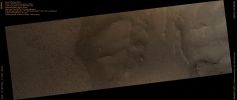
ESP_018796_1790_RED_abrowse.jpgEchus' Floor and Wall (Natural Colors; credits for the additional process. and color.: Dr Paolo C. Fienga - Lunexit Team)101 visitenessun commentoMareKromium
|
|

PSP_005388_1975_RED_abrowse-00-PCF-LXTT.jpgPang Boche Crater (CTX Frame - Absolute Natural Colors; credits for the additional process. and color.: Dr Paolo C. Fienga - Lunexit Team) 101 visitenessun commentoMareKromium
|
|

Craters-Unnamed_Crater-Arabia_Terra-2.jpgMartian "Love" (EDM - Absolute Natural Colors; credits for the additional process. and color.: Dr Paolo C. Fienga - Lunexit Team)101 visiteThis picture of a "heart-shaped" feature in Arabia Terra on Mars was taken on May 23, 2010, by the Context Camera (CTX) on NASA's Mars Reconnaissance Orbiter. A small Impact Crater near the tip of the heart is responsible for the formation of the bright, heart-shaped feature. When the impact occurred, darker material on the Surface was blown away while brighter material beneath it was revealed.
Some of this brighter material appears to have flowed further downslope to form the heart, as the small impact occurred on the Ejecta Blanket of a much larger Impact Crater.
The heart-shaped feature is about 1 Km (0,6 mile) long and is centered at 21,9° North Lat. and 12,7° West Long.
These pictures are subframes of the full CTX image B21_017910_2002_XI_20N012W, taken just at the start of northern summer on Mars. North is to the right, and illumination is from the upper right.MareKromium
|
|
| 2237 immagini su 187 pagina(e) |
 |
|
|
|
|
64 | |
|
|
|
|





