| Piú viste - Mars Reconnaissance Orbiter (MRO) |

PSP_004052_2045_RED_abrowse-01.jpgUnnamed Crater with Layers near Mawrth Vallis (EDM - Absolute Natural Colors; credits for the additional process. and color.: Dr Paolo C. Fienga - Lunexit Team)105 visitenessun commentoMareKromium
|
|

ESP_020163_0980_RED_abrowse.jpgSouth Polar Features (Absolute Natural Colors; credits: Dr Paolo C. Fienga - Lunexit Team)105 visiteHiRISE images are monochromatic across much of the scene, but in the center we return color data. The color strip down the center of this image gives us insight into Aerosols (such as particles of Dust and Frost) suspended in the Atmosphere and the seasonal processes that get them there. In the Winter Mars' South Polar Region is covered by a layer of CO2 ice (dry ice).
In the Spring this ice evaporates from the top and the bottom of the Seasonal Ice Layer (typically a few centimeters thick). Where there are cracks in the ice, the gas from below escapes, carrying fine particles from the Surface up to the top of the ice. Larger particles fall back onto the ground in Fan-shaped Deposits pointing in a direction determined by the local winds. We see the smaller particles (Dust) suspended in the air locally over the cracks as the bluish tone over the Regions with Fans.
Over Regions without Fans, where Gas and Dust from the Surface are not escaping into the Atmosphere, the Surface is a more pinkish tone.MareKromium
|
|

ESP_020827_1595_RED_abrowse-PCF-LXTT.jpgOlivine-rich Terrain (Absolute Natural Colors; credits for the additional process. and color.: Dr Paolo C. Fienga - Lunexit Team)105 visitenessun commentoMareKromium
|
|
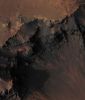
ESP_028962_1645-PCF-LXTT-IPF.jpgFeatures of Coprates Chasma (Absolute Natural Colors; credits for the additional process. and color.: Dr Paolo C. Fienga/Lunar Explorer Italia/Italian Planetary Foundation)105 visiteMars Local Time: 15:39 (Middle Afternoon)
Coord. (centered): 15,450° South Lat. and 303,273° East Long.
Spacecraft altitude: 260,5 Km (such as about 162,8 miles)
Original image scale range: 52,1 cm/pixel (with 2 x 2 binning) so objects ~ 1 mt and 56 cm across are resolved
Map projected scale: 50 cm/pixel
Map projection: EQUIRECTANGULAR
Emission Angle: 5,5°
Phase Angle: 61,5°
Solar Incidence Angle: 56° (meaning that the Sun was about 34° above the Local Horizon of the imaged Region, at the time that the picture was taken)
Solar Longitude: 180,3° (Northern Autumn - Southern Spring)
Credits: NASA/JPL/University of Arizona
Additional process. and coloring: Lunar Explorer ItaliaMareKromium
|
|

Psp_009861_2590_red.jpgNorth Polar Terrain (possibe True Colors; credits: Lunar Explorer Italia)104 visiteMars Local Time: 14:49 (early afternoon)
Coord. (centered): 78,8° North Lat. and 120,4° East Long.
Spacecraft altitude: 321,3 Km (such as about 200,8 miles)
Original image scale range: 64,3 cm/pixel (with 1 x 1 binning) so objects ~1,93 mt across are resolved
Map projected scale: 50 cm/pixel
Map projection: EQUIRECTANGULAR
Emission Angle: 6,4°
Phase Angle: 55,4°
Solar Incidence Angle: 61° (meaning that the Sun is about 29° above the Local Horizon)
Solar Longitude: 121,6° (Northern Summer)
Credits: NASA/JPL/University of Arizona
Additional process. and coloring: Lunar Explorer ItaliaMareKromium
|
|
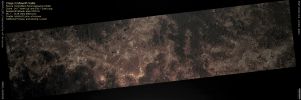
PSP_006742_2050_RED_abrowse.jpgClays in Mawrth Vallis (MULTISPECTRUM; credits: Lunexit)104 visiteMawrth Vallis is one of the most colorful parts of Mars. However, it is not quite as colorful as seen in this observation, where this “extra” color comes from the fact that HiRISE can “see” into part of the infrared, enhancing its ability to detect color differences that are indicative of various minerals.
Properly identifying those minerals is where the CRISM instrument excels.
They show that this area has a variety of different types of clay minerals: these are especially interesting because they had to form when water was interacting with rocks.
The different types of clays point to different water chemistries and temperatures.
With HiRISE, we can better pinpoint how these different materials are distributed across the surface. Furthermore, by taking two images we can produce a stereo image and see the topography, allowing the different clay-bearing layers to be traced in 3D. MareKromium
|
|

PSP_004072_1845_RED_abrowse-00.jpgThe "End" of Lethe Vallis (CTX Frame - Enhanced Natural Colors; credits for the additional process. and color.: Dr Paolo C. Fienga - Lunexit Team)104 visiteHiRISE image PSP_004072_1845 shows the funnel-shaped Terminus of Lethe Vallis, a winding Channel in the Elysium Planitia Region of Mars.
Lethe Vallis flows from South-West to North-East between 2 basins: Cerberus Palus and Eastern Elysium Plantia. Where it empties into the latter, the Channel abruptly widens (see the EDM n.1).
On the West side (up) of this HiRISE image, Lethe Vallis is approx. 800 mt wide; on the East side (down), it is more than 7 Km in width. As the fluid that carved the Channel spread out, its erosive power diminished. Thus, where the Channel is wider, it contains numerous high-standing Mesas that are primarily composed of pre-existing material that was not fully eroded away.
The Floor of Lethe Vallis is covered in solidified Lava and blanketed by a thin layer of light-toned Dust. The Lava has a rough, ridged appearance where its surface buckled as it cooled, and a smoother polygonal texture where it was not significantly deformed. Interestingly, Lava textures are visible high on the Banks and Terraces of the Lethe Vallis. Farther away from the Channel, the Terrain is older and more heavily cratered.MareKromium
|
|
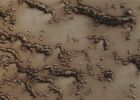
ESP_025118_2570_RED-PCF-LXTT-00A.jpgDefrosting Northern Dunes (CTX Frame "A" - Absolute Natural Colors; credits for the additional process. and color.: Dr Paolo C. Fienga - Lunexit Team)104 visiteMars Local Time: 13:58 (early afternoon)
Coord. (centered): 76,6° North Lat. and 104,1° East Long.
Spacecraft altitude: 317,7 Km (such as about 198,6 miles)
Original image scale range: 31,8 cm/pixel (with 1 x 1 binning) so objects ~ 95,0 cm across are resolved
Map projected scale: 25 cm/pixel
Map projection: POLAR STEREOGRAPHIC
Emission Angle: 0,8°
Sun - Mars - MRO (or "Phase") Angle: 63,5°
Solar Incidence Angle: 63° (meaning that the Sun is about 27° above the Local Horizon)
Solar Longitude: 39,2° (Northern Spring)
Credits: NASA/JPL/University of Arizona
Additional process. and coloring: Lunar Explorer ItaliaMareKromium
|
|

PIA08013_modest.jpgThe "First Frame" from MRO103 visiteThis view shows a full-resolution portion of the first image of Mars taken by the High Resolution Imaging Science Experiment camera (HiRISE) on NASA's Mars Reconnaissance Orbiter. The spacecraft, launched Aug. 12, 2005, began orbiting Mars on March 10, 2006. The image is of an area in Mars' mid-latitude Southern Highlands.
HiRISE took this first test image from orbit on March 24, 2006, from an altitude of 2.489 Km (about 1.547 miles), achieving a resolution of 2,49 mt (98" - inches) per pixel, or picture element. The smallest objects of discernable shape are about 3 pixels across. An image acquired at this latitude during the Mars Reconnaissance Orbiter's main science phase, beginning in fall 2006, would be taken from an altitude of about 280 Km (approx. 174 miles) and have a resolution of 28 cm (11") per pixel.
This view covers an area about 4,5 by 2,1 Km (about 1,6 by 1,3 miles).
The quality of this test image is spectacular, with no hint to the eye of any smear or blurring. A high signal-to-noise ratio reveals fine details even in the shadows.
|
|
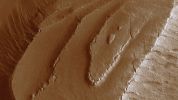
PSP_003442_1215_RED_browse-01.jpgLayers in Spallanzani Crater (extra-detail mgnf)103 visiteThe layers within Spallanzani Crater are eroding in a stair-stepped pattern.
Each layer appears as a sequence of a broad flat area or plateau, which drops off abruptly down to the next flat surface (see this extra-detail mgnf).
This stair-stepped pattern suggests that the layers have discreet boundaries that may be the result of differing compositions, time of deposition, or both. Near, but not at the edge of each plateau, the material is fracturing into polygonal plates or blocks that tilt downward away from the plateau center. MareKromium
|
|
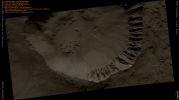
PSP_004060_1440_RED_abrowse-00.jpgUnnamed Southern Crater with deep Gullies (CTX Frame - Absolute Natural Colors; credits for the additional process. and color.: Dr Paolo C. Fienga - Lunexit Team)103 visitenessun commentoMareKromium
|
|

ESP_019612_2250_RED_abrowse.jpgMud-Volcanoes (?) in Acidalia Planitia (Absolute Natural Colors; credits for the additional process. and color.: Dr Paolo C. Fienga - Lunexit Team)103 visiteThis proposed future Mars Landing Site in Acidalia Planitia targets densely occurring Mounds thought to be "Mud Volcanoes".
Mud Volcanoes are geological structures formed when a mixture of gas, liquid and fine-grained rock (or mud) is forced to the Surface from several meters to kilometers underground.
Scientists are targeting these Mud Volcanoes because the sediments, brought from depth, could contain organic materials that might provide evidence for possible past and present microbial life on Mars.MareKromium
|
|
| 2237 immagini su 187 pagina(e) |
 |
|
|
|
|
63 | |
|
|
|
|





