| |

| Piú viste - Mars Reconnaissance Orbiter (MRO) |

ESP_019565_2355_RED_abrowse-PCF-LXTT.jpgNorthern Plains (Absolute Natural Colors; credits for the additional process. and color.: Dr Paolo C. Fienga - Lunexit Team:)108 visitenessun commentoMareKromium
|
|
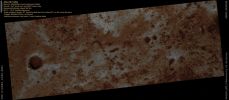
PSP_010882_2040_RED_abrowse-PCF-LXTT.jpgFeatures of Mawrth Vallis (Absolute Natural Colors; credits for the additional process. and color.: Dr Paolo C. Fienga - Lunexit Team)108 visitenessun commentoMareKromium
|
|
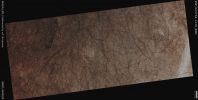
ESP_023734_1270_RED_abrowse-PCF-LXTT.jpgDD Tracks' Network (Absolute Natural Colors; credits for the additional process. and color.: Dr Paolo C. Fienga - Lunexit Team)108 visiteMars Local Time: 14:25 (Early Afternoon)
Coord. (centered): 52,6° South Lat. and 113,9° East Long.
Spacecraft altitude: 249,8 Km (such as about 156,1 miles)
Original image scale range: 50,0 cm/pixel (with 2 x 2 binning) so objects ~ 1 mt and 50 cm across are resolved
Map projected scale: 50 cm/pixel
Map projection: EQUIRECTANGULAR
Emission Angle: 1,4°
Sun-Mars-Spacecraft (or "Phase") Angle: 55,3°
Solar Incidence Angle: 56° (meaning that the Sun is about 34° above the Local Horizon)
Solar Longitude: 347,4° (Northern Winter)
Credits: NASA/JPL/University of Arizona
Additional process. and coloring: Dr Paolo C. Fienga - Lunar Explorer ItaliaMareKromium
|
|

Craters-Unnamed_Southern_Impact_Crater_with_colorful_Layers-ESP_028693_1535-CTX-EDM-PCF-LXTT-IPF-1.jpgUnnamed Southern Impact Crater with Colorful Layers (Absolute Natural Colors; credits for the additional process. and color.: Dr Paolo C. Fienga - Lunar Explorer Italia/Italian Planetary Foundation)108 visiteThis image, obtained by the NASA - Mars Reconnaissance Orbiter (HiRISE Camera), shows us a wide portion of a relatively recent (geologically speaking, of course...) Impact Crater, located in the Southern Hemisphere of the Red Planet, and which is about 7 Km wide. Partway down from (but still quite close to) the Crater Rim, there is a prominent bright Layer of Bedrock. The full-resolution color data shows three distinct Bedrock colors: a pale yellow, a light greenish-gray and a very dark blue (almost black, in Absolute Natural Colors). These Layers should reasonably correspond to different types of Rock that, in time, were deposited as nearly flat-lying sheets; nobody can be sure, but - perhaps - this "colorful" Layering is a combination of Lava Flows and Sediments. The relatively blue and dark blue colors visible in the HiRISE InfraRed Color Frame (not shown here and which, in the Absolute Natural Colors' EDM - inset -, appear as greenish-gray and extremely dark blue to almost black) might correspond to Minerals like Olivine and Pyroxene, which can easily be found, among others, in some specific types of Lava.
Mars Local Time: 15:39 (Middle Afternoon)
Coord. (centered): 26,092° South Lat. and 88,942° East Long.
Spacecraft altitude: 257,7 Km (such as about 161,0 miles)
Original image scale range: 51,6 cm/pixel (with 2 x 2 binning) so objects ~ 1 mt and 55 cm across are resolved
Map projected scale: 50 cm/pixel
Map projection: EQUIRECTANGULAR
Emission Angle: 5,0°
Phase Angle: 66,0°
Solar Incidence Angle: 61° (meaning that the Sun was about 29° above the Local Horizon at the time the picture was taken)
Solar Longitude: 168,7° (Northern Summer - Southern Winter)
Credits: NASA/JPL/University of Arizona
Additional process. and coloring: Lunar Explorer Italia
These two pictures (which are a NASA - Original Mars Reconnaissance Orbiter CTX b/w and EDM color frames, both identified by the serial n. ESP_028693_1535) have been additionally processed and then colorized (and re-colorized, respectively) in Absolute Natural Colors (such as the colors that a human eye would actually perceive if someone were onboard the NASA - Mars Reconnaissance Orbiter and then looked down, towards the Surface of Mars), by using an original technique created - and, in time, dramatically improved - by the Lunar Explorer Italia Team.MareKromium
|
|

ESP_027758_1530-2-PCF-LXTT-IPF.jpgWater-Ice in a Chlorite-bearing Escarpment in North/Western Hellas Planitia (EDM - Absolute Natural Colors; credits for the additional process. and color.: Dr Paolo C. Fienga/Lunar Explorer Italia/Italian Planetary Foundation)108 visiteA South-facing Escarpment located in the North/Western part of the Martian Region known as Hellas Planitia (a target that was chosen for the research of Phyllosilicates) showed us the presence, inside the Rocks (---> mostly in their horizontal cracks) forming it, of a pale bluish Material, barely visible in this Absolute Natural Color image. The CRISM Spectra of such Material showed that it consists of a combination of Chlorite and Water Ice. This image was captured by the NASA - Mars Reconnaissance Orbiter during the Southern Martian Winter, such as in the time period when the Southern Hemisphere's South-facing Escarpments (just like this one) of the Red Planet retain Water Ice Deposits that formed during that dark, long and extremely cold Season.
Mars Local Time: 15:36 (Middle Afternoon)
Coord. (centered): 26,501° South Lat. and 55,094° East Long.
Spacecraft altitude: 268,2 Km (such as about 166,552 miles)
Original image scale range: 26,8 cm/pixel (with 1 x 1 binning) so objects ~ 80 cm across are resolved
Map projected scale: 25 cm/pixel
Map projection: EQUIRECTANGULAR
Emission Angle: 18,0°
Phase Angle: 56,7°
Solar Incidence Angle: 69° (meaning that the Sun was about 21° above the Local Horizon at the time the picture was taken)
Solar Longitude: 131,4° (Northern Summer - Southern Winter)
Credits: NASA/JPL/University of Arizona
Additional process. and coloring: Lunar Explorer Italia
This picture (which is a NASA - Original Mars Reconnaissance Orbiter NON-Map Projected false color EDM frame identified by the serial n. ESP_027758_1530-1) has been additionally processed, magnified to aid the visibility of the details, contrast enhanced and then re-colorized in Absolute Natural Colors (such as the colors that a human eye would actually perceive if someone were onboard the NASA - Mars Reconnaissance Orbiter and then looked down, towards the Surface of Mars), by using an original technique created - and, in time, dramatically improved - by the Lunar Explorer Italia Team.MareKromium
|
|

PSP_001750_1425.jpgSouthern Crater (side-view; credits: Dr M. Faccin)107 visitenessun commentoMareKromium
|
|

ESP_019195_2655_RED_abrowse.jpgNorth Polar Boundary (Absolute Natural Colors; credits for the additional process. and color.: Dr Paolo C. Fienga - Lunexit Team:)107 visiteMars Local Time: 14:09 (early afternoon)
Coord. (centered): 85,3° North Lat. and 160,3° East Long.
Spacecraft altitude: 324,6 Km (such as about 202,9 miles)
Original image scale range: 32,5 cm/pixel (with 1 x 1 binning) so objects ~97 cm across are resolved
Map projected scale: 25 cm/pixel
Map projection: POLAR STEREOGRAPHIC
Emission Angle: 10,8°
Sun-Mars-Spacecraft (or Phase) Angle: 61,9°
Solar Incidence Angle: 71° (meaning that the Sun is about 19° above the Local Horizon)
Solar Longitude: 141,1° (Northern Summer)
Credits: NASA/JPL/University of Arizona
Additional process. and coloring: Dr Paolo C. Fienga - Lunexit TeamMareKromium
|
|

ESP_020297_2045_RED_abrowse.jpgFeatures of Mawrth Vallis - Layering (Absolute Natural Colors; credits for the additional process. and color.: Dr Paolo C. Fienga - Lunexit Team)107 visiteMawrth Vallis is a Martian Region that is famous for its "Mineral Diversity", which includes Clay minerals that formed by the chemical alteration of both rocks and loose “Regolith” (such as Soil) by water.
There is a high surface area of bedded Phyllosilicate (Clay) exposures (in a range of tens of kilometers), located in the Bright-Toned Materials.
The CRISM instrument working on the MRO Spacecraft detects a variety of Clay minerals here, which could signify different processes of formation.
The High Resolution of the HiRISE camera helps us to see and trace out Layers, Polygonal Fractures and, with CRISM, to examine the distribution of various minerals across the entire Surface.
In the light of the above considerations and data, this Surface comes out as scientifically compelling for the Mars Science Laboratory (MSL) Rover 'Curiosity' (this Region is one of the four candidate Landing Sites for the MSL).MareKromium
|
|

PSP_005149_1715_RED_browse-PCF-LXTT.jpgLight-toned Layering and a huge Collapse Feature near Jus Chasma (Absolute Natural Colors; additional process.: Dr Paolo C. Fienga - Lunexit Team)107 visitenessun commentoMareKromium
|
|
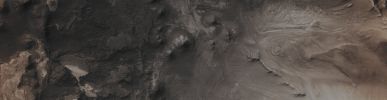
ESP_025231_1720-PCF-LXTT-IPF.jpgFeatures of Jus Chasma (Absolute Natural Colors; credits for the additional process. and color.: Dr Paolo C. Fienga/Lunar Explorer Italia/Italian Planetary Foundation)107 visiteThis image, taken by the NASA - Mars Reconnaissance Orbiter in December 2011, shows us a portion of Jus Chasma, a segment of the massive Martian Canyon System known as Vallis Marineris; the most important detail visible in the picture is given by the presence, within the Chasma, of a Fault (which, by the way, it had been previously imaged by the NASA - Mars Global Surveyor (MGS) - Mars Orbiter Camera (MOC).
If you look carefully towards the centre/right (Dx) side of the picture, you will also notice that a small Valley cuts across the Ridge. Planetary Scientists have asked themselves if what we see here could be the final result of the action of some Tectonic Process, and a Study that was carried out about this topic in the AD 2012, suggested that Mars actually possesses Tectonic Plates! However, and even admitting that what has been suggested by the aformentioned Study is actually true, the question about how these processes worked (or are still working, even though in just a "residual way"...) here and, perhaps, elsewhere on the Red Planet, is still unanswered.
Mars Local Time: 14:56 (Early Afternoon)
Coord. (centered): 7,899° South Lat. and 279,399° East Long.
Spacecraft altitude: 287,5 Km (such as about 178,53 miles)
Original image scale range: 28,8 cm/pixel (with 1 x 1 binning) so objects ~ 86 cm across are resolved
Map projected scale: 25 cm/pixel
Map projection: EQUIRECTANGULAR
Emission Angle: 24,3°
Phase Angle: 33,4°
Solar Incidence Angle: 50° (meaning that the Sun was about 40° above the Local Horizon at the time the picture was taken)
Solar Longitude: 43,2° (Northern Spring - Southern Fall)
Credits: NASA/JPL/University of Arizona
Additional process. and coloring: Lunar Explorer Italia
This picture (which is a NASA - Original Mars Reconnaissance Orbiter NON_Map Projected CTX b/w frame identified by the serial n. ESP_025231_1720 and a NASA - Original Mars Reconnaissance Orbiter EDM false-color frame identified by the serial n. ESP_025164_1655-1) have been additionally processed and then colorized (and re-colorized, respectively) in Absolute Natural Colors (such as the colors that a human eye would actually perceive if someone were onboard the NASA - Mars Reconnaissance Orbiter and then looked down, towards the Surface of Mars), by using an original technique created - and, in time, dramatically improved - by the Lunar Explorer Italia Team.MareKromium
|
|

PSP_002419_1675_RED_abrowse-00.jpgLayers and Dark Debris in Melas Chasma (CTX Frame - Natural Colors; credits for the additional process. and color.: Dr Paolo C. Fienga - Lunexit Team)106 visitenessun commentoMareKromium
|
|

Q-U-BosporusPlanum-PCF-LXTT3.jpgFeatures of Bosporus Planum (Natural Colors; credits for the additional process. and color.: Dr Paolo C. Fienga - Lunexit Team)106 visitenessun commentoMareKromium
|
|
| 2237 immagini su 187 pagina(e) |
|
|
|
|
|
61 | |
|
|
|
|
|
|





