| Piú viste - Mars Reconnaissance Orbiter (MRO) |
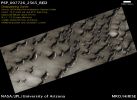
PSP_007726_2565_RED_abrowse-PCF-LXTT-IPF.jpgNorthern Dunes (Absolute Natural Colors; credits for the additional process. and color.: Dr Paolo C. Fienga/Lunar Explorer Italia/Italian Planetary Foundation)110 visiteThis NASA - Mars Reconnaissance Orbiter "HiRISE" image shows a portion of a Dunefield where many large "Barchan" (meaning "Crescent-shaped"), a few "Barchanoid" (meaning a "Non uniformly Crescent-shaped") and some smaller Dome-shaped Sand Dunes can be seen. The Dunefield that contains all these types of Sand Dunes is located in the Northern Regions of Mars and in a specific place where the first significant changes occurring to Sand Dunes was reported on the Red Planet (in the AD 2008). That study made by Dr Bourke (et al.) used a time series of NASA - Mars Global Surveyor (MGS), Mars Orbiter Camera (MOC) images taken over a period of 3 Martian Years (which are equivalent to 6 Earth Years) and showed that 2 (two) approx. 20 meter-wide Dome Dunes disappeared while a third one shrank by an estimated 15%.
Now, the HiRISE image here confirms that the first two Sand Dune studied by Dr Bourke no longer exist but, interestingly, it also suggests that the Sediment removal is still ongoing, since the third Dune has dramatically reduced its volume. On the other hand, it must be noticed and underlined that this "Dune-Changing Process" does not occur in a uniform and generalized way (at least in this specific location), since many of the other large Dunes present in the Dunefield do not show any (apparent/obvious) change; however, more time and some more precise measurements (fit to display evidence of the occurrence of an actual change of the larger Dunes, either in their shape, or their position) are needed in order to achieve a more substantiated conclusion.
In addition to that, we should also consider that it is even possible that the stability of all the other larger Dunes present in the Dunefield might be caused by the circumstance that the Sediment existing inside them is now (let us say "at present time"...) unavailable for removal, due to Induration (meaning that said Sediment became too hard to be blown away by just a simple, even though quite strong sometime, Aeolian Action, but in a future - maybe as a consequence of a dramatic variation in the Surface Temperature of this Region of Mars - its physical conditions could change again, and therefore make it fit to be remodeled, removed or, maybe, totally dispersed).
In the end, the change observed in the small Dome-shaped Dunes indicates, once and for all, that certainly not all Dunes on Mars are effectively and permanently stabilized and immobile, as it was erroneously believed for a long time.
Mars Local Time: 14:10 (Early Afternoon)
Coord. (centered): 76,182° North Lat. and 95,300° East Long.
Spacecraft altitude: 318,0 Km (such as about 198,8 miles)
Original image scale range: 63,6 cm/pixel (with 2 x 2 binning) so objects ~ 1 mt and 91 cm across are resolved
Map projected scale: 50 cm/pixel
Map projection: POLAR STEREOGRAPHIC
Emission Angle: 2,8°
Phase Angle: 62,5°
Solar Incidence Angle: 60° (meaning that the Sun was about 30° above the Local Horizon at the time the picture was taken)
Solar Longitude: 47,6° (Northern Spring- Southern Autumn)
Credits: NASA/JPL/University of Arizona
Additional process. and coloring: Lunar Explorer Italia
This picture (which is a NASA - Original Mars Reconnaissance Orbiter EDM color frame identified by the serial n. PSP_007726_2565) has been additionally processed and then colorized in Absolute Natural Colors (such as the colors that a human eye would actually perceive if someone were onboard the NASA - Mars Reconnaissance Orbiter and then looked down, towards the Surface of Mars), by using an original technique created - and, in time, dramatically improved - by the Lunar Explorer Italia Team.MareKromium
|
|

Coprates_Labes_Canyon-Tra_000849_1675_red~0.jpgCoprates Labes (possible True Colors; credits: Lunar Explorer Italia)109 visiteCoprates Labes is a Martian canyon, part of the huge Valles Marineris System. Valles Marineris most likely formed through tectonic processes, with extensional stresses leading to collapse of the terrain that now lies at the base of the canyons. Filling most of this image, we see a raised block on the canyon bottom, which is quite possibly a horst—a block bounded by faults that separate it from sunken blocks on each side. The raised block is heavily eroded, possibly by wind; this erosion has exposed its internal layering, especially at the Southeastern margin of the block.
Here we see asymmetric erosion features with shallow slopes trailing off to the North-West, suggesting that southeasterly winds dominate the flow through this Region. The arrangement of dunes and ripples in the lower right portion of the image confirms this prevailing wind direction.
Finally, dark-toned material appears to have flowed from North-East to South-West along the block, possibly moving in a very fluid debris flow. MareKromium
|
|
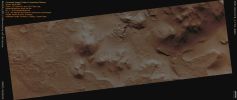
PSP_002478_1770_RED_abrowse-00.jpgEroding Crater Fill (CTX Frame - Natural Colors; credits for the additional process. and color.: Dr Paolo C. Fienga - Lunexit Team) 109 visiteThis image shows the edge of a Mound (----> terrapieno) of sediments in the center of a large Impact Crater near Amenthes Planum.
The Mound probably once filled much more of the Crater, but it is now eroding away. A broad view shows several small plateaus which have likely been preserved by a relatively resistant cap layer, while other levels are exposed elsewhere.MareKromium
|
|
ESP_018709_1445_RED-PCF-LXTT2.jpgGullies and Frost in a Southern Unnamed Crater (Natural Colors; credits for the additional process. and color.: Dr Paolo C. Fienga - Lunexit Team)109 visite"...Quello che è successo è piuttosto chiaro; se poi noi oggi lanciamo l’allarme e tra qualche giorno tutto verrà ripristinato come prima, bene… Saremo stati i soliti complottisti allarmisti. Ma se così non fosse...
Comunque sia, i fatti sono questi: da ieri sera (circa le 19:00 CET) i frames HiRise red in b/n (e dunque le immagini orbitali integrali) non sono più disponibili al Pubblico.
Ma in realtà è anche successo di peggio; non solo questi files non sono stati pubblicati per le nuove immagini postate proprio ieri, in giornata, ma sono spariti anche tutti i files passati. TUTTI, dal primo all’ultimo… non uno di meno. Da un momento all’altro, insomma, quasi sedicimila b/n Orbital Frames integrali sono spariti.
Già questo evento avrebbe fatto incavolare i qui presenti, ma a ciò aggiungiamo che i frames ora disponibili, spesso e volentieri, mostrano solo delle porzioni di immagine, e non la "veduta orbitale globale".
Ciò nonostante, siamo riusciti comunque a ritrovare i "nostri" frames nei labirinti dei Server Ftp NASA. Resta ovvio il fatto che una simile ricerca fa sì che il campo di chi riesca/possa/voglia/sia capace di accedere a tali dati si restringa moltissimo.
E poi, last but not least, si rende la ricerca ancor più facilmente tracciabile (anche se su questo aspetto nessuno si è mai fatto paranoie di sorta - non siamo certo noi che nascondiamo qualcosa, anzi…).
Ciliegina finale: il visualizzatore jpeg2000 per i dettagli dei frames risulta avere (sempre da ieri) alcune delle librerie java corrotte. Tradotto in soldoni: non si riesce più a visualizzare nulla.
Quindi chi vuol guardare una foto scattata da duecento chilometri di altezza può farlo (con difficoltà, ma alla fine ci può pure riuscire); chi invece cerca i dettagli vicini al mezzo metro per pixel di definizione… o si scarica vari gb di dati per ogni singolo frame e ricerca in manuale, oppure si attacca al tram e va a leggersi la Gazzetta dello Sport.
Per chi non avesse familiarità con simili softwares, Vi diciamo questo: immaginate (in aggiunta al fatto di dover scaricare files enormi e quindi pesantissimi) di prendere un "tappeto" di una ventina di metri per dieci e poi, tramite il Vostro monitor, tra i milioni e milioni di nodi che vanno a comporlo, immaginate di metterVi a cercare i dettagli di interesse osservando i singoli nodi manualmente.
Anche per questo problema, per ora, abbiamo trovato una soluzione - macchinosa ma funzionante! - grazie ad una piccola applicazione che si va ad aggiungere al visualizzatore ufficiale, e che deve essere avviata solo in un certo momento, altrimenti non funziona neppure lei.
Ma ciò non toglie che le sorprese (e le conseguenze di una simile decisione) sono state tante e, tra l’altro, forse non sono neppure finite...".
...Meditate, gente, meditate...MareKromium
|
|
ESP_018534_1985_RED_abrowse-PCF-LXTT1.jpgLava Flows at the base of Olympus Mons (Absolute Natural Colors; credits for the additional process. and color.: Dr Paolo C. Fienga - Lunexit Team)109 visitenessun commentoMareKromium
|
|

ESP_019360_1780_RED_abrowse-00.jpgFeatures of Meridiani Planum (CTX Frame - Natural Colors; credits for the additional process. and color.: Dr Paolo C. Fienga - Lunexit Team)109 visitenessun commentoMareKromium
|
|

PSP_005349_0930_RED_abrowse-1.jpgCircular Feature in the South Polar Residual Cap (Natural Colors; credits for the additional process. and color.: Dr Paolo C. Fienga - Lunexit Team)109 visiteThis 4 Km-diameter Circular Surface Feature near the Edge of the South Polar Residual Cap was recognized in Mariner 9 and Viking Orbiter images taken in the '70s, but its origin could not be inferred. It was therefore targeted for HiRISE stereo imaging.
The bright areas in this image are covered by CO2 frost, and the "Swiss Cheese" terrain typical of the South Polar Residual Cap covers much of the imaged area.
The Dark Walls of the Circular Depression do not have as much Frost on them, and are fractured in a polygonal pattern. Apparently the Surface of the Walls has been extensively modified by thermal expansion and contraction of water ice. It also appears that the "Swiss Cheese" Terrain of the Residual Cap has buried the Floor of the Circular Depression, as well as the Terrain surrounding the Feature, making it difficult to infer its origin.
Its circular symmetry is consistent with an impact origin, but there is no evidence of a Crater Rim or Ejecta Blanket (perhaps because they have been buried).
The Depression may also have formed by collapse, but there is little evidence of extensional fractures that would be expected around a Collapse Pit. Analysis of HiRISE stereo data may help the interpretation of this Feature.MareKromium
|
|

PSP_005980_1725_RED_abrowse-PCF-LXTT.jpgLayered Collapse Pit in Noctis Labyrinthus (Absolute Natural Colors; credits for the additional process. and color.: Dr Paolo C. Fienga - Lunexit Team)109 visitenessun commentoMareKromium
|
|

PSP_005401_1960_RED_abrowse.jpgVolcanic Channels, East of Olympus Mons (Absolute Natural Colors; credits for the additional process. and color.: Dr Paolo C. Fienga - Lunexit) 109 visitenessun commentoMareKromium
|
|
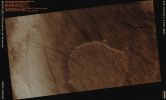
ESP_022657_1260_RED_abrowse-PCF-LXTT-00.jpgUnnamed Crater in Noachis Terra (CTX Frame - Absolute Natural Colors; credits for the additional process. and color.: Dr Paolo C. Fienga - Lunexit Team)109 visitenessun commentoMareKromium
|
|

ESP_011884_2045_RED_abrowse-01.jpgUnusual Translucent Surface on the edge of a candidate Collapse Pit (edm frame - inset in False Colors, credits: Dr M. Faccin; inset in Natural Colors, credits: Lunar Explorer Italia)108 visiteOsservate attentamente: appena visibile nell'inset in Colori Naturali, ma del tutto evidente in quello elaborato in Falsi Colori, potete vedere NITIDAMENTE il margine (bordo) inferiore del pozzo (caratterizzato da piccoli accumuli di sabbia e pietrisco) anche guardando ATTRAVERSO LA SUPERFICIE TRASLUCIDA (color ambra nella versione in Colori Naturali e color celeste nella versione in Falsi Colori) che sembra formare una sorta di "anello" (o un numero "9") intorno al bordo superiore del pozzo.
Di qualunque materia si tratti, questo fenomeno a noi sembra straordinario; e a Voi???MareKromium
|
|

Q-U-BosporusPlanum-PCF-LXTT2.jpgFeatures of Bosporus Planum (Natural Colors; credits for the additional process. and color.: Dr Paolo C. Fienga - Lunexit Team)108 visitenessun commentoMareKromium
|
|
| 2237 immagini su 187 pagina(e) |
 |
|
|
|
|
60 | |
|
|
|
|





