| Piú viste - Mars Reconnaissance Orbiter (MRO) |
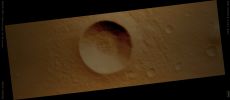
Psp_009414_1915_red.jpgRecent Impact Crater (possible True Colors; credits: Lunar Explorer Italia)112 visiteMars Local Time: 15:30 (middle afternoon)
Coord. (centered): 11,5° North Lat. and 100,8° East Long.
Spacecraft altitude: 289,2 Km (such as about 180,8 miles)
Original image scale range: 28,9 cm/pixel (with 1 x 1 binning) so objects ~87 cm across are resolved
Map projected scale: 25 cm/pixel
Map projection: EQUIRECTANGULAR
Emission Angle: 17,4°
Phase Angle: 36,6°
Solar Incidence Angle: 51° (meaning that the Sun is about 39° above the Local Horizon)
Solar Longitude: 105,5° (Northern Summer)
Credits: NASA/JPL/University of Arizona
Additional process. and coloring: Lunar Explorer ItaliaMareKromium
|
|
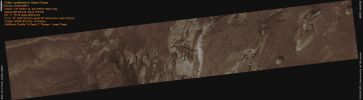
ESP_017528_1830_RED_abrowse.jpgGully-like Landforms in Aram Chaos (Natural Colors; credits for the additional process. and color.: Dr Paolo C. Fienga - Lunexit Team)112 visiteThis observation shows erosional features on light-toned rocks in Aram Chaos, a crater near the Equator of Mars that has been nearly filled with sedimentary rocks.
In enhanced color, the sediments are very distinctive. The rocks show a sharp change in color partway down the slope, indicating a change in the properties of the rock, probably to a different composition.
The erosional features have Alcoves with Aprons downslope, and in some cases have hints of channels, potentially due to abrasion by falling debris.
These morphologies bear some resemblance to Gullies commonly found in the Mid-Latitudes, which are often thought to have formed due to erosion by liquid water from melting snow.
Near the Equator, however, snowmelt in Mars' recent climate is less likely.MareKromium
|
|

ESP_018969_1950_RED_abrowse-PCF-LXTT.jpgSmall-scale Volcanic Activity in Tharsis (Absolute Natural Colors; credits for the additional process. and color.: Dr Paolo C. Fienga - Lunexit Team)112 visitenessun commentoMareKromium
|
|

Dunes_and_DD_Tracks-PIA13538-PCF-LXTT-000.jpgUnnamed Southern Crater with Large Dunefield and DD Streaks (CTX Frame - Absolute Natural Colors; credits for the additional process. and color.: Dr Paolo C. Fienga - Lunexit Team) 112 visitenessun commentoMareKromium
|
|

ESP_019570_2240-MF-LXTT-2.jpgPits and Fractures in Deuteronilus Mensae (Image-Mosaic; credits for the additional process. and color.: Elisabetta Bonora - Lunexit Team) 112 visitenessun commentoMareKromium
|
|
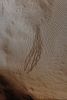
ESP_022991_2070_RED_abrowse-PCF-LXTT-01.jpgSlope Streaks (EDM - Slightly Enhanced Natural Colors; credits for the additional process. and color.: Dr Paolo C. Fienga - Lunexit Team)112 visitenessun commentoMareKromium
|
|

Craters-Gale_Crater-ESP_028256_9022-EB-MF-LXTT-IPF.jpgFeatures of Gale Crater (Natural Colors; credits for the additional process. and color.: Elisabetta Bonora and Marco Faccin/Lunar Explorer Italia/Italian Planetary Foundation)112 visitenessun commentoMareKromium
|
|
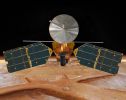
00-MRO-front-view_br~0.jpgHere is the "Mars Reconnaisance Orbiter"111 visiteThis artist's concept of the Mars Reconnaissance Orbiter features the spacecraft's main bus facing down, toward the red planet. The large silver circular feature above the spacecraft bus is the high-gain antenna, the spacecraft's main means of communicating with both Earth and other spacecraft. The long, thin pole behind the bus is the SHARAD antenna. Seeking liquid or frozen water, SHARAD will probe the subsurface using radar waves at a 15-25 MHz frequency band, "seeing" in the first few hundreds of feet (up to 1 kilometer) of Mars' crust. The large instrument (covered in black thermal blanketing) in the center is the HiRISE camera. This powerful camera will provide the highest-resolution images from orbit to date.
The other easily visible instruments are: the Electra telecommunications package which is the gold-colored instrument directly left of the HiRISE camera. It will act as a communications relay and navigation aid for Mars spacecraft. To the right of the HiRISE camera is the Context Imager (CTX).
|
|

PSP_008311_1835_RED_abrowse-00.jpgFeatures and Mineralogy of Aram Chaos (context-frame - MULTISPECTRUM; credits: Lunexit)111 visiteThis image is from Aram Chaos, a large crater connected to the Ares Vallis Outflow Channel. It is called “chaos” because of the rough floor topography, large slumped blocks and large fractures that may have been caused by removal of subsurface material.MareKromium
|
|

ESP_014139_2070_RED_abrowse-01.jpgFumes, North of Mawrth Vallis (Natural Colors; credits: Dr M. Faccin)111 visiteUna splendida ed affascinante (nonchè ECCEZIONALE) visione di "fumi" che si sollevano da una regione di modeste dimensioni situata a Nord della famosa Mawrth Vallis. La scoperta - perchè di scoperta si tratta - è del nostro Marco Faccin; la NASA, purtroppo, sebbene da noi sollecitata al riguardo, non ha - evidentemente... - ancora trovato il tempo di rispondere e di darci qualche delucidazione su quello che staremmo guardando.
Il dettaglio in oggetto non è assolutamente visibile/distinguibile osservando il full-frame MRO in formato JPEG, ma bisogna aprire il file in JP2 e "mettersi a cercare".
I "fumi" che vedete in questa colorizzazione (fatta al TOP delle nostre possibilità, miscelando la tecnica di colorizzazione in Colori Naturali STD con la Tecnica MULTISPECTRUM) sono stati da noi identificati come tali (e NON, quindi, come nebbie) in quanto riteniamo di aver individuato i punti esatti di emanazione.
Lo spettacolo che stiamo osservando, quindi ed a nostro parere, potrebbe costituire l'evidenza oggettiva di una Caldera Attiva (simile, concettualmente, alle cosiddette "Solfatare" di Pozzuoli - NA).
Morale: Marte è tutt'altro che morto...MareKromium
|
|

PSP_004072_1845_RED_abrowse-01.jpgThe "End" of Lethe Vallis (EDM n.1 - Enhanced Natural Colors; credits for the additional process. and color.: Dr Paolo C. Fienga - Lunexit Team)111 visitenessun commentoMareKromium
|
|

PSP_005069_1670_RED_abrowse-00.jpgExposed Faults and Gravity Wasting Evidence in Coprates Chasma (CTX Frame - Absolute Natural Colors; credits for the additional process. and color.: Dr Paolo C. Fienga - Lunexit Team)111 visitenessun commentoMareKromium
|
|
| 2237 immagini su 187 pagina(e) |
 |
|
|
|
|
58 | |
|
|
|
|





