| Piú viste - Mars Reconnaissance Orbiter (MRO) |
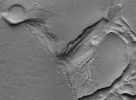
ESP_019570_2240-MF-LXTT-1.jpgPits and Fractures in Deuteronilus Mensae (EDM; credits for the additional process. and color.: Elisabetta Bonora - Lunexit Team) 114 visiteAcquisition Date: 29 September 2010
Mars Local Time (M.L.T.): 15:31 (middle afternoon)
Latitude (centered): 43,8° North
Longitude (East): 25,2°
Range to Target Site: 310 km (such as 193,7 miles)
Original image scale range: 31 cm/pixel (with 1 x 1 binning) so objects ~93 cm across are resolved
Map Projected Scale: 25 cm/pixel
Map projection: EQUIRECTANGULAR
Emission Angle: 14,4°
Phase Angle: 43,0°
Solar Incidence Angle (S.I.A.): 57°, with the Sun about 33° above the Local Horizon
Solar longitude: 156° (Northern Summer)MareKromium
|
|

PSP_004052_2045_RED_abrowse-02-PIA13726.jpgUnnamed Crater with Layers near Mawrth Vallis (Enhanced Natural Colors; credits: NASA/JPL-Caltech/University of Arizona)114 visiteThis image covers part of an Unnamed Impact Crater roughly 4 Km (approx. 2,5 miles) in diameter; the upper portion of the picture shows a one Km segment of the Crater's Inner Wall and Rim.
The Surface outside the Crater is relatively dark, while the Inner Wall of the Crater exposes lighter, Layered Bedrock of diverse colors. A few dark patches on the Crater Wall have small Dunes or Ripples on their surfaces, and are likely Pits filled with Dark Sand. This Crater provides a window into the Sub-Surface of Mars, revealing Layered Sedimentary Deposits.
Just about 30 Km (approx. 18,6 miles) to the East of this Crater lies Mawrth Vallis, an ancient Channel that may have been carved by catastrophic Floods.
In Layered Deposits surrounding Mawrth Vallis, the orbiting spectrometers OMEGA (on Mars Express) and CRISM (on MRO) have detected Phyllosilicate (such as Clay) minerals, which must have formed in the presence of water.
In this Region on Mars, the colors of the Layers seen by HiRISE often correlate with distinct water-bearing minerals observed by CRISM, so the color diversity seen here may reflect a dynamic environment at this location on early Mars.
Note: the color in these images is enhanced; it is not as it would normally appear to the human eye.MareKromium
|
|
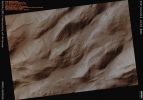
ESP_022991_2070_RED_abrowse-PCF-LXTT-00.jpgSlope Streaks (CTX Frame - Natural Colors; credits for the additional process. and color.: Dr Paolo C. Fienga - Lunexit Team)114 visitenessun commentoMareKromium
|
|

ESP_022592_2140_RED_abrowse-PCF-LXTT.jpgMounds in Northern Chrise Planitia (Absolute Natural Colors; credits for the additional process. and color.: Dr Paolo C. Fienga - Lunexit Team)114 visitenessun commentoMareKromium
|
|

Chasma_Boreale-PSP_001374_2650_RED.jpgChasma Boreale (False Colors)113 visitenessun commentoMareKromium
|
|

PSP_003368_1755_RED_browse.jpgProposed MSL Site in Juventae Chasma (detail of the so-called "Martian Handwriting")113 visiteForse qualche Lettore avrà già riconosciuto il luogo e l'oggetto di questa ripresa e forse no.
Nel dubbio, Vi diciamo che si dovrebbe trattare (il condizionale è d'obbligo, poichè non abbiamo le coordinate esatte al centesimo di grado e quindi potremmo anche sbagliarci - ma di poco...) di una porzione della famosa - si fa per dire, naturalmente - "Scritta Marziana" di cui si è parlato sia nel Forum di SpazioUfo.com, sia nella nostra Rubrica TruePlanets.
Nostra opinione?
Se si tratta effettivamente di una porzione della "Scritta", allora pensiamo che adesso risulterà evidente a tutti come il parlare di artificialità del rilievo sia stato non solo azzardato e fuori luogo, ma addirittura ridicolo.
In caso contrario (e cioè qualora questo dettaglio fosse semplicemente relativo ad una zona promiscua alla "Scritta"), un simile e spettacolare frame MRO ci deve comunque essere di aiuto per capire, una volta che esso sia stato posto a confronto con il frame ESA-Mars Express relativo alla medesima zona, che l'operare congetture usando le orrende ed extra-piallate pseudo-immagini ESA è più che periglioso: è - semplicemente - assurdo.
E con questo, almeno per noi, la querelle sulla "Calligrafia Marziana"...è chiusa.MareKromium
|
|
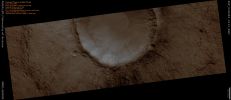
ESP_018385_2215_RED_abrowse.jpgUnnamed Crater in Acidalia Planitia (Natural Colors; credits for the additional process. and color.: Dr Paolo C. Fienga - Lunexit Team)113 visitenessun commentoMareKromium
|
|
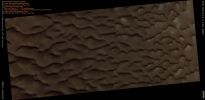
PSP_003141_1330_RED_abrowse-00-PCF-LXTT.jpgThe Dunes of Kaiser Crater (CTX Frame - Natural Colors; credits for the additional process. and color.: Dr Paolo C. Fienga - Lunexit Team)113 visiteCaption NASA:"Image PSP_003141_1330 shows a Sand Dunefield in Kaiser Crater, a 210 Km (such as about 130 miles) wide Impact Basin in the Hellespontus Region of Mars.Winds have trapped massive quantities of Sand on the Floors of broad Craters in this Region.
The steepest slopes on each Dune, such as the Slip-Faces, point to the East indicating that the dominant wind direction in this part of the Dunefield is from West to East. Patches of seasonal frost can be seen in the low areas between the Dunes".
Nota Lunexit: noi non crediamo che che le aree ad albedo più elevata (e che appaiono di un bel color bianco/argento nel frame colorizzato) le quali sono chiaramente individuabili fra le dune sìano, come dice la NASA, "chiazze di brine ghiacciate".
O meglio: può darsi che esse lo sìano, così come è pure plausibile che si tratti di sabbie cristalline (ne abbiamo già incontrate nei Campi di Dune) o di porzioni di suolo libere dalle sabbie (e che magari evidenziano il "Martian Paving"...) MareKromium
|
|

ESP_022494_1385_RED_abrowse-PCF-LXTT.jpgLobate "Flow Feature" in Eastern Hellas Planitia (Absolute Natural Colors; credits for the additional process. and color.: Dr Paolo C. Fienga - Lunexit Team)113 visitenessun commentoMareKromium
|
|
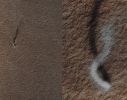
ESP_026051_2160-PCF-LXTT-01.jpgSerpentine Dust Devil in Amazonis Planitia (CTX Frame - Absolute Natural Colors; credits for the additional process. and color.: Dr Paolo C. Fienga - Lunexit Team)113 visiteA "towering" (----> very tall, of imposing height) Dust Devil (also hereafter written "DD") casts a serpentine shadow over the Surface in this beautiful, late Springtime image of the Amazonis Planitia Region of Mars. The length of the shadow of this DD indicates (a simple calculation is needed and all the necessary data to make it are available) that the Dust Plume is/should be more than 800 meters, or about half a mile, in height; on the other hand, the delicate arc that gave to the Dust Plume its serpentine appearence, was most likely produced by a Westerly (----> coming from the West) Breeze which blew at about 250-meter of its height, thus causing the top of the Plume itself to bend towards the East. The Dust Plume itself is approximately 30 meters in diameter.
A consistent number of Dust Devil Tracks (also hereafter written "DD Tracks" or "DDT" for short) trend from the North/West to the South/East and it is really interesting to notice that these Tracks are quite bright, whereas Dust Devil Tracks visible elsewhere on Mars are usually dark. However, Dark DD Tracks are believed to form where Bright Dust is lifted from the Surface by these swirling small Hurricanes, thus revealing a darker Substrate; but here, in the Amazonis Planitia Region of Mars, the Dust Cover (such as the amount of Dust covering the Surface of the Region) is still too thick to be penetrated by such kind of a scouring (as a matter of fact, you have to remember that a thick blanket of Bright and fresh Dust was deposited over Amazonis Planitia recently, during a Regional and - relatively - long Dust Storm, that occurred right before the arrival of the NASA - Mars Reconnaissance Orbiter). Anyway, the Bright Tracks could also form when the already settled Dust is stirred up by the strong Winds generated by the Dust Devils (Tangential Winds whose Speed reached up to 70 mph - miles-per-hour - have, actually, already been recorded in previous HiRISE images of other Dust Devils).
It is also extremely interesting to underline that this image was taken during the time of year when Mars is farthest from the Sun. Just as on Earth, Martian Winds are powered by Solar Heating. Exposure to the Sun's Rays should be at a minimum during this season and yet, even now, Dust Devils act relentlessly to clean the Surface of freshly deposited Dust, a little bit at a time.
Picture's Data
Mars Local Time: 15:03 (Early Afternoon)
Coord. (centered): 35,8° North Lat. and 207,5° East Long.
Spacecraft altitude: 307,7 Km (such as about 192,3 miles)
Original image scale range: 30,8 cm/pixel (with 1 x 1 binning) so objects ~ 92 cm across are resolved
Map projected scale: 25 cm/pixel
Map projection: EQUIRECTANGULAR
Emission Angle: 16,1°
Phase Angle: 25,1°
Solar Incidence Angle: 41° (meaning that the Sun is about 49° above the Local Horizon)
Solar Longitude: 71,3° (Northern Spring)
Credits: NASA/JPL/University of ArizonaMareKromium
|
|

ESP_026356_1960_RED_NOMAP_browse-PCF-LXTT.jpgUnusually-looking Landforms near Grota Valles (Absolute Natural Colors; credits for the additional process. and color.: Dr Paolo C. Fienga - Lunexit Team)113 visiteThe Landforms visible in this observation are quite diverse, with a segment of the Cerberus Fossae (such as a deep Trough extending East-West) and Surrounding Terrain that has been eroded by some Fluid, either Water (actually Mud) or Lava. There are also many Boulders in places, either on steep Slopes or excavated by Impact Craters. The high Hills are Islands of older Terrain surrounded by younger Lavas.
Mars Local Time: 15:08 (Early Afternoon)
Coord. (centered): 15,724° North Lat. and 162,022° East Long.
Spacecraft altitude: 281,3 Km (such as about 175,8 miles)
Original image scale range: 28,1 cm/pixel (with 1 x 1 binning) so objects ~ 84 cm across are resolved
Map projected scale: 25 cm/pixel
Map projection: EQUIRECTANGULAR
Emission Angle: 4,7°
Sun - Mars - MRO (or "Phase") Angle: 40,5°
Solar Incidence Angle: 45° (meaning that the Sun is about 45° above the Local Horizon)
Solar Longitude: 81,7° (Northern Spring - Southern Autumn)
Credits: NASA/JPL/University of Arizona
Additional process. and coloring: Lunar Explorer ItaliaMareKromium
|
|

Q-pia08014-08-AEB1-full-reduced1.jpgMartian Southern Highlands (8) - HR112 visitenessun commento
|
|
| 2237 immagini su 187 pagina(e) |
 |
|
|
|
|
57 | |
|
|
|
|





