| Piú viste - Mars Reconnaissance Orbiter (MRO) |

ESP_032097_1810-PCF-LXTT-IPF.jpgEquatorial Dunefield (Absolute Natural Colors; credits for the additional process. and color. Dr Paolo C. Fienga/Lunar Explorer Italia/Italian Planetary Foundation)120 visiteMars Local Time: 14:08 (Early Afternoon)
Coord. (centered): 1,068° North Lat. and 30,111° East Long.
Spacecraft altitude: 268,9 Km (such as about 166,986 miles)
Original image scale range: 53,8 cm/pixel (with 2 x 2 binning) so objects ~ 1 mt and 61 cm across are resolved
Map projected scale: 50 cm/pixel
Map projection: EQUIRECTANGULAR
Emission Angle: 0,0°
Phase Angle: 34,9°
Solar Incidence Angle: 35° (meaning that the Sun was about 55° above the Local Horizon at the time the picture was taken)
Solar Longitude: 328,5° (Northern Winter - Southern Summer)
Credits: NASA/JPL/University of Arizona
Additional process. and coloring: Lunar Explorer Italia
This picture (which is a NASA - Original Mars Reconnaissance Orbiter NON-Map Projected CTX b/w frame identified by the serial n. ESP_032097_1810) has been additionally processed and then colorized in Absolute Natural Colors (such as the colors that a human eye would actually perceive if someone were onboard the NASA - Mars Reconnaissance Orbiter and then looked down, towards the Surface of Mars), by using an original technique created - and, in time, dramatically improved - by the Lunar Explorer Italia Team.MareKromium
|
|

Volcanoes-Arsia_Mons-PIA13540-1.jpgLayers in the lower West Flank of Arsia Mons (Natural Colors; credits for the additional process. and color.: Dr Paolo C. Fienga - Lunexit Team)119 visiteMareKromium
|
|

PSP_003830_1740_RED_abrowse-00.jpgLayered Bedrock in Candor Chasma (CTX Frame - Absolute Natural Colors; credits for the additional process. and color.: Dr Paolo C. Fienga - Lunexit Team)119 visiteThis image shows an area of Layered Deposits in Candor Chasma. Here, Sheets and Dunes of dark-toned Sand cover the light-toned, Layered Bedrock. Accumulations of dark Sand accentuate bedding within the light-toned Bedrock, giving some areas a sort of "zebra-striped" pattern.
In the left side of the scene, the Bedrock has been eroded into steep, craggy Cliffs. Some sections of these Cliffs are covered by triangular-shaped Debris Fans that are intermediate in color between the dark-toned Sand and light-toned Bedrock. These Fans may contain a mix of light-toned Bedrock that has crumbled away from the surrounding Cliffs as well as wind-blown Sand and Dust.
The Surfaces of some Fans are dissected by Gullies, which most likely formed through Dry Avalanching. The bottoms of the Gully Channels are often darker in tone than the surrounding Fan Surface. This may be due to accumulations of wind-blown Sand in the Gully Floor.MareKromium
|
|
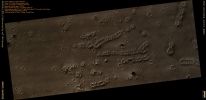
PSP_003494_2075_RED_abrowse.jpgCrater Cluster with Cones and Ridges in Utopia Planitia (Natural Colors; credits for the additional process. and color.: Dr Paolo C. Fienga - Lunexit Team)119 visiteThis image shows Cratered Cones in Utopia Planitia. Cones with Summit Craters join together in places to form Ridges up to several kilometers long, with Troughs running along the Summit.
In many of these cases it is evident that the Ridge Systems formed by merging of multiple Cones, since the arcs of individual Cones can be distinguished.
These features are probably formed by eruption of Subsurface material-Mud or Lava. Lava can form Cinder or Spatter Cones, and eruptions from localized sources along a single Fissure could produce the Ridges.
The absence of obvious (---> evidenti) Lava Flows near the Cones may argue against this mechanism, but ascending Lava could have interacted with Subsurface Water or Ice, leading to a more explosive eruption.
An alternative is eruptions of pressurized Mud from depth ("Mud Volcanism"), a process which occurs in certain environments on Earth.
This observation has a few minor gaps where transmission errors caused data to be lost. These appear as narrow black bars.MareKromium
|
|
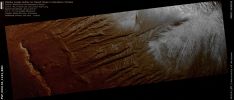
PSP_009156_1335_red_abrowse-PCF-LXTT.jpgGullies on a Massif Slope in Nereidum Montes (Absolute Natural Colors; credits for the additional process. and color.: Dr Paolo C. Fienga - Lunexit) 119 visitenessun commentoMareKromium
|
|
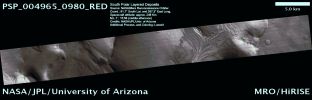
PSP_004965_0980_RED_abrowse-00~0.jpgSouth Polar Layered Deposits - SPLD (Absolute Natural Colors; credits for the additional process. and color.: Dr Paolo C. Fienga - Lunexit Team)118 visiteThe South Polar Layered Deposits (SPLD) are interesting because they were probably formed by global climate changes on Mars, like ice ages on Earth. The Martian SPLD are rich in water ice, but appear to be covered by a dusty layer that protects the underlying ice from evaporation and erosion.MareKromium
|
|
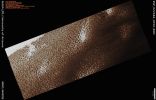
ESP_022684_0950_RED_abrowse-PCF-LXTT.jpgSouth Polar Monitoring (Absolute Natural Colors; credits for the additional process. and color.: Dr Paolo C. Fienga - Lunexit Team)118 visitenessun commentoMareKromium
|
|

Dust_Storm-MGS-41669_Zurek-1-PIA22519.gifThe Global Dust Storm that wiped Oppy away (Annotated)118 visiteCaption NASA:"This set of images from NASA’s Mars Reconnaissance Orbiter (MRO) shows a fierce, giant Dust Storm is kicking up on Mars, with Rovers on the Surface indicated as icons. The spread of the Storm can be seen in the salmon-colored overlay. These images from MRO's Mars Color Imager start from May 31, when the Dust Event was first detected, and go through June 11, 2018.
MRO creates Global Maps of Mars but roll maneuvers for targeted observations produce gaps in the coverage, which appear as black gores in the aforementioned Maps. On some days there are data drops where partial or full orbits of coverage are missing. Green and purple observed in the South Polar Region indicate saturated pixels. Latitude is indicated along the Vertical Axis. Longitude is indicated along the Horizontal Axis".MareKromium
|
|

Dust_Storm-MGS-41668_PIA22519_original_marci-dgm-v04-for-home-page-5.gifThe Global Dust Storm that wiped Oppy away118 visiteCaption NASA:"This set of images from NASA’s Mars Reconnaissance Orbiter (MRO) shows a fierce, giant Dust Storm is kicking up on Mars, with Rovers on the Surface indicated as icons. The spread of the Storm can be seen in the salmon-colored overlay. These images from MRO's Mars Color Imager start from May 31, when the Dust Event was first detected, and go through June 11, 2018.
MRO creates Global Maps of Mars but roll maneuvers for targeted observations produce gaps in the coverage, which appear as black gores in the aforementioned Maps. On some days there are data drops where partial or full orbits of coverage are missing. Green and purple observed in the South Polar Region indicate saturated pixels. Latitude is indicated along the Vertical Axis. Longitude is indicated along the Horizontal Axis".MareKromium
|
|

Channel-PSP_001342_1910_RED.jpgSecondary Craters' Field and a deep Channel117 visitenessun commentoMareKromium
|
|

ESP_012584_1265_RED_abrowse-01.jpg"Hot Surprise" in Nia Vallis (EDM - credits: Dr M. Faccin)117 visiteUn inconfondibile "segno di calore" è apparso in quelle che, a nostro parere, sono le immediate vicinanze della Superficie: una piccola "fiamma" che, se non altro nella sua forma (a "Fiaccola", o "Flare"), nelle sue dimensioni (siamo nell'ordine del metro o poco più) e colore (la Fiaccola, guarda caso, è "Blu"...), ci ricorda la fantomatica Blue Flare che tanto ha intrigato ed intriga i Ricercatori di Anomalìe Lunari.
In questo frame, la nostra piccola "Blue Flare" aleggia/emerge sulla/dalla Superficie di Nia Vallis o nelle sue immediatissime vicinanze (ossìa potrebbe librarsi a pochi metri dal suolo).
La configurazione del dettaglio - una volta escluso l'image-artifact - ci suggerisce l'eventualità per cui si possa trattare di un fenomeno equiparabile ai cosiddetti "fuochi fatui", di terrestre (e, spesso, "lugubre") memoria, ossìa combustione di modesti quantitativi di gas derivanti da decomposizione di elementi organici (usualmente si tratta di Metano o Fosfano).
I luoghi "preferiti" per la verificazione di questo tipo di fenomeni sono i cimiteri, le aree ricche di acque stagnanti o semi-stagnanti (paludi e stagni) e le brughiere.
In questo caso...siamo su Marte e quindi, tutto sommato, i cimiteri ci sentiamo di escluderli come possibile causa della Flare.
Ed anche la brughiera non sembra un luogo attinente, vista la regione sorvolata dalla Sonda.
Ma come escludere la presenza di acque stagnanti sub-superficiali, magari ricchissime di elementi organici?
Cosa c'è - REALMENTE - nel sottosuolo di Marte?MareKromium
|
|

PSP_005349_0930_RED_abrowse-0.jpgCircular Feature in the South Polar Residual Cap (Absolute Natural Colors; credits for the additional process. and color.: Dr Paolo C. Fienga - Lunexit Team)117 visiteThis 4 Km-diameter Circular Surface Feature near the Edge of the South Polar Residual Cap was recognized in Mariner 9 and Viking Orbiter images taken in the '70s, but its origin could not be inferred. It was therefore targeted for HiRISE stereo imaging.
The bright areas in this image are covered by CO2 frost, and the "Swiss Cheese" terrain typical of the South Polar Residual Cap covers much of the imaged area.
The Dark Walls of the Circular Depression do not have as much Frost on them, and are fractured in a polygonal pattern. Apparently the Surface of the Walls has been extensively modified by thermal expansion and contraction of water ice. It also appears that the "Swiss Cheese" Terrain of the Residual Cap has buried the Floor of the Circular Depression, as well as the Terrain surrounding the Feature, making it difficult to infer its origin.
Its circular symmetry is consistent with an impact origin, but there is no evidence of a Crater Rim or Ejecta Blanket (perhaps because they have been buried).
The Depression may also have formed by collapse, but there is little evidence of extensional fractures that would be expected around a Collapse Pit. Analysis of HiRISE stereo data may help the interpretation of this Feature.MareKromium
|
|
| 2237 immagini su 187 pagina(e) |
 |
|
|
|
|
54 | |
|
|
|
|





