| Piú viste - Mars Reconnaissance Orbiter (MRO) |

ESP_020395_1260_RED_abrowse.jpgFeatures of Liu Hsin Crater (Absolute Natural Colors; credits for the additional process. and color.: Dr Paolo C. Fienga - Lunexit Team)128 visitenessun commentoMareKromium
|
|

ESP_024887_2155_RED-PCF-LXTT-01.jpgFluvial "Fan" On an Unnamed Crater Floor (EDM - Enhanced Absolute Natural Colors; credits for the additional process. and color.: Dr Paolo C. Fienga - Lunexit Team)128 visiteMars Local Time: 14:34 (early afternoon)
Coord. (centered): 35,2° North Lat. and 304,5° East Long.
Spacecraft altitude: 296,1 Km (such as about 185,1 miles)
Original image scale range: 29,6 cm/pixel (with 1 x 1 binning) so objects ~ 89 cm across are resolved
Map projected scale: 25 cm/pixel
Map projection: EQUIRECTANGULAR
Emission Angle: 8,9°
Sun - Mars - MRO (or "Phase") Angle: 33,2°
Solar Incidence Angle: 41° (meaning that the Sun is about 49° above the Local Horizon)
Solar Longitude: 31,0° (Northern Spring)
Credits: NASA/JPL/University of Arizona
Additional process. and coloring: Lunar Explorer ItaliaMareKromium
|
|
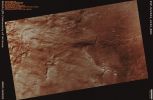
ESP_022643_2235_RED_abrowse.jpgNorthern Arabia Terra (Enhanced Natural Colors; credits for the additional process. and color.: Dr Paolo C. Fienga - Lunexit Team)127 visitenessun commentoMareKromium
|
|
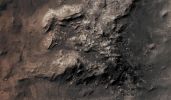
ESP_025296_1535-PCF-LXTT-00-A.jpgExposed "Uplifted" Bedrock (CTX Frame "A" - Absolute Natural Colors; credits for the additional process. and color.: Dr Paolo C. Fienga - Lunar Explorer Italia)127 visiteMars Local Time: 14:54 (early afternoon)
Coord. (centered): 26,3° South Lat. and 305,2° East Long.
Spacecraft altitude: 255,8 Km (such as about 159,9 miles)
Original image scale range: 25,6 cm/pixel (with 1 x 1 binning) so objects ~ 77 cm across are resolved
Map projected scale: 25 cm/pixel
Map projection: EQUIRECTANGULAR
Emission Angle: 1,2°
Sun - Mars - MRO (or "Phase") Angle: 62,0°
Solar Incidence Angle: 61° (meaning that the Sun is about 29° above the Local Horizon)
Solar Longitude: 45,4° (Northern Spring)
Credits: NASA/JPL/University of Arizona
Additional process. and coloring: Lunar Explorer ItaliaMareKromium
|
|
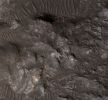
ESP_025296_1535-PCF-LXTT-02-A.jpgExposed "Uplifted" Bedrock (CTX Frame "C" - Absolute Natural Colors; credits for the additional process. and color.: Elisabetta Bonora and Marco Faccin - Lunexit Team)127 visiteMars Local Time: 14:54 (early afternoon)
Coord. (centered): 26,3° South Lat. and 305,2° East Long.
Spacecraft altitude: 255,8 Km (such as about 159,9 miles)
Original image scale range: 25,6 cm/pixel (with 1 x 1 binning) so objects ~ 77 cm across are resolved
Map projected scale: 25 cm/pixel
Map projection: EQUIRECTANGULAR
Emission Angle: 1,2°
Sun - Mars - MRO (or "Phase") Angle: 62,0°
Solar Incidence Angle: 61° (meaning that the Sun is about 29° above the Local Horizon)
Solar Longitude: 45,4° (Northern Spring)
Credits: NASA/JPL/University of Arizona
Additional process. and coloring: Lunar Explorer Italia MareKromium
|
|

Kunowsky_Crater_-_Sand_Dunes-StripedDunes_HiRISE_1182.jpgStriped Sand Dunes127 visiteCaption NASA:"Why are these sand dunes on Mars striped?
No one is sure.
The featured image shows striped dunes in Kunowsky Crater on Mars, photographed recently with the Mars Reconnaissance Orbiter’s HiRISE Camera.
Many Martian dunes are known to be covered unevenly with carbon dioxide (dry ice) frost, creating patterns of light and dark areas. Carbon dioxide doesn’t melt, but sublimates, turning directly into a gas. Carbon dioxide is also a greenhouse material even as a solid, so it can trap heat under the ice and sublimate from the bottom up, causing geyser-like eruptions. During Martian spring, these eruptions can cause a pattern of dark defrosting spots, where the darker sand is exposed.
The featured image, though, was taken during Martian Autumn, when the weather is getting colder – making these stripes particularly puzzling. One hypothesis is that they are caused by cracks in the ice that form from weaker eruptions or thermal stress as part of the day-night cycle, but research continues.
Watching these dunes and others through more Martian seasons may give us more clues to solve this mystery".MareKromium
|
|

ESP_020061_1720_RED_abrowse-PCF-LXTT.jpgBright and Dark Plains (Absolute Natural Colors; additional process. and color.: Dr Paolo C. Fienga - Lunexit Team)126 visiteThis HiRISE image shows a mixture of bright and dark Terrain along the plains just West of Ganges Chasma.
The concentration of these bright patches adjacent to an old Impact Crater suggests that the bright patches could represent Ejecta from when the crater formed.
This would be an interesting discovery because it would mean that a different unit underlies the Surface we now see. Alternatively, much of the Plains in this Region seem to have a dark surficial cover (probably aeolian debris). Where this darker debris has been removed by the wind, the underlying brighter substrate would be exposed.
Mineralogic information from the CRISM instrument would be very useful for determining if the bright patches contain minerals indicative of water - such as Clays - or if they are Basalts (produced from Volcanic Eruptions).MareKromium
|
|
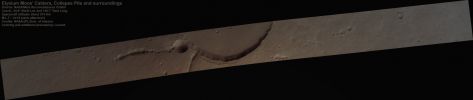
PSP_004903_2050_RED_browse-PCF-LXTT.jpgElysium Mons' Caldera and Collapse Pits (Absolute Natural Colors; credits for the additional process. and color.: Dr Paolo C. Fienga - Lunexit Team)126 visitenessun commentoMareKromium
|
|
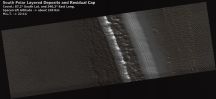
PSP_002856_0875_red-PCF-LXTT.jpgSouth Polar Layered Deposits and Scarp (Absolute Natural Colors; credits: Dr Paolo C. Fienga - Lunexit Team)126 visitenessun commentoMareKromium
|
|

ESP_020812_1530_RED_abrowse-PCF-LXTT-1.jpgPossible MSL Landing Site inside Holden Crater (Absolute Natural Colors; credits for the additional process. and coloring: Dr Paolo C. Fienga - Lunexit Team)126 visitenessun commentoMareKromium
|
|

ESP_023264_1680_RED_abrowse-PCF-LXTT-01.jpgFeatures of Margaritifer Terra (EDM - Enhanced Natural Colors; credits for the additional process. and color: Dr Paolo C. Fienga - Lunexit Team)126 visiteMars Local Time: 14:09 (early afternoon)
Coord. (centered): 12,1° South Lat. and 339,8° East Long.
Spacecraft altitude: 265,1 Km (such as about 165,7 miles)
Original image scale range: 53 cm/pixel (with 2 x 2 binning) so objects ~ 1 mt and 59 cm across are resolved
Map projected scale: 50 cm/pixel
Map projection: EQUIRECTANGULAR
Emission Angle: 0,4°
Sun-Mars-Spacecraft (or "Phase") Angle: 31,2°
Solar Incidence Angle: 32° (meaning that the Sun is about 58° above the Local Horizon)
Solar Longitude: 327,7° (Northern Winter)
Credits: NASA/JPL/University of Arizona
Additional process. and coloring: Dr Paolo C. Fienga - Lunar Explorer ItaliaMareKromium
|
|

ESP_025237_1600_RED-PCF-LXTT-00.jpgFeatures of Hesperia Planum: recent Impact Crater superposing a "Wrinkle Ridge" (CTX Frame - Absolute Natural Colors; credits for the additional process. and color.: Dr Paolo C. Fienga - Lunexit Team)126 visiteMars Local Time: 14:50 (early afternoon)
Coord. (centered): 19,7° South Lat. and 114,9° East Long.
Spacecraft altitude: 256,8 Km (such as about 160,5 miles)
Original image scale range: 25,7 cm/pixel (with 1 x 1 binning) so objects ~ 77 cm across are resolved
Map projected scale: 25 cm/pixel
Map projection: EQUIRECTANGULAR
Emission Angle: 4,0°
Sun - Mars - MRO (or "Phase") Angle: 58,7°
Solar Incidence Angle: 56° (meaning that the Sun is about 34° above the Local Horizon)
Solar Longitude: 43,4° (Northern Spring)
Credits: NASA/JPL/University of Arizona
Additional process. and coloring: Lunar Explorer ItaliaMareKromium
|
|
| 2237 immagini su 187 pagina(e) |
 |
|
|
|
|
51 | |
|
|
|
|





