| Piú viste - Mars Reconnaissance Orbiter (MRO) |
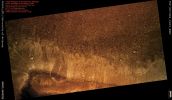
PSP_007492_2265_RED_abrowse-PCF-LXTT.jpgPolygons in Deuteronilus Mensae (Enhanced Absolute Natural Colors; credits for the additional process. and color.: Dr Paolo C. Fienga - Lunexit Team)316 visiteThis image reveals hexagonal and polygonal patterns formed by networks of soil troughs on the floor of a valley in the Deuteronilus Mensae Region, located on the Northern edge of Arabia Terra and borders the Martian Southern Highlands and Northern Lowlands.
The polygonal patterns indicate that the surface has undergone stress, potentially caused by subsidence (sinking), desiccation (drying out), or thermal contraction. These polygon features are similar to permafrost thermal-contraction polygons that form in Polar and High Alpine Regions on Earth by seasonal-to-annual contraction of the subsoil. On Earth, such polygon features are indicative of the presence of ground ice and are commonly referred to as “patterned ground”. The patterns are the result of thermal contraction in ice-cemented soil or permafrost that forms a honeycomb network of small fractures below the surface.
The network of fractures is eventually manifested as shallow troughs at the surface, forming the hexagonal and polygonal patterns visible in this image.
The polygons in this scene average approx. 100 meters (110 yards) in size and appear to be higher in elevation in the center than in the surrounding troughs. Boulders are accumulated in the center of the polygons and dunes are visible in several of the troughs.
The landforms we observe here most likely indicate that ice-rich permafrost is present or has been present in the past.MareKromium
|
|
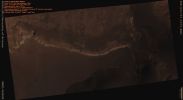
ESP_021757_1975_RED_abrowse-PCF-LXTT.jpgScarp in Syrtis Major (Absolute Natural Colors; credits for the additional process. and color.: Dr Paolo C. Fienga - Lunexit Team)316 visitenessun commentoMareKromium
|
|

ESP_020926_1815_RED_abrowse-PCF-LXTT.jpgLibya Montes (Absolute Natural Colors; credits: Dr Paolo C. Fienga - Lunexit Team)315 visitenessun commentoMareKromium
|
|
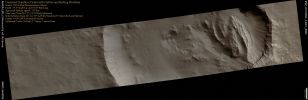
ESP_015900_1465_RED_abrowse-00-PCF-LXTT.jpgUnnamed Southern Crater with Gullies, Rolling Boulders and Dunes (CTX Frame - Absolute Natural Colors; credits for the additional process. and color.: Dr Paolo C. Fienga - Lunexit Team)315 visiteCaption NASA:"Although this image was primarily taken to study the Gullies in the Inner Walls of the Crater, it also reveals a few other interesting things.
Near the Gullies in the Northern Wall of the Crater, for instance, some Boulders have bounced down the Slope, leaving trails of Hollows along their paths (see EDM n. 1).MareKromium
|
|
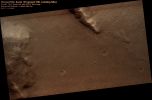
PSP_002193_1670_red-PCF-LXTT.jpgFeatures of Margaritifer Terra (Natural Colors; credits for the additional process. and color.: Dr Paolo C. Fienga - Lunexit Team)315 visitenessun commentoMareKromium
|
|

PSP_002345_1095_red-PCF-LXTT.jpgSouthern Dunes (Absolute Natural Colors; credits for the additional process. and color.: Dr Paolo C. Fienga - Lunexit Team)314 visitenessun commentoMareKromium
|
|

ESP_022999_1335_RED_abrowse-PCF-LXTT-00.jpgUnnamed Crater with Gullies (CTX Frame - Absolute Natural Colors; credits for the additional process. and color.: Dr Paolo C . Fienga - Lunar Explorer Italia)311 visitenessun commentoMareKromium
|
|

ESP_020892_1275_RED_abrowse-PCF-LXTT.jpgLike a "Dry Waterfall" (Absolute Natural Colors; credits for the additional process. and color.: Dr Paolo C. Fienga - Lunexit Team)309 visitenessun commentoMareKromium
|
|

ESP_021569_1650-PCF-LXTT.jpgOver the Columbia Hills (Absolute Natural Colors; credits: Dr Paolo C. Fienga - Lunexit Team)309 visiteAcquisition date: 04 March 2011
Mars Local Time (M.L.T.): 15:11 (Early Afternoon)
Latitude (centered): 14,6° South
Longitude (East): 175,6°
Spacecraft Altitude: approx. 264 Km (163,944 miles)
Original Image Scale Range: 26,4 cm/pixel (with 1 x 1 binning) so objects ~79 cm across are resolved
Map Projected Scale: 25 cm/pixel and North is up
Map Projection: EQUIRECTANGULAR
Emission Angle: 2,9°
Sun-Surface-Spacecraft Angle (i.e.: Phase Angle): 48,7°
Solar Incidence Angle (S.I.A.): 46°, with the Sun about 44° above the Local Horizon
Solar Longitude: 247,7° - Northern AutumnMareKromium
|
|

ESP_020959_0985_RED_abrowse.jpgEarly Spring in Inca City (Absolute Natural Colors; credits for the additional process. and color.: Dr Paolo C. Fienga - Lunexit Team)308 visitenessun commentoMareKromium
|
|

Psp_001700_2505_red-00~0.jpgLauth Crater and the Frozen "Pseudo-Lake" of Vastitas Borealis (CTX Frame - Absolute Natural Colors; credits for the additional process. and color.: Dr Paolo C. Fienga - Lunexit Team)308 visiteThe right side of PSP_001700_2505 shows a portion of a Frost Patch on a Mound inside a Northern Hemisphere Crater (unofficially known as "Lauth Crater").
The Frost Patch has remained largely stable at least since the Viking era (late 1970s). The bright Frost Region is bounded by a Dunefield on the North-East. Several sizes of Dunes are visible. The size classes probably represent generations of Dunes that formed under a variety of dominant wind conditions. MareKromium
|
|
ESP_021577_1375_RED_abrowse-PCF-LXTT.jpgKnob in Argyre Planitia (Absolute Natural Colors; credits for the additional process. and color.: Dr Paolo C. Fienga - Lunexit Team)308 visitenessun commentoMareKromium
|
|
| 2237 immagini su 187 pagina(e) |
 |
|
|
5 | |
|
|
|
|
|
|





