| Piú viste - Mars Reconnaissance Orbiter (MRO) |
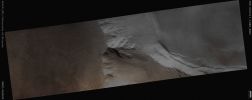
Psp_009317_1980_red~0.jpgPortion of the Southern Wall of Olympus Mons Caldera (Absolute Natural Colors; credits for the additional process. and color: Dr Paolo C. Fienga - Lunexit Team)136 visiteMars Local Time: 15:21 (early afternoon)
Coord. (centered): 17,8° North Lat. and 226,6° East Long.
Spacecraft altitude: 259,3 Km (such as about 162,1 miles)
Original image scale range: 51,9 cm/pixel (with 1 x 1 binning) so objects ~1,56 mt across are resolved
Map projected scale: 50 cm/pixel
Map projection: EQUIRECTANGULAR
Emission Angle: 3,3°
Phase Angle: 50,1°
Solar Incidence Angle: 47° (meaning that the Sun is about 43° above the Local Horizon)
Solar Longitude: 102,1° (Northern Summer)
Credits: NASA/JPL/University of Arizona
Additional process. and coloring: Dr Paolo C. Fienga - Lunar Explorer Italia MareKromium
|
|

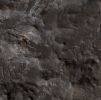
ESP_025715_2605-PCF-LXTT.jpgNorth Polar Layers in Springtime (Darkened Absolute Natural Colors; credits for the additional process. and color.: Dr Paolo C. Fienga/Lunexit Team)136 visiteMars Local Time: 14:08 (Early Afternoon)
Coord. (centered): 80,268° North Lat. and 4,645° East Long.
Spacecraft altitude: 318,7 Km (such as about 199,2 miles)
Original image scale range: 31,9 cm/pixel (with 1 x 1 binning) so objects ~ 96 cm across are resolved (with 4 x 4 binning)
Map projected scale: 25 cm/pixel
Map projection: POLAR STEREOGRAPHIC
Emission Angle: 5,4°
Sun - Mars - MRO (or "Phase") Angle: 56,4°
Solar Incidence Angle: 60° (meaning that the Sun is about 30° above the Local Horizon)
Solar Longitude: 59,8° (Northern Spring/Southern Fall)
Credits: NASA/JPL/University of Arizona MareKromium
|
|
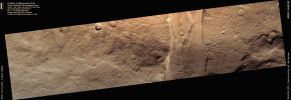
ESP_025296_1535-PCF-LXTT-02-B.jpgExposed "Uplifted" Bedrock (CTX Frame "D" - Absolute Natural Colors; credits for the additional process. and color.: Elisabetta Bonora and Marco Faccin - Lunexit Team)136 visiteMars Local Time: 14:54 (early afternoon)
Coord. (centered): 26,3° South Lat. and 305,2° East Long.
Spacecraft altitude: 255,8 Km (such as about 159,9 miles)
Original image scale range: 25,6 cm/pixel (with 1 x 1 binning) so objects ~ 77 cm across are resolved
Map projected scale: 25 cm/pixel
Map projection: EQUIRECTANGULAR
Emission Angle: 1,2°
Sun - Mars - MRO (or "Phase") Angle: 62,0°
Solar Incidence Angle: 61° (meaning that the Sun is about 29° above the Local Horizon)
Solar Longitude: 45,4° (Northern Spring)
Credits: NASA/JPL/University of Arizona
Additional process. and coloring: Lunar Explorer Italia MareKromium
|
|

PSP_003086_2015_red-PCF-LXTT.jpgProposed MSL Landing Site in Nili Fossae (Natural Colors; credits for the additional process. and color.: Dr Paolo C. Fienga - Lunexit Team) 135 visitenessun commentoMareKromium
|
|
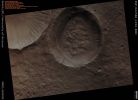
PSP_005442_1660_RED_abrowse-PCF-LXTT.jpgGraben in Memnonia Fossae (Natural Colors; credits for the additional process. and color.: Dr Paolo C. Fienga - Lunexit Team)135 visiteThis HiRISE image shows a Graben (roughly 2,5 Km or 1,6 miles wide) cutting a Ridge near Memnonia Sulci, a Region of Mars West of the massive Tharsis Volcanic Province. A Graben is a Trough created when 2 normal Faults (Faults dipping at an angle, with the overhanging wall sliding downwards) opposite each other lower the block of rock in between them. They are commonly associated with the tectonically-driven extension of a region and are also found in volcanic areas. Graben occur on many planets and moons, including Earth.
In this case, the Graben (running roughly East-West, indicating extension in the North-South direction) is cutting a Ridge, showing that it is more recent. The Ridge may also be tectonic in origin, therefore representing a different epoch and different type of tectonic activity.
Relationships like this can be used to determine the sequence of events in the history of the Region. The Graben Walls can also expose the local rocks at depth; in this case there is no obvious indication of Layering.MareKromium
|
|
ESP_022586_1450_RED_abrowse-PCF-LXTT.jpgUnnamed Southern Craters (Absolute Natural Colors; credits for the additional process. and color.: Dr Paolo C. Fienga - Lunexit Team)135 visitenessun commentoMareKromium
|
|

PSP_008301_2480_RED_abrowse-PCF-LXTT-01.jpgPolygons in Vastitas Borealis (EDM - Absolute Natural Colors; credits for the additional process. and color: Dr Paolo C. Fienga - Lunexit Team)135 visitenessun commentoMareKromium
|
|

PSP_005011_0885-PCF-LXTT-01.jpgThe "Terra Incognita" (CTX Frame "B" - Absolute Natural Colors; credits for the additional process. and color.: Dr Paolo C. Fienga - Lunexit Team)135 visiteMars Local Time: 21:11 (early evening hours)
Coord. (centered): 88,4° South Lat. and 191,1° East Long.
Spacecraft altitude: 256,6 Km (such as about 160,4 miles)
Original image scale range: 25,7 cm/pixel (with 1 x 1 binning) so objects ~ 77 cm across are resolved
Map projected scale: 25 cm/pixel
Map projection: POLAR STEREOGRAPHIC
Emission Angle: 17,3°
Sun - Mars - MRO (or "Phase") Angle: 80,2°
Solar Incidence Angle: 69° (meaning that the Sun is about 21° above the Local Horizon)
Solar Longitude: 299,8° (Northern Winter)
Credits: NASA/JPL/University of Arizona
Additional process. and coloring: Lunar Explorer ItaliaMareKromium
|
|

PSP_001784_001454___2030_anaglyph-MF-LXTT1.jpgMartian Crossway (Hi-Def-3D; credits for the additional process.: Dr Marco Faccin - Lunexit Team)134 visitenessun commentoMareKromium
|
|
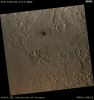
ESP_019195_2175_RED_abrowse.jpgRecent Impact (Natural Colors; credits for the additional process. and color.: Dr Paolo C. Fienga - Lunexit Team)134 visiteAcquisition Date: 31 August 2010
Mars Local Time (MLT): 15:22 (Early Afternoon)
Latitude (centered): 37,3° North
Longitude (East): 182,2°
Range to Target Site: 298,4 Km (such as about 186,5 miles)
Original image scale range: 29,8 cm/pixel (with 1 x 1 binning) so objects ~90 cm across are resolved
Map projected scale: 25 cm/pixel
Map projection: EQUIRECTANGULAR
Emission angle: 2,5°
Sun-Mars-Spacecraft (or Phase) Angle: 52,0°
Solar Incidence Angle: 49° (with the Sun about 41° above the Local Horizon)
Solar Longitude: 141,1° - Northern SummerMareKromium
|
|

ESP_022691_1145_RED_abrowse-PCF-LXTT.jpgSouthern Dunefield and DD Tracks (Absolute Natural Colors; credits for the additional process. and color.: Dr Paolo C. Fienga - Lunexit Team)134 visitenessun commentoMareKromium
|
|
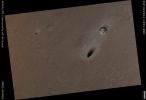
ESP_022612_1855_RED_abrowse-PCF-LXTT.jpgFeatures of Elysium Planitia (Absolute Natural Colors; credits for the additional process. and color: Dr Paolo C. Fienga - Lunexit Team)134 visiteQuattro interessanti (ma per nulla "misteriose, come invece "suggerisce" la NASA...) Surface Features individuate sulla Pianura di Elysium dalla Sonda MRO.
Da Sx a Dx:
1) modesto Windstreak con evidente bruciatura del suolo dovuta, molto probabilmente, ad un recente "impatto esplosivo" (si tratta di un bolide che in parte arriva ad impattare il suolo ed in parte si consuma, disintegrandosi - in maniera esplosiva, appunto -, nelle immediate prossimità del suolo);
2) probabile fase iniziale nella formazione di un pozzo da collasso;
3) altro modesto Windstreak con evidente bruciatura del suolo (idem come al punto 1 che precede); la curiosità è che questo secondo (e pure recente) "impatto esplosivo" si è verificato circa ad ore 6, in prossimità del margine (Rim) di un pre-esistente cratere ormai sepolto (Buried Crater) oppure - più probabilmente - all'interno di un'area che pure sta iniziando a collassare e che, nei secoli (o millenni), creerà un Collapse Pit - di cui la Pianura di Elysium è piena);
4) modestissimo, in termini di profondità, "pozzo veriticale da collasso", o Skylight.MareKromium
|
|
| 2237 immagini su 187 pagina(e) |
 |
|
|
|
|
47 | |
|
|
|
|





