| Piú viste - Mars Reconnaissance Orbiter (MRO) |
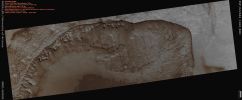
ESP_022682_1360_RED_abrowse-PCF-LXTT-01.jpgSouthern Wall with Gullies (Natural Colors; credits for the additional process. and color.: Dr Paolo C. Fienga - Lunar Explorer Italia)139 visitenessun commentoMareKromium
|
|
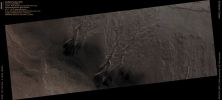
ESP_014256_1300_RED_abrowse-PCF-LXTT-1.jpgUnnamed Crater with Gullies (Absolute Natural Colors; credits for the additional process. and color.: Dr Paolo C. Fienga - Lunar Explorer Italia)139 visiteMars Local Time: 14:27 (Early Afternoon)
Coord. (centered): 49,9° South Lat. and 33,9° East Long.
Spacecraft altitude: 252,1 Km (such as about 157,5 miles)
Original image scale range: 50,4 cm/pixel (with 2 x 2 binning) so objects ~ 1 mt and 51 cm across are resolved
Map projected scale: 50 cm/pixel
Map projection: EQUIRECTANGULAR
Emission Angle: 3,1°
Sun-Mars-Spacecraft (or "Phase") Angle: 47,6°
Solar Incidence Angle: 45° (meaning that the Sun is about 45° above the Local Horizon)
Solar Longitude: 319,4° (Northern Winter)
Credits: NASA/JPL/University of Arizona
Additional process. and coloring: Dr Paolo C. Fienga - Lunar Explorer ItaliaMareKromium
|
|

Dunes_and_DD_Tracks-PIA13538-PCF-LXTT-001.jpgSouthern Dunes and DD Tracks (Absolute Natural Colors; credits for the additional process. and color.: Dr Paolo C. Fienga - Lunexit Team)138 visiteUna "singolare" Anomalìa che non può e non deve passare inosservata (di qualsiasi evento o fenomeno - naturale o artificiale - Essa costituisca l'espressione visibile).MareKromium
|
|

Dunes_and_DD_Tracks-PIA13538-PCF-LXTT-003.jpgSouthern Dunes and DD Tracks: the Anomaly (an Image-Mosaic by Dr Paolo C. Fienga - Lunexit Team)138 visiteChe il "Disco Nero" sia un oggetto reale o un (nuovo e bizzarro) image-artifact, molto probabilmente noi non verremo mai a saperlo; ma che la NASA, spesso e volentieri, faccia dei pasticci i quali - agli occhi degli Appassionati e a volte, anche degli Studiosi - ci fanno rabbrividire, lo sappiamo, ormai, da molto tempo.
Ma, per il momento, lasciamo perdere ogni "dietrologia" ed andiamo a vedere la questione in dettaglio: l'immagine con il "Disco Nero" (con l'Anomalìa, insomma) è il Prodotto NASA "Full-Res JPEG" da 1,1 MB, estratto dal "NASA - Planetary Photojournal" (laddove venne pubblicato in data 25 Ottobre 2010), contrassegnato dal seriale n. PIA13538 ed estratto, dice la NASA, dal Prodotto NASA "Hi-Rise" PSP_003695_1250 (un Prodotto al quale la NASA stessa fa rimando nella pagina dedicata al frame PIA13538).
Tuttavia, se si va a guardare il Prodotto Hi-Rise PSP_003695_1250, seguendo il link fornito dalla NASA (e che porta effettivamente al Prodotto Hi-Rise PSP_003695_1250) il Disco Nero non risulta visibile. Non c'è. E' "sparito".
Perchè?
Forse perchè abbiamo sbagliato qualcosa noi e, di conseguenza, abbiamo "frainteso" l'immagine?
O perchè l'Anomalia è, palesemente, un image-artifact creatosi durante la "trasformazione" del Prodotto PSP_003695_1250 in Prodotto PIA13538?
No.
L'Anomalìa "scompare" perchè, molto semplicemente, il Prodotto PIA13538 ed il Prodotto Hi-Rise PSP_003695_1250 NON SONO lo stesso prodotto!
L'angolo di Fase - che, Vi ricordiamo, è l'Angolo disegnato dal Sole, l'Oggetto Ripreso (ivi, il Suolo di Marte e l'Anomalìa) e la Sonda che lo riprende (ivi, il Mars Reconnaissance Orbiter) - è palesemente diverso, come il nostro mosaico dimostra - riteniamo - in maniera evidente ed inequivocabile.
Conclusioni: si tratta di un Cover-up venuto malissimo? Di un (mega)-pasticcio NASA? O di un semplice errore (ancorchè piuttosto grossolano)?
Questo, ovviamente, noi non lo sappiamo e non lo possiamo sapere. Però il nostro compito, che è quello di osservare, analizzare e riportare alla Vostra attenzione i dati disponibili in chiave "informativa e divulgativa", lo abbiamo svolto: bene ed al 100%.
E queste nostre considerazioni non sono "complottismo": esse sono semplice e pura Professionalità nell'adempimento delle nostre mansioni.
Una "professionalità" che anche la NASA (ma non solo), allorchè produce Informazione e Divulgazione, dovrebbe imparare ad usare: perchè i "grandi (se non "immensi") mezzi", da soli, non bastano!
Meditateci sopra e poi, se volete, scrivete qualche commento...MareKromium
|
|

Psp_009457_2505_red.jpgNorthern Landscape (possible True Colors; credits: Lunar Explorer Italia)137 visiteMars Local Time: 14:49 (early afternoon)
Coord. (centered): 70,0° North Lat. and 352,1° East Long.
Spacecraft altitude: 320,6 Km (such as about 200,4 miles)
Original image scale range: 64,1 cm/pixel (with 1 x 1 binning) so objects ~1,92 mt across are resolved
Map projected scale: 50 cm/pixel
Map projection: EQUIRECTANGULAR
Emission Angle: 8,6°
Phase Angle: 60,0°
Solar Incidence Angle: 52° (meaning that the Sun is about 38° above the Local Horizon)
Solar Longitude: 107,1° (Northern Summer)
Credits: NASA/JPL/University of Arizona
Additional process. and coloring: Lunar Explorer ItaliaMareKromium
|
|

ESP_020812_1530_RED_abrowse-PCF-LXTT-2.jpgThe "Dragon" of Holden Crater137 visitenessun commentoMareKromium
|
|

PSP_005071_2150_RED_abrowse-PCF-LXTT.jpgPit Craters in Alba Patera (Absolute Natural Colors; credits for the additional process. and color.: Dr Paolo C. Fienga - Lunexit Team)137 visitenessun commentoMareKromium
|
|
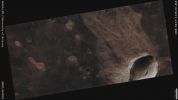
ESP_024227_2240_RED_abrowse-PCF-LXTT.jpgPossible Mud-Volcanoes in Acidalia Planitia (Absolute Natural Colors; credits for the additional process. and color.: Dr Paolo C. Fienga - Lunexit Team) 137 visiteMars Local Time: 13:58 (Early Afternoon)
Coord. (centered): 43,7° North Lat. and 318,5° East Long.
Spacecraft altitude: 329,9 Km (such as about 206,2 miles)
Original image scale range: 33,0 cm/pixel (with 1 x 1 binning) so objects ~ 99 cm across are resolved
Map projected scale: 25 cm/pixel
Map projection: EQUIRECTANGULAR
Emission Angle: 25,3°
Sun-Mars-Spacecraft (or "Phase") Angle: 89,5°
Solar Incidence Angle: 49° (meaning that the Sun is about 41° above the Local Horizon)
Solar Longitude: 6,8° (Northern Spring)
Credits: NASA/JPL/University of Arizona
Additional process. and coloring: Dr Paolo C. Fienga - Lunar Explorer ItaliaMareKromium
|
|

Chasma_Boreale-Psp_001412_2650_red-01.jpgChasma Boreale: the Martian "Pentagon" and other unusual surface features (2)136 visiteMareKromium
|
|

PSP_009003_1890_RED.jpgPseudo-Pyramid and Fissures in Cerberus Fossae (Extremely Enhanced and Saturated Natural Colors; credits for the additional process. and color.: Dr Paolo C. Fienga - Lunexit Team)136 visiteThis image shows a part of the Cerberus Fossae Region, a system of aligned fissures that lays East of Elysium.
The fissures were probably the source of floods of both water and lava. The most recent event was a massive outpouring of basaltic lava (a fluid-type of lava like that commonly erupted by Kilauea in Hawaii), which produced a host of volcanic features in the Region, as described by Jaeger et al. (2007).
Here, as at other locations, the fossae appear a dark red in the Lunexit Natural Color image. Dark red tones are usually associated with basaltic rock. The reddish ripples found on the trough floor could be wind-blown sand comprised of fine fragments of basalt. The upper plains are a relatively bland tone, perhaps due to a thin coating of dust; however, impact craters in the image also show reddish boulders and ripples, indicating that they have excavated the same basaltic rock layers cut by the fossae. This is typical of the Region, as floods of lava coat much of the area.
The mesas of older rock on the left side of the fissures are remnants of a former surface, now eroded. The surrounding Region has many knobs and larger protruding topography, which may be remnants of the same materials. The topmost layer in each mesa is very resistant to weathering, as in places it actually overhangs the lower rocks. This cap layer could be solidified lava, although it appears somewhat bland in color.
Although the mesa is clearly eroded and the cap rock breaks up into boulders, few rocks are visible at the bottom of the slope. The lava plains may have buried the former basal slope, or debris may have been swept away by lava or floodwater, that could also have contributed to eroding the mesa.MareKromium
|
|
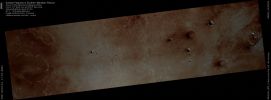
PSP_009352_1770_red_abrowse-PCF-LXTT.jpgSouthern Meridiani Planum (Absolute Natural Colors; credits for the additional process. and color.: Dr Paolo C. Fienga - Lunexit Team)136 visitenessun commentoMareKromium
|
|

Craters-Gale_Crater-PIA14307-PCF-LXTT.jpgCemented Fractures in the Mountain inside Gale Crater (Absolute Natural Colors; credits for the additional process. and color.: Dr Paolo C. Fienga - Lunexit Team)136 visiteOne type of feature of scientific interest on the mountain inside Gale Crater is exposure of Cemented Fractures, evidence that groundwater once reached to at least that height of the Mountain.
This image of that part of the mountain, taken by the High Resolution Imaging Science Experiment camera on NASA's Mars Reconnaissance Orbiter, shows symmetry in how material on one side of each fracture is balanced by material on the other side. This pattern indicates that mineral-saturated groundwater once filled the fractures. The water deposited minerals on both sides of the opening, eventually filling the gap.MareKromium
|
|
| 2237 immagini su 187 pagina(e) |
 |
|
|
|
|
46 | |
|
|
|
|





