| Piú viste - Mars Reconnaissance Orbiter (MRO) |
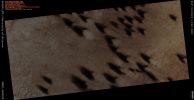
ESP_022605_1390_RED_abrowse.jpgDunes on Arkhangelsky Crater Floor (Absolute Natural Colors; credits for the additional process. and color.: Dr Paolo C. Fienga - Lunexit Team)148 visitenessun commentoMareKromium
|
|

ESP_023484_1365_RED_abrowse-PCF-LXTT.jpgFlow Features, South of Reull Vallis (Absolute Natural Colors; credits for the additional process. and color: Dr Paolo C. Fienga - Lunexit Team)148 visiteMars Local Time: 14:14 (early afternoon)
Coord. (centered): 43,3° South Lat. and 97,0° East Long.
Spacecraft altitude: 255,1 Km (such as about 159,4 miles)
Original image scale range: 25,5 cm/pixel (with 1 x 1 binning) so objects ~ 77 cm across are resolved
Map projected scale: 25 cm/pixel
Map projection: EQUIRECTANGULAR
Emission Angle: 7,3°
Sun-Mars-Spacecraft (or "Phase") Angle: 50,2°
Solar Incidence Angle: 45° (meaning that the Sun is about 45° above the Local Horizon)
Solar Longitude: 337,1° (Northern Winter)
Credits: NASA/JPL/University of Arizona
Additional process. and coloring: Dr Paolo C. Fienga - Lunar Explorer ItaliaMareKromium
|
|

ESP_025237_1600_RED-PCF-LXTT-01.jpgFeatures of Hesperia Planum: recent Impact Crater superposing a "Wrinkle Ridge" (EDM - Absolute Natural Colors; credits for the additional process. and color.: Dr Paolo C. Fienga - Lunexit Team)147 visiteMars Local Time: 14:50 (early afternoon)
Coord. (centered): 19,7° South Lat. and 114,9° East Long.
Spacecraft altitude: 256,8 Km (such as about 160,5 miles)
Original image scale range: 25,7 cm/pixel (with 1 x 1 binning) so objects ~ 77 cm across are resolved
Map projected scale: 25 cm/pixel
Map projection: EQUIRECTANGULAR
Emission Angle: 4,0°
Sun - Mars - MRO (or "Phase") Angle: 58,7°
Solar Incidence Angle: 56° (meaning that the Sun is about 34° above the Local Horizon)
Solar Longitude: 43,4° (Northern Spring)
Credits: NASA/JPL/University of Arizona
Additional process. and coloring: Lunar Explorer ItaliaMareKromium
|
|

PSP_005011_0885-PCF-LXTT-00.jpgThe "Terra Incognita" (CTX Frame "A" - Absolute Natural Colors; credits for the additional process. and color.: Dr Paolo C. Fienga - Lunexit Team)147 visiteMars Local Time: 21:11 (early evening hours)
Coord. (centered): 88,4° South Lat. and 191,1° East Long.
Spacecraft altitude: 256,6 Km (such as about 160,4 miles)
Original image scale range: 25,7 cm/pixel (with 1 x 1 binning) so objects ~ 77 cm across are resolved
Map projected scale: 25 cm/pixel
Map projection: POLAR STEREOGRAPHIC
Emission Angle: 17,3°
Sun - Mars - MRO (or "Phase") Angle: 80,2°
Solar Incidence Angle: 69° (meaning that the Sun is about 21° above the Local Horizon)
Solar Longitude: 299,8° (Northern Winter)
Credits: NASA/JPL/University of Arizona
Additional process. and coloring: Lunar Explorer ItaliaMareKromium
|
|
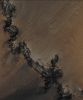
ESP_025570_2330-PCF-LXTT-01.jpgExposed Bedrock on the Wall of an Unnamed Northern Crater (EDM - Absolute Natural Colors; credits for the additional process. and color.: Dr Paolo C. Fienga - Lunar Explorer Italia)147 visiteMars Local Time: 14:46 (early afternoon)
Coord. (centered): 52,6° North Lat. and 15,5° East Long.
Spacecraft altitude: 309,4 Km (such as about 193,4 miles)
Original image scale range: 61,9 cm/pixel (with 2 x 2 binning) so objects ~ 1 mt and 86 cm across are resolved
Map projected scale: 50 cm/pixel
Map projection: EQUIRECTANGULAR
Emission Angle: 7,9°
Sun - Mars - MRO (or "Phase") Angle: 38,4°
Solar Incidence Angle: 45° (meaning that the Sun is about 45° above the Local Horizon)
Solar Longitude: 54,9° (Northern Spring)
Credits: NASA/JPL/University of Arizona
Additional process. and coloring: Lunar Explorer ItaliaMareKromium
|
|
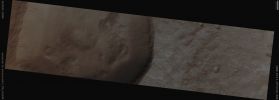
ESP_023770_1570_RED_abrowse.jpgUnnamed Southern Crater (Absolute Natural Colors; credits for the additional process. and color.: Dr Paolo C. Fienga - Lunexit Team)146 visiteMars Local Time: 14:14 (Early Afternoon)
Coord. (centered): 23,0° South Lat. and 206,0° East Long.
Spacecraft altitude: 258,5 Km (such as about 161,6 miles)
Original image scale range: 51,7 cm/pixel (with 2 x 2 binning) so objects ~ 1 mt and 55 cm across are resolved
Map projected scale: 50 cm/pixel
Map projection: EQUIRECTANGULAR
Emission Angle: 3,9°
Phase Angle: 40,7°
Solar Incidence Angle: 37° (meaning that the Sun is about 53° above the Local Horizon)
Solar Longitude: 348,9° (Northern Winter)
Credits: NASA/JPL/University of Arizona
Additional process. and coloring: Dr Paolo C. Fienga - Lunar Explorer ItaliaMareKromium
|
|
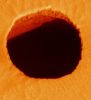
PSP_004847_1745_RED_browse-02.jpgThe "Martian Black Hole"...Again! (EDM - False Colors)145 visiteVi invitiamo a leggere l'ultimo articolo sull'argomento (pubblicato su TruePlanets) dal titolo "Velvet Underground".MareKromium
|
|
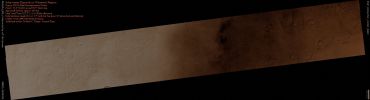
PSP_006250_2200_RED_abrowse-PCF-LXTT-0.jpgFeatures of Nilosyrtis Region (Absolute Natural Colors; credits for the additional process. and color.: Dr Paolo C. Fienga - Lunexit Team)145 visitenessun commentoMareKromium
|
|
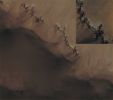
ESP_025570_2330-PCF-LXTT-00.jpgExposed Bedrock on the Wall of an Unnamed Northern Crater (CTX Frame and EDM - Absolute Natural Colors; credits for the additional process. and color.: Dr Paolo C. Fienga - Lunar Explorer Italia)145 visiteMars Local Time: 14:46 (early afternoon)
Coord. (centered): 52,6° North Lat. and 15,5° East Long.
Spacecraft altitude: 309,4 Km (such as about 193,4 miles)
Original image scale range: 61,9 cm/pixel (with 2 x 2 binning) so objects ~ 1 mt and 86 cm across are resolved
Map projected scale: 50 cm/pixel
Map projection: EQUIRECTANGULAR
Emission Angle: 7,9°
Sun - Mars - MRO (or "Phase") Angle: 38,4°
Solar Incidence Angle: 45° (meaning that the Sun is about 45° above the Local Horizon)
Solar Longitude: 54,9° (Northern Spring)
Credits: NASA/JPL/University of Arizona
Additional process. and coloring: Lunar Explorer ItaliaMareKromium
|
|

South_Polar_Feature-PIA13727.jpgBizarre-looking Surface Feature - Sol 2467 (EDM - Absolute Natural Colors; credits for the additional process. and color.: Dr Paolo C. Fienga - Lunexit Team)144 visiteThis approx. 4 Km diameter Surface Feature near the edge of the South Polar Residual Cap was recognized in Mariner 9 and Viking Orbiter images taken in the 1970s, but its origin could not be inferred. It was therefore targeted for HiRISE stereo imaging.
The bright areas in this image are covered by CO2 Frost, and the "Swiss Cheese" Terrain typical of the South Polar Residual Cap covers much of the imaged area.
The Dark Walls of the Circular Depression do not have as much Frost on them and are fractured in a Polygonal Pattern. Apparently the Surface of the Walls has been extensively modified by thermal expansion and contraction of water ice. It also appears that the "Swiss Cheese" Terrain of the Residual Cap has buried the Floor of the Circular Depression, as well as the Terrain surrounding the Feature, making it difficult to infer its origin.
Its circular symmetry is consistent with an impact origin, but there is no evidence of a Crater Rim or Ejecta Blanket (perhaps because they have been buried). The Depression may also have formed by Collapse, but there is little evidence of extensional fractures that would be expected around a Collapse Pit. Analysis of HiRISE stereo data may help the interpretation of this however really peculiar Surface Feature.MareKromium
|
|

ESP_022998_0980_RED_abrowse-PCF-LXTT.jpgErosional South Polar Features (Natural Colors; credits for the additional process. and color.: Dr Paolo C. Fienga - Lunexit Team)143 visitenessun commentoMareKromium
|
|
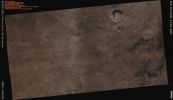
ESP_022606_1390_RED_abrowse.jpgMid-Southern Latitudes' Surface Features (Absolute Natural Colors; credits for the additional process. and color.: Dr Paolo C. Fienga - Lunexit Team)143 visitenessun commentoMareKromium
|
|
| 2237 immagini su 187 pagina(e) |
 |
|
|
|
|
44 | |
|
|
|
|





