| Piú viste - Mars Reconnaissance Orbiter (MRO) |
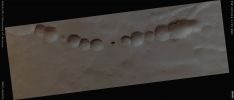
PSP_005414_1735_RED_abrowse-PCF-LXTT-00.jpgPit Chain on Arsia Mons (CTX Frame - Absolute Natural Colors; credits for the additional process. and color.: Dr Paolo C. Fienga - Lunexit Team)153 visiteCaption NASA:"The Chain of Collapse Pits visible in this image formed by collapse as the giant Shield Volcano, Arsia Mons, was pulled apart. While Magma intruding into the Volcano might have pushed the rocks aside, it is also possible that the collapse is caused by the volcano falling apart underneath its own weight.
Acquisition date: September, 22nd, 2007
M.L.T.: 14:14 (Early Afternoon)
Latitude (centered): 6,5° South
Longitude (East): 240,0°
Spacecraft Altitude: 252,4 Km
Original Image Scale Range: 25,3 cm/pixel (with 1 x 1 binning) so objects ~76 cm across are resolved
Map Projected Scale: 25 cm/pixel and North is up
Map Projection: EQUIRECTANGULAR
Emission Angle: 3,9°
Sun-Mars-Spacecraft (Phase) Angle: 38,1°
S.I.A.: 34°, with the Sun about 56° above the Local Horizon
Solar Longitude: 318,2° (Northern Winter)MareKromium
|
|

ESP_023383_1590_RED_abrowse-PCF-LXTT.jpgLight-Toned Layered Rock Outcrop in Ladon Valles (Absolute Natural Colors; credits for the additional process. and color.: Dr Paolo C. Fienga - Lunexit Team)153 visiteMars Local Time: 14:04 (Early Afternoon)
Coord. (centered): 20,8° South Lat. and 330,3° East Long.
Spacecraft altitude: 280,4 Km (such as about 175,3 miles)
Original image scale range: 28,1 cm/pixel (with 1 x 1 binning) so objects ~ 84 cm across are resolved
Map projected scale: 25 cm/pixel
Map projection: EQUIRECTANGULAR
Emission Angle: 22,2°
Sun-Mars-Spacecraft (or "Phase") Angle: 52,7°
Solar Incidence Angle: 31° (meaning that the Sun is about 59° above the Local Horizon)
Solar Longitude: 332,8° (Northern Winter)
Credits: NASA/JPL/University of Arizona
Additional process. and coloring: Dr Paolo C. Fienga - Lunar Explorer ItaliaMareKromium
|
|
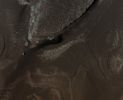
PSP_004026_1765-3-GB-PCF-LXTT.jpgVery strange "Dark Spot" in Aureum Chaos (EDM - Absolute Natural Colors; credits for the additional process. and color.: Dr Paolo C. Fienga - Lunexit Team)152 visiteAll'interno di questo canalone - uno dei tanti che si trovano nella Regione peri-Equatoriale conosciuta come Aureum Chaos (situata ad approx. 4° di Lat. Sud ed approx. 334° di Long. Est) -, assieme alle solite "ripples" (dunette), ho scorto una chiazza scura (che è emersa di un denso color nero, a seguito del processing Multispettrale da me abitualmente usato) la quale mi ha lasciato perplesso.
In attesa di esaminare il dettaglio in formato JP2, posso comunque dire che POTREBBE trattarsi di un'area infossata la quale si è, nel tempo, riempita di polveri sottilissime (tipo il nostro "particolato").
Polveri che, come sapete bene, se osservate a risoluzione modesta, appaiono come una (appunto) "chiazza scura" che ha, vagamente, le sembianze di un laghetto (o meglio: di una sorta di palude...).
Ritengo di poter ESCLUDERE l'eventualità per cui si tratti di una semplice ombra e mi piace considerare l'ipotesi (vista la curiosa - ma, a mio parere, davvero FORTISSIMA - somiglianza fra questa "chiazza nera" e le "chiazze nere" presenti sulla butterata Superficie della Luna Saturniana Iperione - Hyperion) per cui si possa trattare di un autentico affioramento di idrocarburi (surfacing hydrocarbons). Un "laghetto di petrolio" (o di sabbie intrise di petrolio), insomma...
Un'eventualità, quest'ultima, da me già ipotizzata (non solo per Iperione e Titano, ma anche per il Pianeta Rosso) da qualche anno e, al momento, non confermata nè smentita dalla NASA (sempre e solo per quanto attinente Marte).
Le Vostre opinioni saranno, come sempre, apprezzate.
Dr Paolo C. Fienga - Lunar Explorer ItaliaMareKromium
|
|
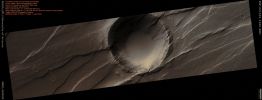
ESP_021593_1920_RED_abrowse-PCF-LXTT.jpgUnnamed Crater cut by Faults and Graben (Absolute Natural Colors; credits for the additional process. and color.: Dr Paolo C. Fienga - Lunexit Team)152 visitenessun commentoMareKromium
|
|

PSP_003063_2050_red.jpgProposed MSL Landing Site in Mawrth Vallis (Natural Colors; credits for the additional process. and color.: Dr Paolo C. Fienga - Lunexit Team) 151 visitenessun commentoMareKromium
|
|
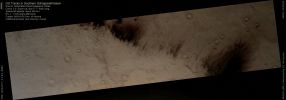
PSP_006477_1745_RED_abrowse-PCF-LXTT.jpgDD Tracks in Southern Schiaparelli Basin (CTX Frame - Natural Colors; credits for the additional process. and color.: Dr Paolo C. Fienga - Lunexit Team) 151 visitenessun commentoMareKromium
|
|
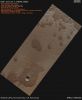
ESP_023117_0980_RED_abrowse-PCF-LXTT.jpgErosional South Polar Features (Natural Colors; credits for the additional process. and color.: Dr Paolo C. Fienga - Lunexit Team)151 visitenessun commentoMareKromium
|
|
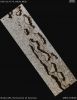
ESP_023779_0930_RED_abrowse.jpgSouth Polar Residual Cap "Intraseasonal Change" Monitoring (Absolute Natural Colors; credits for the additional process. and color.: Dr Paolo C. Fienga - Lunexit Team)151 visiteMars Local Time: 17:36 (Middle Afternoon)
Coord. (centered): 86,8° South Lat. and 15,7° East Long.
Spacecraft altitude: 247,5 Km (such as about 154,7 miles)
Original image scale range: 49,5 cm/pixel (with 2 x 2 binning) so objects ~ 1 mt and 49 cm across are resolved
Map projected scale: 50 cm/pixel
Map projection: POLAR STEREOGRAPHIC
Emission Angle: 1,4°
Phase Angle: 85,9°
Solar Incidence Angle: 85° (meaning that the Sun is about 5° above the Local Horizon)
Solar Longitude: 349,2° (Northern Winter)
Credits: NASA/JPL/University of Arizona
Additional process. and coloring: Dr Paolo C. Fienga - Lunar Explorer ItaliaMareKromium
|
|

Ruins-ESP_038184_1815_57-1.jpgUnusually-looking Surface Features on Mars (EDM from ESP 038184-1815-57)150 visitenessun commentoMareKromium
|
|
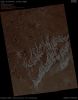
ESP_020960_1160_RED_abrowse-PCF-LXTT-2.jpgDunes in Aonia Terra (Absolute Natural Colors; credits for the additional process. and color.: Dr Paolo C. Fienga - Lunexit Team)149 visitenessun commentoMareKromium
|
|
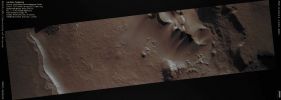
PSP_010221_1420_RED_abrowse-00.jpgAeolian Features (CTX Frame - Absolute Natural Colors; credits for the additional process. and color.: Dr Paolo C. Fienga - Lunexit Team)149 visitenessun commentoMareKromium
|
|

PSP_008011_1975_RED_abrowse-00-PCF-LXTT.jpgFresh and Rayed Unnamed Crater in Tharsis Region (CTX Frame - Absolute Natural Colors; credits for the additional process. and color.: Dr Paolo C. Fienga - Lunexit Team) 149 visiteThis image shows a small Rayed Impact Crater, about 160 mt (530 feet) in diameter, in the Tharsis Region. Relatively recent impacts form Rays of Ejecta that spray out radially from the Crater. In addition to relatively fine material, large boulders and smaller secondary craters are visible in the rays surrounding this crater. Secondary Craters are recognized by their shallow depths (in comparison to Primary Impact Craters), irregular shapes, and appearance in Clusters and Linear Chains.
Mars Local Time: 15:02 (Early Afternoon)
Coord. (centered): 17,4° North Lat. and 248,8° East Long.
Spacecraft altitude: 274,1 Km (such as about 171,3 miles)
Original image scale range: 27,4 cm/pixel (with 1 x 1 binning) so objects ~ 82 cm across are resolved
Map projected scale: 25 cm/pixel
Map projection: EQUIRECTANGULAR
Emission Angle: 0,2°
Sun-Mars-Spacecraft (or "Phase") Angle: 42,8°
Solar Incidence Angle: 43° (meaning that the Sun is about 47° above the Local Horizon)
Solar Longitude: 57,4° (Northern Spring)
Credits: NASA/JPL/University of Arizona
Additional process. and coloring: Dr Paolo C. Fienga - Lunar Explorer ItaliaMareKromium
|
|
| 2237 immagini su 187 pagina(e) |
 |
|
|
|
|
43 | |
|
|
|
|





