| Piú viste - Mars Reconnaissance Orbiter (MRO) |

ESP_023327_2065_RED_abrowse-PCF-LXTT-00.jpgDark Dust Devil Tracks on colourful Dunes (CTX Frame - Absolute Natural Colors; credits for the additional process. and color.: Dr Paolo C. Fienga - Lunexit Team)163 visiteMars Local Time: 14:09 (Early Afternoon)
Coord. (centered): 26,1° North Lat. and 57,0° East Long.
Spacecraft altitude: 304,8 Km (such as about 190,5 miles)
Original image scale range: 30,5 cm/pixel (with 1 x 1 binning) so objects ~ 91 cm across are resolved
Map projected scale: 25 cm/pixel
Map projection: EQUIRECTANGULAR
Emission Angle: 20,6°
Phase Angle: 36,0°
Solar Incidence Angle: 49° (meaning that the Sun is about 41° above the Local Horizon)
Solar Longitude: 330,5° (Northern Winter)
Credits: NASA/JPL/University of Arizona
Additional process. and coloring: Dr Paolo C. Fienga - Lunar Explorer Italia
Caption NASA:"Dust Devils leave Tracks behind them that create the beautiful swirling patterns visible in the EDM n.2 (approximately 0,5 Km, or about 0,3 miles across) and in many other images of Dust-covered Terrain. Suction created by the air rotating in a whirlwind removes a thin layer of light-colored Dust from the Martian Surface, leaving behind dark lines in the Dust Devil's path. That's what usually happens. In this case, however, there is an unusual Streak that appears brighter at one end (see EDM n.1 - approximately 0,6 Km or just about 0,4 miles across, with North is roughly upwards).
The bright Streak could be a deposit of light-colored Material that the Dust Devil dropped for some reason: maybe the Dust Devil died out right at this spot. Or it could be that at this particular location, the underlying dune is brighter than the dust on top of it, so when the dust devil removed the surface layer, a brighter layer below was revealed. Or there could be some other explanation we haven't even thought of yet!
Numerous small Slope Streaks are also visible in this image; for example, on the left side of the EDM n.2, indicated by the white arrow. These are thought to occur when a thin layer of Dust Avalanches downhill, revealing darker material beneath. Over time, these Streaks, like the DDTs, slowly brighten to match their surroundings, as Dust is deposited from the Atmosphere to cover them".MareKromium
|
|

PSP_002574_1865_red-PCF-LXTT.jpgLayered Rocks in Arabia Terra (Natural Colors; credits for the additional process. and color.: Dr Paolo C. Fienga - Lunexit Team)162 visitenessun commentoMareKromium
|
|

PSP_002291_1335_red-PCF-LXTT.jpgGullies in Terra Sirenum (Absolute Natural Colors; credits for the additional process. and color.: Dr Paolo C. Fienga - Lunexit) 162 visitenessun commentoMareKromium
|
|
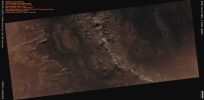
ESP_022580_1560_RED_abrowse-PCF-LXTT.jpgUplifted Layered Materials (Absolute Natural Colors; credits for the additional process. and color.: Dr Paolo C. Fienga - Lunexit Team)162 visitenessun commentoMareKromium
|
|

ESP_023674_1590_RED_abrowse-PCF-LXTT-00.jpgColorful Central Peak in an Unnamed Crater (CTX Frame - Absolute Natural Colors; credits for the additional process. and color.: Dr Paolo C. Fienga - Lunexit Team)162 visiteMars Local Time: 14:11 (Early Afternoon)
Coord. (centered): 20,5° South Lat. and 306,4° East Long.
Spacecraft altitude: 259,1 Km (such as about 162,0 miles)
Original image scale range: 51,8 cm/pixel (with 2 x 2 binning) so objects ~ 1 mt and 56 cm across are resolved
Map projected scale: 50 cm/pixel
Map projection: EQUIRECTANGULAR
Emission Angle: 7,2°
Sun-Mars-Spacecraft (or "Phase") Angle: 41,5°
Solar Incidence Angle: 35° (meaning that the Sun is about 55° above the Local Horizon)
Solar Longitude: 345,0° (Northern Winter)
Credits: NASA/JPL/University of Arizona
Additional process. and coloring: Dr Paolo C. Fienga - Lunar Explorer ItaliaMareKromium
|
|

ESP_013499_1650-3.jpgDust Devil and the Star-like Surface Feature (image-mosaic; credits: Dr M. Faccin and Elisabetta Bonora)161 visiteGrazie agli sforzi congiunti del nostro Senior Partner e Tecnico dell'Immagine (Dr Marco Faccin) e della nostra Junior Partner e Collaboratrice Esterna (Elisabetta Bonora), abbiamo finalmente la possiblità di gettare un pizzico di luce e di chiarezza sul "mistero" dello Star-like Shining che viene ininterrottamente inquadrato dal MER Spirit da ormai un paio di mesi.
Ebbene, grazie alla doppia ripresa della medesima zona di Gusev Crater, come ottenuta dal MER Spirit e dalla Sonda Mars Reconnaissance Orbiter - una ripresa apparentemente finalizzata a descrivere il movimento di un Dust Devil - siamo riusciti ad individuare, dall'inquadratura orbitale, il dettaglio che, a nostro parere, dovrebbe costituire una tanto evidente, quanto difficilmente spiegabile, Anomalìa di Superficie.
Un dettaglio che, come Voi stessi potete verificare osservando l'EDM processato dal nostro Dr Faccin, si caratterizza per l'essere un OGGETTO REALE (apparentemente a pianta squadrata, di albedo elevata, capace di proiettare un'ombra e che ci risulta completamente NON-Contestualizzabile - ergo potrebbe anche trattarsi di un rilievo NON Naturale...) e NON, come qualcuno aveva ipotizzato, un image-artifact.
La distanza che separa, nel frame orbitale, il DD dallo Star-like Shining, la riteniamo compresa fra i 110 ed i 130 metri.
Da notare, infine, che nell'EDM proposto dalla NASA/JPL/Univ. of Arizona (guardate su http : / / hirise . lpl . arizona . edu / images / 2009 / details / cut / ESP_013499_1650_cut . jpg - rubricato come "Stunning Image"), il rilievo luminoso di cui si sta trattando è stato escluso dall'immagine (ci viene da dire "ovviamente"...).
Queste annotazioni le pubblichiamo affinchè Voi possiate svolgere le Vostre (a questo punto) INFORMATE e quanto mai OPPORTUNE riflessioni su una nuova - secondo noi sempre più affascinante e, per certi versi, sconcertante - "Martian Oddity".MareKromium
|
|
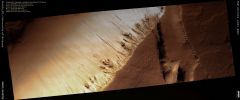
PSP_003545_2025_RED_abrowse-PCF-LXTT-00.jpgIntersection between Hyblaeus and Elysium Chasmata (CTX Frame - Natural Colors; credits for the additional process. and color.: Dr Paolo C. Fienga - Lunexit Team)161 visitenessun commentoMareKromium
|
|

ESP_023491_0935_RED_abrowse-PCF-LXTT.jpgFeatures of the South Polar Residual Cap (Absolute Natural Colors; credits for the additional process. and color: Dr Paolo C. Fienga - Lunexit Team)161 visiteMars Local Time: 16:54 (middle afternoon)
Coord. (centered): 86,2° South Lat. and 309,1° East Long.
Spacecraft altitude: 244,6 Km (such as about 152,9 miles)
Original image scale range: 24,5 cm/pixel (with 1 x 1 binning) so objects ~ 73 cm across are resolved
Map projected scale: 25 cm/pixel
Map projection: POLAR STEREOGRAPHIC
Emission Angle: 2,8°
Sun-Mars-Spacecraft (or "Phase") Angle: 81,0°
Solar Incidence Angle: 80° (meaning that the Sun is about 10° above the Local Horizon)
Solar Longitude: 337,4° (Northern Winter)
Credits: NASA/JPL/University of Arizona
Additional process. and coloring: Dr Paolo C. Fienga - Lunar Explorer ItaliaMareKromium
|
|
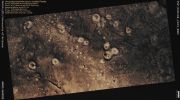
PSP_008548_2205_RED_abrowse.jpgMounds in Acidalia Planitia (Enhanced Absolute Natural Colors; credits for the additional process. and color.: Dr Paolo C. Fienga - Lunexit Team)161 visiteCaption NASA:"This image shows bright mounds scattered throughout a rather flat, dark landscape. These mounds range approximately between 20 and 500 meters (yards) in diameter.
The largest among them show central crater-like depressions which give them an appearance similar to terrestrial volcanoes. The origin of these mounds is still unclear. The most widely accepted hypotheses involve extrusion of underlying fluid-like materials (lava, wet/icy sediments) through weak points in the surface.
Similar mounds have been observed elsewhere in the Northern Lowlands (the Northern Lowlands encompass a vast region of Mars younger than the rest of the Planet, as shown by lower number of impact craters, and well below its average altitude). Mounds such as the ones shown in this image may hold important clues for scientist to decipher the history of the Northern Lowlands: an old ocean basin?
The site of continental-scale volcanism?
Detailed analysis of HiRISE and other complementary datasets will help solve this mystery".MareKromium
|
|
ESP_025786_2485-PCF-LXTT-00.jpgPhoenix is still there... (CTX Frame - Absolute Natural Colors; credits for the additional process. and color.: Dr Paolo C. Fienga - Lunexit Team)160 visiteMars Local Time: 14:37 (early afternoon)
Coord. (centered): 68,2° North Lat. and 234,3° East Long.
Spacecraft altitude: 313,3 Km (such as about 195,8 miles)
Original image scale range: 31,3 cm/pixel (with 1 x 1 binning) so objects ~ 94 cm across are resolved
Map projected scale: 25 cm/pixel
Map projection: POLAR STEREOGRAPHIC
Emission Angle: 4,4°
Sun - Mars - MRO (or "Phase") Angle: 48,5°
Solar Incidence Angle: 52° (meaning that the Sun is about 38° above the Local Horizon)
Solar Longitude: 62,3° (Northern Spring)
Credits: NASA/JPL/University of Arizona
Additional process. and coloring: Lunar Explorer ItaliaMareKromium
|
|

PIA23513-1000w.jpgFlying over Olympus & Friends...160 visitenessun commentoMareKromium
|
|

ESP_023145_1935_RED_abrowse.jpgDunes in Western Arabia Terra (Absolute Natural Colors; credits for the additional process. and color.: Dr Paolo C. Fienga - Lunexit Team)159 visiteMars Local Time: 14:04 (Early Afternoon)
Coord. (centered): 13,4° North Lat. and 345,1° East Long.
Spacecraft altitude: 279,5 Km (such as about 174,7 miles)
Original image scale range: 55,9 cm/pixel (with 2 x 2 binning) so objects ~ 1 mt and 68 cm across are resolved
Map projected scale: 50 cm/pixel
Map projection: EQUIRECTANGULAR
Emission Angle: 2,0°
Sun-Mars-Spacecraft (or "Phase") Angle: 43,6°
Solar Incidence Angle: 42° (meaning that the Sun is about 48° above the Local Horizon)
Solar Longitude: 322,6° (Northern Winter)
Credits: NASA/JPL/University of Arizona
Additional process. and coloring: Dr Paolo C. Fienga - Lunar Explorer ItaliaMareKromium
|
|
| 2237 immagini su 187 pagina(e) |
 |
|
|
|
|
41 | |
|
|
|
|





