| Piú viste - Mars Reconnaissance Orbiter (MRO) |
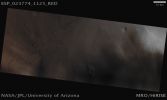
ESP_023774_1125_RED_abrowse.jpgPossible Signs of Hydration (Absolute Natural Colors; credits for the additional process. and color.: Dr Paolo C. Fienga - Lunar Explorer Italia) 169 visiteMars Local Time: 14:35 (Early Afternoon)
Coord. (centered): 67,3° South Lat. and 105,4° East Long.
Spacecraft altitude: 249 Km (such as about 155,6 miles)
Original image scale range: 49,8 cm/pixel (with 2 x 2 binning) so objects ~ 1 mt and 49 cm across are resolved
Map projected scale: 50 cm/pixel
Map projection: POLAR STEREOGRAPHIC
Emission Angle: 1,8°
Phase Angle: 69,2°
Solar Incidence Angle: 68° (meaning that the Sun is about 22° above the Local Horizon)
Solar Longitude: 349° (Northern Winter)
Credits: NASA/JPL/University of Arizona
Additional process. and coloring: Dr Paolo C. Fienga - Lunar Explorer ItaliaMareKromium
|
|

PSP_005011_0885-PCF-LXTT-02.jpgThe "Terra Incognita" (Saturated Natural Colors; credits for the additional process. and color.: Dr Paolo C. Fienga - Lunexit Team)169 visiteMars Local Time: 21:11 (early evening hours)
Coord. (centered): 88,4° South Lat. and 191,1° East Long.
Spacecraft altitude: 256,6 Km (such as about 160,4 miles)
Original image scale range: 25,7 cm/pixel (with 1 x 1 binning) so objects ~ 77 cm across are resolved
Map projected scale: 25 cm/pixel
Map projection: POLAR STEREOGRAPHIC
Emission Angle: 17,3°
Sun - Mars - MRO (or "Phase") Angle: 80,2°
Solar Incidence Angle: 69° (meaning that the Sun is about 21° above the Local Horizon)
Solar Longitude: 299,8° (Northern Winter)
Credits: NASA/JPL/University of Arizona
Additional process. and coloring: Lunar Explorer ItaliaMareKromium
|
|

ESP_020319_1470_RED_abrowse-PCF-LXTT.jpgIce-rich Lobate Debris-Aprons in Terra Promethei (Absolute Natural Colors; credits for the additional process. and color.: Dr Paolo C. Fienga - Lunexit Team)168 visiteThis image shows a portion of a Lobate "Debris-Apron! along the bottom of a Hill in the Promethei Terra Region of Mars. This Region contains many such Mesas surrounded by Lobate Debris-Aprons that are thought to be ice-rich.
These Aprons have been interpreted as a variety of possible features including Rock Glaciers, ice-rich Mass Movements, or Debris-covered Glacial Flows. Recent radar data have shown them to be composed of nearly 100% pure ice.
Parallel Grooves and Ridges indicate the direction of flow.
Both the Debris-Apron and the Plains beyond it are blanketed with an ice-rich Mantle that is common throughout the Martian Mid-Latitudes. The Mantle Deposits are pitted and grooved perhaps due to the sublimation of ice. This Mantle is thought to have been deposited as snow around 10 million years ago during a period of high obliquity, when the Planet's Axis was more tilted and environmental conditions could have been more conducive to snowfall in these Regions.
Several small Impact Craters are visible on the Plains that appear to have been filled with Mantling Deposits that have subsequently been partially removed. These Craters give us clues to the erosional history of the Deposit.MareKromium
|
|
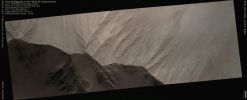
PSP_007946_2035_RED_abrowse-PCF-LXTT.jpgOlympus' Lava (Absolute Natural Colors; credits for the additional process. and color.: Dr Paolo C. Fienga - Lunexit Team)168 visitenessun commentoMareKromium
|
|
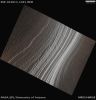
ESP_023813_1045_RED_abrowse.jpgSouth presso-Polar Layers (Natural Colors; credits for the additional process. and color.: Dr Paolo C. Fienga - Lunexit Team)167 visiteMars Local Time: 15:26 (Early Afternoon)
Coord. (centered): 76,3° South Lat. and 134,0° East Long.
Spacecraft altitude: 270,3 Km (such as about 169,0 miles)
Original image scale range: 54,1 cm/pixel (with 2 x 2 binning) so objects ~ 1 mt and 52 cm across are resolved
Map projected scale: 50 cm/pixel
Map projection: POLAR STEREOGRAPHIC
Emission Angle: 24,5°
Sun-Mars-Spacecraft (or "Phase") Angle: 65,4°
Solar Incidence Angle: 78° (meaning that the Sun is about 12° above the Local Horizon)
Solar Longitude: 350,6° (Northern Winter)
Credits: NASA/JPL/University of Arizona
Additional process. and coloring: Dr Paolo C. Fienga - Lunar Explorer ItaliaMareKromium
|
|

ESP_023314_1440_RED_abrowse-PCF-LXTT-00.jpgUnusual Surface Features in Hellas Planitia (CTX Frame - Enhanced Absolute Natural Colors; credits for the additional process. and color.: Dr Paolo C. Fienga - Lunexit Team)167 visiteMars Local Time: 14:16 (Early Afternoon)
Coord. (centered): 35,9° South Lat. and 58,6° East Long.
Spacecraft altitude: 261,1 Km (such as about 163,2 miles)
Original image scale range: 52,2 cm/pixel (with 2 x 2 binning) so objects ~ 1 mt and 57 cm across are resolved
Map projected scale: 50 cm/pixel
Map projection: EQUIRECTANGULAR
Emission Angle: 6,0°
Sun-Mars-Spacecraft (or "Phase") Angle: 34,3°
Solar Incidence Angle: 39° (meaning that the Sun is about 51° above the Local Horizon)
Solar Longitude: 329,9° (Northern Winter)
Credits: NASA/JPL/University of Arizona
Additional process. and coloring: Dr Paolo C. Fienga - Lunar Explorer ItaliaMareKromium
|
|
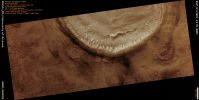
ESP_017405_2270_RED_abrowse.jpgNorthern Hemisphere Gullies on West-Facing Crater Slope (Natural Colors; credits for the additional process. and color.: Dr Paolo C. Fienga - Lunexit Team)166 visiteThis image shows the Eastern (West-facing) side of an Unnamed Impact Crater in the Mid-Latitudes of the Northern Hemisphere.
Like many Mid-Latitude Craters, this one has Gullies along its Walls that are composed of Alcoves, Channels and Debris Aprons. The origins of these Gullies have been the subject of much debate; they could have formed by flowing water, liquid Carbon Dioxide, or dry granular flows. The orientation of these Gullies is of interest because many Craters only contain Gullies on certain Walls, such as those that are Pole-facing. This could be due to changes in orbital conditions and differences in solar heating along specific Walls.
Many of the other features observed in and around this Crater however are indicative of an ice-rich terrain, which may lend credence to the water formation hypothesis, at least for the Gullies visible here. The most notable of these features is the "Scalloped Terrain" in and around the Crater.
This type of Terrain has been interpreted as a sign of surface caving, perhaps due to sublimation of underlying ice.
Another sign of ice is the presence of parallel lineations and pitted material on the Floor of the Crater, similar to what is referred to as concentric Crater Fill. Parallel linear cracks are also observed along the Crater Wall over the Gullies, which could be due to thermal contraction of ice-rich material.
All of these features taken together are evidence for ice-rich material having been deposited in this Region during different climatic conditions that has subsequently begun to melt and/or sublimate under current conditions. More recently, Aeolian Deposits have accumulated around the Crater as evidenced by the parallel ridges dominating the landscape.
Dust Devil Streaks are also visible crossing the Aeolian Ridges.
Written by: Dan BermanMareKromium
|
|
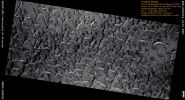
PSP_006959_2610_RED_abrowse-PCF-LXTT.jpgFrozen Dunes (Absolute Natural Colors; credits for the additional process. and color.: Dr Paolo C. Fienga - Lunexit Team)166 visitenessun commentoMareKromium
|
|
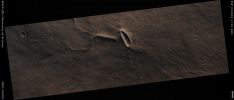
PSP_010569_1720_red-PCF-LXTT.jpgSmall Shield Volcano in Eastern Tharsis (Absolute Natural Colors; credits for the additional process. and color.: Dr Paolo C. Fienga - Lunar Explorer Italia) 166 visiteMars Local Time: 15:44 (Middle Afternoon)
Coord. (centered): 7,8° South Lat. and 249,3° East Long.
Spacecraft altitude: 254,9 Km (such as about 159,3 miles)
Original image scale range: 51 cm/pixel (with 2 x 2 binning) so objects ~1,53 mt across are resolved
Map projected scale: 50 cm/pixel
Map projection: EQUIRECTANGULAR
Emission Angle: 6,8°
Phase Angle: 53,4°
Solar Incidence Angle: 59° (meaning that the Sun is about 31° above the Local Horizon)
Solar Longitude: 148,5° (Northern Summer)
Credits: NASA/JPL/University of Arizona
Additional process. and coloring: Dr Paolo C. Fienga - Lunar Explorer ItaliaMareKromium
|
|
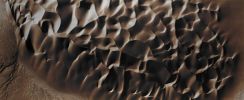
ESP_025481_1385-PCF-LXTT.jpgLarge Southern Dunefield (Absolute Natural Colors; credits for the additional process. and color.: Dr Paolo C. Fienga - Lunexit Team)166 visiteMars Local Time: 15:05 (early afternoon)
Coord. (centered): 41,2° South Lat. and 297,6° East Long.
Spacecraft altitude: 254,1 Km (such as about 158,8 miles)
Original image scale range: 50,8 cm/pixel (with 2 x 2 binning) so objects ~ 1 mt and 53 cm across are resolved
Map projected scale: 50 cm/pixel
Map projection: EQUIRECTANGULAR
Emission Angle: 7,8°
Sun - Mars - MRO (or "Phase") Angle: 70,0°
Solar Incidence Angle: 74° (meaning that the Sun is about 16° above the Local Horizon)
Solar Longitude: 51,8° (Northern Spring)
Credits: NASA/JPL/University of Arizona
Additional process. and coloring: Lunar Explorer ItaliaMareKromium
|
|
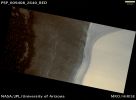
Psp_009408_2640_red.jpgMass Wasting on the North Polar Scarp (possible True Colors; credits: Lunar Explorer Italia)164 visiteMars Local Time: 13:34 (early afternoon)
Coord. (centered): 84,0° North Lat. and 230,1° East Long.
Spacecraft altitude: 316,9 Km (such as about 198,0 miles)
Original image scale range: 31,7 cm/pixel (with 1 x 1 binning) so objects ~95 cm across are resolved
Map projected scale: 25 cm/pixel
Map projection: EQUIRECTANGULAR
Emission Angle: 0,8°
Phase Angle: 61,0°
Solar Incidence Angle: 60° (meaning that the Sun is about 30° above the Local Horizon)
Solar Longitude: 105,3° (Northern Summer)
Credits: NASA/JPL/University of Arizona
Additional process. and coloring: Lunar Explorer ItaliaMareKromium
|
|

Coprates_Labes_Canyon-Tra_000849_1675_red~1.jpgUnusual Landforms or...Something more?!?163 visiteUn ottimo lavoro di osservazione ed estrapolazione realizzato dal nostro caro Amico e Socio Lorenzo Leone ci riporta ad una (ormai) annosa e vexata questione: alcuni rilievi di Marte, nella loro "stranezza", restano rilievi naturali o si tratta di remnants di strutture artificiali?
Voi, cari Amici, la nostra posizione la conoscete; ma per questa volta - e diremmo con buona ragione - ci piace citare Lorenzo:"...Prendendo in esame una delle ultime immagini pubblicate, Coprates Labes, mi sono voluto divertire analizzandola nel tentativo di catturare le forme più strane (e sicuramente più fantasiose), ma di sicuro interesse.
Le immagini parlano da sole: abbiamo 2 possibili piramidi ed un "fortino".
Un gioco di luci ombre, aiutato da oggetti particolari, ma fantasticare e analizzare non nuoce certamente.
Ed è certo che Marte, almeno per me, riesce sempre a stupire...".
E noi condividiamo al 100%!MareKromium
|
|
| 2237 immagini su 187 pagina(e) |
 |
|
|
|
|
40 | |
|
|
|
|





