| Piú viste - Mars Reconnaissance Orbiter (MRO) |

ESP_020892_1275_RED_abrowse-01.jpgGullies in Argyre Planitia (EDM - Natural Colors; credits for the additional process. and color.: Dr Paolo C. Fienga - Lunexit Team)357 visitenessun commentoMareKromium
|
|
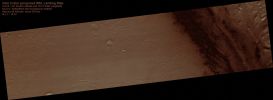
PSP_003453_1750_RED_browse-PCF-LXTT.jpgPossible MSL Landing Site inside Gale Crater (Absolute Natural Colors; credits for the additional process. and color.: Dr Paolo C. Fienga - Lunexit Team)344 visitenessun commentoMareKromium
|
|

ESP_020929_1360_RED_abrowse.jpgUplifted Bedrock (Absolute Natural Colors; credits for the additional process. and color.: Dr Paolo C. Fienga - Lunexit Team)333 visiteCaption NASA:"Large Impact Craters expose deep Bedrock. After the transient cavity forms, the Crater Floor rebounds and creates a permanent structural Uplift, typically equivalent to about 10% of the Crater diameter.
A Crater approx. 70 Km (43,47 miles) wide like this one, can raise up and expose Bedrock that was approx. 7 Km (4,34 miles) lower in elevation prior to the Impact.
Deeper rocks are usually older, and on Mars the oldest rocks are interesting because they are more likely to have been altered by water and provide clues to ancient environments and processes. This image reveals good Bedrock exposures with diverse rock types (as indicated by colors and textures)".MareKromium
|
|
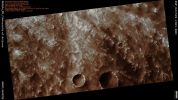
ESP_021599_1965_RED_abrowse-PCF-LXTT.jpgSandy Rivers and Unnamed Craters (Enhanced Natural Colors; credits: Dr Paolo C. Fienga - Lunexit Team)333 visitenessun commentoMareKromium
|
|

ESP_024058_2470-PCF-LXTT-00.jpgSeasonal Frost and Snow in Vastitas Borealis (CTX Frame "A" - Absolute Natural Colors; credits for the additional process. and color.: Dr Paolo C. Fienga - Lunexit Team)333 visiteMars Local Time: 13:44 (Early Afternoon)
Coord. (centered): 66,6° North Lat. and 247,8° East Long.
Spacecraft altitude: 315,6 Km (such as about 197,2 miles)
Original image scale range: 31,6 cm/pixel (with 1 x 1 binning) so objects ~ 63,1 cm across are resolved (with 2 x 2 binning)
Map projected scale: 25 cm/pixel
Map projection: POLAR STEREOGRAPHIC
Emission Angle: 7,5°
Sun-Mars-Spacecraft (or "Phase") Angle: 74,0°
Solar Incidence Angle: 69° (meaning that the Sun is about 21° above the Local Horizon)
Solar Longitude: 0,3° (Northern Spring)
Credits: NASA/JPL/University of Arizona
Additional process. and coloring: Dr Paolo C. Fienga - Lunar Explorer ItaliaMareKromium
|
|

Mawrth_Vallis-PIA01924-PCF-LXTT.jpgMineral Diversity in Mawrth Vallis (Absolute Natural Colors; credits for the additional process. and color.: Dr Paolo C. Fienga - Lunexit Team)331 visitenessun commentoMareKromium
|
|

ESP_020941_0980_RED_abrowse.jpgPseudo "South Polar Trees" (Natural Colors; credits for the additional process. and color.: Dr Paolo C. Fienga - Lunexit Team)330 visitenessun commentoMareKromium
|
|
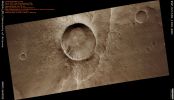
ESP_021596_1500_RED_abrowse-PCF-LXTT.jpgUnnamed Southern Crater (Enhanced Natural Colors; credits: Dr Paolo C. Fienga - Lunexit Team)330 visitenessun commentoMareKromium
|
|
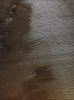
Nili_Fossae-PCF-LXTT-02.jpgFeatures of Nili Fossae (Natural Colors; credits for the additional process. and color.: Dr Paolo C. Fienga - Lunexit Team)327 visitenessun commentoMareKromium
|
|

ESP_020918_1400_RED_abrowse.jpgOutcrops in the Southern Latitudes (Natural Colors; credits for the additional process. and color.: Dr Paolo C. Fienga - Lunexit Team)319 visitenessun commentoMareKromium
|
|

ESP_020793_1935_RED_abrowse-PCF-LXTT.jpgElliptical Impact Crater or Crater Chain? (Natural Colors; credits for the additional process. and color.: Dr Paolo C. Fienga - Lunexit Team)317 visiteCaption NASA:"This image shows what appears to be a highly Elliptical Crater, which would be unusual. Closer examination reveals that it is probably two overlapping Craters that formed concurrently, plus several smaller Craters aligned with the Long Axis of the elliptical depression.
This type of "Crater Chain" can form from a highly oblique impact, in which the Impactor (Bolide) trajectory is almost parallel to the Surface".MareKromium
|
|

ESP_020875_0980_RED_abrowse-PCF-LXTT.jpgSouth Polar "Pseudo-Trees" (Absolute Natural Colors; credits for the additional process. and color.: Dr Paolo C. Fienga - Lunexit Team)316 visitenessun commentoMareKromium
|
|
| 2237 immagini su 187 pagina(e) |
 |
|
4 | |
|
|
|
|
|
|
|





