| Piú viste - Mars Reconnaissance Orbiter (MRO) |

PIA10147-Starburst_Channels-PCF-LXTT.jpgThe "Arthur Clarke Trees" (Enhanced Absolute Natural Colors; credits for the additional process. and color.: Dr Paolo C. Fienga - Lunexit Team)208 visitenessun commentoMareKromium
|
|

ESP_021915_1005-PCF-LXTT-2.jpgPromethei Planum (CTX Frame n.2 - Absolute Natural Colors; credits for the additional process. and color.: Dr Paolo C. Fienga - Lunexit Team)208 visiteAcquisition Date: March, 31st, 2011
Mars Local Time (M.L.T.): 15:55 (Middle Afternoon)
Latitude (centered): 79,5° South
Longitude (East): 109,4°
Range to target site: 249,2 Km
Original image Scale Range: 49,9 cm/pixel (with 2 x 2 binning) so objects ~150 cm across are resolved
Map Projected Scale: 50 cm/pixel
Map projection: POLAR STEREOGRAPHIC
Emission Angle: 3,5°
Phase Angle: 57,4°
Solar Incidence Angle (S.I.A.): 60°, with the Sun about 30° above the Local Horizon
Solar Longitude: 264,8° - Northern AutumnMareKromium
|
|
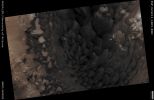
ESP_024213_1805_RED_abrowse.jpgLarge Equatorial Dunefield (Absolute Natural Colors; credits for the additional process. and color.: Dr Paolo C. Fienga - Lunexit Team)208 visiteMars Local Time: 14:17 (Early Afternoon)
Coord. (centered): 0,5° North Lat. and 348,8° East Long.
Spacecraft altitude: 275,9 Km (such as about 172,4 miles)
Original image scale range: 27,6 cm/pixel (with 1 x 1 binning) so objects ~ 83 cm across are resolved
Map projected scale: 25 cm/pixel
Map projection: EQUIRECTANGULAR
Emission Angle: 9,2°
Sun-Mars-Spacecraft (or "Phase") Angle: 43,5°
Solar Incidence Angle: 34° (meaning that the Sun is about 56° above the Local Horizon)
Solar Longitude: 6,2° (Northern Spring)
Credits: NASA/JPL/University of Arizona
Additional process. and coloring: Dr Paolo C. Fienga - Lunar Explorer ItaliaMareKromium
|
|
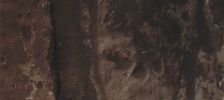
ESP_024017_1650-PCF-LXTT-00.jpgPossible Phyllosilicates at Coprates Catena (CTX "A" - Enhanced Absolute Natural Colors; credits for the additional process. and color.: Dr Paolo C. Fienga - Lunexit Team) 208 visiteMars Local Time: 14:15 (Early Afternoon)
Coord. (centered): 14,9° South Lat. and 301,3° East Long.
Spacecraft altitude: 259,5 Km (such as about 162,2 miles)
Original image scale range: 51,9 cm/pixel (with 2 x 2 binning) so objects ~ 1 mt and 56 cm across are resolved
Map projected scale: 50 cm/pixel
Map projection: EQUIRECTANGULAR
Emission Angle: 8,9°
Sun-Mars-Spacecraft (or "Phase") Angle: 44,7°
Solar Incidence Angle: 36° (meaning that the Sun is about 54° above the Local Horizon)
Solar Longitude: 358,7° (Northern Winter)
Credits: NASA/JPL/University of Arizona
Additional process. and coloring: Dr Paolo C. Fienga - Lunar Explorer ItaliaMareKromium
|
|

ESP_022276_1670_RED_abrowse-PCF-LXTT.jpgFeatures of Capri Chasma (Absolute Natural Colors; credits for the additional process. and color.: Dr Paolo C. Fienga - Lunexit Team)207 visitenessun commentoMareKromium
|
|
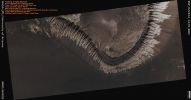
ESP_022632_1670_RED_abrowse-PCF-LXTT-00.jpgFeatures of the Valles Marineris (Absolute Natural Colors; credits for the additional process. and color: Dr Paolo C. Fienga - Lunexit Team)207 visitenessun commentoMareKromium
|
|
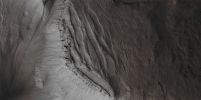
ESP_024094_1330-PCF-LXTT-01.jpgFeatures of Asimov Crater (CTX "B" - Enhanced Absolute Natural Colors; credits for the additional process. and color.: Dr Paolo C. Fienga - Lunexit Team) 207 visiteMars Local Time: 14:31 (Early Afternoon)
Coord. (centered): 46,8° South Lat. and 5,1° East Long.
Spacecraft altitude: 254,0 Km (such as about 158,8 miles)
Original image scale range: 25,4 cm/pixel (with 1 x 1 binning) so objects ~ 76 cm across are resolved
Map projected scale: 25 cm/pixel
Map projection: EQUIRECTANGULAR
Emission Angle: 6,1°
Sun-Mars-Spacecraft (or "Phase") Angle: 54,4°
Solar Incidence Angle: 58° (meaning that the Sun is about 32° above the Local Horizon)
Solar Longitude: 1,7° (Northern Spring)
Credits: NASA/JPL/University of Arizona
Additional process. and coloring: Dr Paolo C. Fienga - Lunar Explorer ItaliaMareKromium
|
|

ESP_023937_2240-PCF-LXTT-00.jpgUnnamed Northern Crater with deeply incised Gullies (CTX Frame "A" - Absolute Natural Colors; credits for the additional process. and color.: Dr Paolo C. Fienga - Lunexit Team)207 visiteMars Local Time: 14:08 (early afternoon)
Coord. (centered): 43,5° North Lat. and 319,4° East Long.
Spacecraft altitude: 304,2 Km (such as about 190,1 miles)
Original image scale range: 30,4 cm/pixel (with 1 x 1 binning) so objects ~ 91 cm across are resolved
Map projected scale: 25 cm/pixel
Map projection: EQUIRECTANGULAR
Emission Angle: 9,2°
Phase Angle: 47,5°
Solar Incidence Angle: 54° (meaning that the Sun is about 36° above the Local Horizon)
Solar Longitude: 355,5° (Northern Winter)
Credits: NASA/JPL/University of Arizona
Additional process. and coloring: Lunar Explorer ItaliaMareKromium
|
|

ESP_024481_1605-PCF-LXTT.jpgSkylight in Daedalia Planum (Enhanced Absolute Natural Colors; credits for the additional process. and color.: Dr Paolo C. Fienga - Lunexit Team)207 visiteMars Local Time: 14:38 (early afternoon)
Coord. (centered): 19,5° South Lat. and 237,6° East Long.
Spacecraft altitude: 274,7 Km (such as about 171,7 miles)
Original image scale range: 27,5 cm/pixel (with 1 x 1 binning) so objects ~ 82 cm across are resolved
Map projected scale: 25 cm/pixel
Map projection: EQUIRECTANGULAR
Emission Angle: 23,9°
Phase Angle: 31,1°
Solar Incidence Angle: 47° (meaning that the Sun is about 43° above the Local Horizon)
Solar Longitude: 16,3° (Northern Spring)
Credits: NASA/JPL/University of Arizona
Additional process. and coloring: Lunar Explorer ItaliaMareKromium
|
|
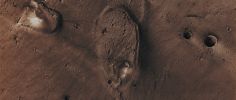
PSP_009709_2155_red-PCF-LXTT-1.jpgMesa in Acidalia Planitia Region (Absolute Natural Colors; credits for the additional process. and color.: Dr Paolo C. Fienga - Lunexit Team)207 visiteMars Local Time: 15:22 (early afternoon)
Coord. (centered): 35,3° North Lat. and 322,3° East Long.
Spacecraft altitude: 293,7 Km (such as about 183,5 miles)
Original image scale range: 29,4 cm/pixel (with 1 x 1 binning) so objects ~ 58,8 cm across are resolved (with 2 x 2 binning)
Map projected scale: 25 cm/pixel
Map projection: EQUIRECTANGULAR
Emission Angle: 0,3°
Phase Angle: 45,7°
Solar Incidence Angle: 46° (meaning that the Sun is about 44° above the Local Horizon)
Solar Longitude: 116,1° (Northern Summer)
Credits: NASA/JPL/University of Arizona
Additional process. and coloring: Lunar Explorer ItaliaMareKromium
|
|
ESP_022274_1855_RED_abrowse-PCF-LXTT.jpgFeatures of an Unnamed Crater (Absolute Natural Colors; credits for the additional process. and color.: Dr Paolo C. Fienga - Lunexit Team)206 visitenessun commentoMareKromium
|
|

PSP_008842_1705_red-PCF-LXTT.jpgSmall Shield-Volcano and Caldera (Enhanced Natural Colors; credits for the additional process. and color.: Dr Paolo C. Fienga - Lunar Explorer Italia)206 visiteThis image is centered on the vent area of a small shield volcano located within the Summit Caldera of Arsia Mons, the southernmost of the large three Tharsis Montes Volcanoes.
Since the first details of the volcano were revealed by the Viking orbiters 30 years ago, the presence of a string of several small Shield Volcanoes across the Floor of the Caldera has been known. The resolution of the Viking images was insufficient to show more than the mere presence of small Shield Volcanoes and the fact that they appeared to line up along a linear trend across the Floor. And, it was suspected that the small Shield Volcanoes were the source of the lava flows that appeared to cover the floor of the Caldera, but details have been elusive.
This HiRISE image of the central small Shield Volcano on the Caldera Floor shows that there are numerous lava flows radiating from a small summit crater. To the North and South, the lavas have accumulated in lobes, some of which radiate smaller channels and lobes. About midway from the crater, to both left and right of the image, the surface appears very smooth and there are few details visible. Until detailed geologic mapping is done, it is difficult to conclude whether these smooth areas represent distal ponding of lavas that erupted from the summit crater of the small Shield Volcano, lava flows that have invaded from outside the image area at a time later than the formation of the small Shield Volcano, or later deposits of dust and ash that have simply covered the surface.
Whatever the relationships, it is clear that the Floor of the Largest Caldera on Mars is far from a bland surface of old lava flows. Numerous flows and multiple vents have all interacted to create a complex series of surfaces that record the geologic development of the Caldera Floor. MareKromium
|
|
| 2237 immagini su 187 pagina(e) |
 |
|
|
|
|
24 | |
|
|
|
|





