| Piú viste - Mars Reconnaissance Orbiter (MRO) |
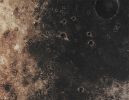
ESP_024556_2045-PCF-LXTT-00a.jpgFeatures of Mawrth Vallis (CTX Frame "A" - Absolute Natural Colors; credits for the additional process. and color.: Dr Paolo C. Fienga - Lunexit Team)215 visiteMars Local Time: 14:24 (early afternoon)
Coord. (centered): 24,1° North Lat. and 342,5° East Long.
Spacecraft altitude: 286,8 Km (such as about 179,2 miles)
Original image scale range: 28,7 cm/pixel (with 1 x 1 binning) so objects ~ 86 cm across are resolved
Map projected scale: 25 cm/pixel
Map projection: EQUIRECTANGULAR
Emission Angle: 0,3°
Phase Angle: 38,2°
Solar Incidence Angle: 38° (meaning that the Sun is about 52° above the Local Horizon)
Solar Longitude: 19,1° (Northern Spring)
Credits: NASA/JPL/University of Arizona
Additional process. and coloring: Lunar Explorer ItaliaMareKromium
|
|

ESP_024997_1155_RED-PCF-LXTT-00.jpgSouthern Dunefield partially covered with Frost (CTX Frame "A" - Absolute Natural Colors; credits for the additional process. and color.: Dr Paolo C. Fienga - Lunexit Team)215 visiteCoord. (centered): 64,2° North Lat. and 194,5° East Long.
MareKromium
|
|

ESP_024988_1370_RED-PCF-LXTT-00.jpgSouthern Dark Dunefield (CTX Frame "A" - Absolute Natural Colors; credits for the additional process. and color.: Dr Paolo C. Fienga - Lunexit Team)215 visiteCoord. (centered): 42,6° South Lat. and 74,0° East Long.MareKromium
|
|
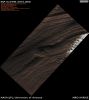
ESP_021996_0935_RED_abrowse-PCF-LXTT.jpgSouth Polar Layered Deposits near Chasma Austale (Absolute Natural Colors; credits for the additional process. and color.: Dr Paolo C. Fienga - Lunexit Team)214 visitenessun commentoMareKromium
|
|

ESP_022472_1285_RED_abrowse-PCF-LXTT.jpgUnnamed Southern Crater with "Blooming" Gully (Absolute Natural Colors; credits for the additional process. and color.: Dr Paolo C. Fienga - Lunexit Team)214 visiteCaption NASA:"This observation shows Mid-Latitude-Type Gullies as well as dark and light materials. Brown/orange Dunes in this Unnamed Crater can also be seen (East of the Gully Aprons). One of the more stunning features is the Gully formation right outside the center swath of the full image.
At HiRISE resolution, we can examine whether there has been activity in the Gullies that post-dates the placement of windblown materials, like Boulders down the Slopes. We can also gather information to help determine the processes responsible for Gully formation".
Acquisition Date: May, 13th, 2011
Mars Local Time (M.L.T.): 14:33 (Early Afternoon)
Latitude (centered): 51,3° South
Longitude (East): 6,8°
Range to Target Site (Spacecraft Altitude): 254,7 Km (159,2 miles)
Original Image Scale Range: 51 cm/pixel (with 2 x 2 binning) so objects of ~1 meter and 53 cm across are resolved
Map Projected Scale: 50 cm/pixel and North is up
Map Projection: EQUIRECTANGULAR
Emission Angle: 8,4°
Sun-Mars-MRO (or "Phase") Angle: 47,8°
Solar Incidence Angle: 41° (with the Sun about 49° above the Local Horizon)MareKromium
|
|
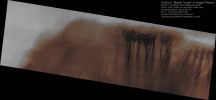
PSP_005160_1150_RED_abrowse-PCF-LXTT-00.jpgGullies in Mantle Terrain in Sisyphi Planum (CTX Frame - Absolute Natural Colors; credits for the additional process. and color.: Dr Paolo C. Fienga - Lunexit Team) 214 visiteCaption NASA:"This observation shows the East-facing Walls of an Unnamed Crater in Sisyphi Planum, near the South Polar Regions. Gullies, as well as Mantle Terrain and Polygons are also visible; these features suggest that at some point in time, liquid and ice may have been present at and near the Surface. The Gullies, which are rather eroded, have ample Alcoves and subdued Channels; dark patches and Ripples in the bottom of the Channels indicate that the most recent activity was Aeolian (such as "wind-driven") in Nature. Mantle Terrains are characterized by their smooth Surface and light, uniform color. They are widely interpreted as Terrains blanketed by a mixture of Ice and Dust, deposited under climatic conditions different from that of today. The Gullies in this image have Alcove Areas that seem to have cut through the Mantle Terrain, exposing the underlying materials". MareKromium
|
|
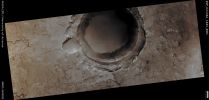
ESP_023382_1845_RED_abrowse-PCF-LXTT.jpgUnnamed Crater in Meridiani Planum (Enhanced Absolute Natural Colors; credits for the additional process. and color.: Dr Paolo C. Fienga - Lunexit Team)214 visiteMars Local Time: 14:07 (Early Afternoon)
Coord. (centered): 4,4° North Lat. and 356,6° East Long.
Spacecraft altitude: 272,9 Km (such as about 170,6 miles)
Original image scale range: 27,3 cm/pixel (with 1 x 1 binning) so objects ~ 82 cm across are resolved
Map projected scale: 25 cm/pixel
Map projection: EQUIRECTANGULAR
Emission Angle: 3,2°
Sun-Mars-Spacecraft (or "Phase") Angle: 32,3°
Solar Incidence Angle: 35° (meaning that the Sun is about 55° above the Local Horizon)
Solar Longitude: 332,8° (Northern Winter)
Credits: NASA/JPL/University of Arizona
Additional process. and coloring: Dr Paolo C. Fienga - Lunar Explorer ItaliaMareKromium
|
|
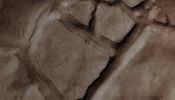
ESP_024074_1425-PCF-LXTT-01.jpgFeatures of Electris Region (CTX "B" - Enhanced Absolute Natural Colors; credits for the additional process. and color.: Dr Paolo C. Fienga - Lunexit Team) 214 visiteMars Local Time: 14:27 (Early Afternoon)
Coord. (centered): 37,1° South Lat. and 189,4° East Long.
Spacecraft altitude: 255,3 Km (such as about 159,6 miles)
Original image scale range: 25,5 cm/pixel (with 1 x 1 binning) so objects ~ 77 cm across are resolved
Map projected scale: 25 cm/pixel
Map projection: EQUIRECTANGULAR
Emission Angle: 6,3°
Sun-Mars-Spacecraft (or "Phase") Angle: 46,6°
Solar Incidence Angle: 51° (meaning that the Sun is about 39° above the Local Horizon)
Solar Longitude: 0,9° (Northern Spring)
Credits: NASA/JPL/University of Arizona
Additional process. and coloring: Dr Paolo C. Fienga - Lunar Explorer ItaliaMareKromium
|
|
PSP_007547_1895_RED_abrowse-04.jpgFeatures of Shalbatana Vallis (EDM n.3 - Absolute Natural Colors; credits for the additional process. and color.: Dr Paolo C. Fienga - Lunexit Team)214 visiteMareKromium
|
|

ESP_024584_1655-PCF-LXTT-01.jpgProximities of the Valles Marineris Canyon System (CTX Frame "B" - Absolute Natural Colors; credits for the additional process. and color.: Dr Paolo C. Fienga - Lunexit Team)214 visiteMars Local Time: 14:30 (early afternoon)
Coord. (centered): 14,2° South Lat. and 302,2° East Long.
Spacecraft altitude: 266,9 Km (such as about 166,8 miles)
Original image scale range: 53,4 cm/pixel (with 2 x 2 binning) so objects ~ 1 mt and 60 cm across are resolved
Map projected scale: 50 cm/pixel
Map projection: EQUIRECTANGULAR
Emission Angle: 6,4°
Phase Angle: 49,1°
Solar Incidence Angle: 44° (meaning that the Sun is about 46° above the Local Horizon)
Solar Longitude: 20,1° (Northern Spring)
Credits: NASA/JPL/University of Arizona
Additional process. and coloring: Lunar Explorer ItaliaMareKromium
|
|
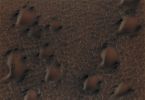
ESP_024265_2535-PCF-LXTT-01.jpgNorth Polar Dunes (EDM - Absolute Natural Colors; credits for the additional process. and color.: Dr Paolo C. Fienga - Lunexit Team)214 visiteMars Local Time: 13:44 (early afternoon)
Coord. (centered): 73,3° North Lat. and 355,1° East Long.
Spacecraft altitude: 317,5 Km (such as about 198,4 miles)
Original image scale range: 31,8 cm/pixel (with 1 x 1 binning) so objects ~ 95 cm across are resolved
Map projected scale: 25 cm/pixel
Map projection: POLAR STEREOGRAPHIC
Emission Angle: 1,8°
Phase Angle: 72,9°
Solar Incidence Angle: 72° (meaning that the Sun is about 18° above the Local Horizon)
Solar Longitude: 8,2° (Northern Spring)
Credits: NASA/JPL/University of Arizona
Additional process. and coloring: Lunar Explorer ItaliaMareKromium
|
|

ESP_024587_1465_RED-PCF-LXTT-00.jpgUnnamed Crater partially invaded by Lava Flow (CTX Frame - Absolute Natural Colors; credits for the additional process. and color.: Dr Paolo C. Fienga - Lunexit Team)214 visiteCoord. (centered): 33,3° South Lat. and 222,7° East Long.MareKromium
|
|
| 2237 immagini su 187 pagina(e) |
 |
|
|
|
|
20 | |
|
|
|
|





