| |

| Piú viste - Mars Reconnaissance Orbiter (MRO) |

ESP_013951_1955_RED_abrowse-00.jpgDark Syrtis Major (CTX Frame - Natural Colors; credits: Dr Paolo C. Fienga - Lunexit Team)54 visiteOn 13 October 1659, Dutch Astronomer Christiaan Huygens turned one of his telescopes towards a bright orange spot in the sky and produced what Percival Lowell would later call “the first drawing of Mars worthy of the name ever made by man”.
Huygens included a "dark spot" in his drawing that is thought to represent Syrtis Major, a small sliver of which is visible in this HiRISE image.
Syrtis Major is a Shield Volcano and its dark color comes from the dark Basaltic Rock present in the area, visible because it lacks the Dust that paints the rest of the Planet its distinct, rusty orangish color. By tracking this "dark spot" in repeated observations, Huygens concluded that Mars rotated every 24 hours: a time not too far off from its true rotation period of approx. 24 hours and 39,58 minutes.MareKromium
|
|

PSP_001916_2220_RED_abrowse.jpgKnobs and Mounds on the Northern Plains (Natural Colors; credits: Dr Paolo C. Fienga - Lunexit Team)54 visiteLight-toned Mounds occur across the image.
The northern part of the image is dominated by small Knobs or Patches, while there are features hundreds of meters across to the South. The larger features frequently have one or more craters and an irregular shape; it has been proposed that these features are Mud Volcanoes, which erupt mud instead of lava.
On Earth, Mud Volcanoes usually form in conditions of tectonic pressurization or rapid burial of sediments.
At high resolution, the Knobs show some fine lineations which may be wind-blown material, but are otherwise very smooth. In between the Mounds, the Surface is rough and rich in Boulders. The few Boulders on the Mounds were likely ejected from nearby Impact Craters.
Information like this from HiRISE images provides useful constraints on the formation and material of these Knobs and Cones.MareKromium
|
|
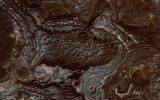
Juventae_Chasma-PIA12489.jpgBright Layered Deposits near Juventae Chasma (Natural Colors; credits: Dr Paolo C. Fienga - Lunexit Team)54 visiteThis view shows color variations in bright Layered Deposits on a plateau near Juventae Chasma in the Valles Marineris egion of Mars. A brown mantle covers portions of the bright deposits. The view covers an area about of 1,2 Km (three-fourths of a mile) across.
The image comes from an observation made by the High Resolution Imaging Science Experiment (HiRISE) camera on NASA's Mars Reconnaissance Orbiter on May 2, 2007.
Researchers have found that these bright Layered Deposits contain Opaline Silica and Iron Sulfates, consistent with low-temperature, acidic aqueous alteration of basaltic materials. They conclude that aqueous activity affected this plateau after formation of the nearby canyons. Although the source of water and sediment remains uncertain, the strong correlation between fluvial landforms and bright Layered Deposits in this Region argues for sustained precipitation, surface runoff, and fluvial deposition occurring during Mars' Hesperian Era on the plateaus adjacent to Valles Marineris and along portions of the canyon walls.
This image is one product from HiRISE observation PSP_003579_1755, centered at 4,7° South Lat. and 296,4 East Long.MareKromium
|
|

Noachis_Terra-PIA13074.jpgNoachis Terra (Natural Colors; credits for the additional process. and color.: Dr Paolo C. Fienga - Lunexit Team)54 visiteThis observation shows Gullies in a semi-circular Trough in Noachis Terra. The Gullies are observed to face all directions.
It is interesting to note that the Gully Morphology seen here depends on the orientation of the Gullies. The morphology differences are most pronounced on the sunlit slope, with the Gullies facing South (down) being more deeply incised than those facing the West. It is unknown what caused the different Gully Morphologies, but there are several possibilities.
Gullies are proposed to form at locations determined by the availability of a forming liquid (thought to be water) and/or the amount of insolation the Slope receives, among other factors. It is possible that the deeper Gullies experienced more erosional events or that their erosional events were more effective for undetermined reasons. It is also possible that the Gullies formed at different times such that they did not have the same amount of water -- either for an individual flow or total -- available to them. Also, the underlying topography could make the Gullies appear relatively more incised without this actually being the case.
The majority of the Gullies on both sides of the Trough appear to originate at a boulder-rich layer visible in the subimage. The layer appears dark on the sunlit slope because the boulders sticking out from the slopes cast shadows. If these Gullies formed by water from the Subsurface, then it is possible that this layer is a permeable layer that conducted water to the Surface.
The layer is deteriorating and traveling down slope in the form of Boulders. These Boulders can clearly be seen in the alcoves of the Gullies on both sides of the Trough.MareKromium
|
|

ESP_017900_2185_RED_abrowse.jpgUnnamed Impact Crater cut by Faults (Natural Colors; credits: Dr Paolo C. Fienga - Lunexit Team)54 visiteThis image reveals an interesting coincidence of two important Planetary Processes: Cratering by Impacts and Tectonism.
Here we have an Impact Crater (the large round feature, approx. 6,2 Km, or 3,9 miles, across) that intersects a series of Faults (the linear features). The Faults are seen to cut the circular Rim of the Impact Crater. Also, the impact did not destroy the adjacent faults. These observations tell us that the Fault was active after the impact occurred.
In addition, by measuring the distance of offset of the different pieces of the Crater Rim separated by the Fault Line (assuming that when the Crater formed, the Rim was continuous around its circumference), the amount of movement along the Fault can be estimated, laterally and vertically. Faults like these cause Troughs to form, called "Graben", of which the heavily shadowed one is a good example. The center (shadowed) section has been dropped downwards relative to the surrounding Terrain, forming the Trough.
It is also clear that parts of the Crater Rim are lower than others where the Graben intersects the Crater. The sides of the Graben (the Faults forming the Walls of the Trough) are sloped, so that the dropped-down part of the Crater Rim has also moved horizontally away from its higher part. The combined down-dropping and moving apart indicates that the land here is being stretched and pulled apart, called "extension". By measuring the amount of offset on all the Faults, we can estimate how much extension has occurred in this part of the Planet.
This location is especially helpful because, as mentioned above, we have a good knowledge of the “before-faulting” configuration of the land, in which the Crater Rim was continuous. Finally, it is interesting that there is no sign of the Fault on the Floor of the Crater – its Floor has not been faulted and no part is down-dropped and stretched apart as the Rim has been. This indicates that some infilling of the Crater (perhaps by Lava or Airborne Sediment) has likely occurred since the Fault was active, burying the trace of the Fault and representing a third stage of geologic history in this area.MareKromium
|
|

PSP_002439_2265_RED_abrowse.jpgScalloped Depressions with Layering (False Colors; credits: Dr Paolo C. Fienga - Lunexit Team)54 visiteThis image of the Northern Plains of Mars is marked by depressions in a layer of material that covers the Region. The depressions, several of which have coalesced together, have scalloped edges and layers in their walls.
Features such as these are most commonly found at approx. 55° North and South latitude.
Their presence has led to hypotheses of the removal of subsurface material, possibly ground ice, by sublimation, and this process is believed to be ongoing today.
In this image, steeper scarps with layers consistently face the North Pole while more gentle slopes without layers face in the direction of the Equator. This is most likely due to differences in Solar Heating.
Large boulders, some several meters in length, are scattered within the depressions and on the surrounding Surface. Also on the Surface surrounding the scalloped depressions is a polygonal pattern of fractures.
This is commonly associated with Scalloped Terrain and indicates that the surface has undergone stress potentially caused by Subsidence (Collapse), Desiccation (Drying-out), or Thermal Contraction.
MareKromium
|
|
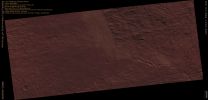
ESP_017888_1950_RED_abrowse.jpgOlympus' Lava Flows (Extremely Enhanced Natural Colors; credits for the additional process. and color.: Dr Paolo C. Fienga - Lunexit Team)54 visiteThe flanks of Olympus Mons are covered with Lava Flows (one on top of the other) Most of these Flows are relatively narrow, with a channel running down the middle. They appear similar to the Lava Flows found on Mt. Etna in Sicily (Italy).
However, in this image, we see these typical Flows partially covered by another, more recent one. This last one also shows a Central Channel, and it is about 10 times wider than the more typical Lava Flows. At the center of the HiRISE image the Channel disappears.
This is probably because the Channel was blocked here and Lava spilled out of it and covered a broad, fan-shaped, area. The eruption that produced this unusual flow was probably more vigorous and perhaps lasted longer than the more common ones.MareKromium
|
|

PSP_002630_1695_RED_abrowse.jpgMelas Chasma (Natural Colors; credits for the additional process. and color.: Dr Paolo C. Fienga - Lunexit Team)54 visiteThis observation shows an Outcrop of bright material in Melas Chasma, part of the giant Valles Marineris Trough (Canyon) System.
These Troughs contain many bright Deposits, often layered. The origin of these materials is still not known, but is the subject of much study because answering this question will provide important information regarding the Geologic History of Mars.
In this image, some layers are visible, but much of the surface has a strange scalloped texture.
The cause of this texture is unclear, but it is likely related to the mechanism of erosion of these Deposits as well as their physical nature. These materials are being eroded by winds, forming elongated ridges called Yardangs.
These winds may also be responsible for the small-scale scalloped texture.
Also, Landslides have produced some Talus Cones, composed of piles of loose debris; these are visible in places, mostly near the base of the Mound, as wedge-shaped features containing many Boulders.MareKromium
|
|

PSP_001816_1410_RED_abrowse-00.jpgGullies and arcuate Ridges in Terra Cimmeria (Natural Colors; credits for the additional process. and color.: Dr Paolo C. Fienga - Lunexit Team)54 visitenessun commentoMareKromium
|
|

ESP_018011_2565_RED_abrowse.jpgBetween Abalos and Olympia Undae... (Absolute Natural Colors; credits: Dr Paolo C. Fienga - Lunexit Team)54 visiteThis HiRISE image shows some large Sand Dunes near the North Pole of Mars. The picture was taken in summertime, with only small patches of ice remaining on the Surface: this show up as bright, somewhat blue, spots on slopes that provide some shading from the Sun.
Geologists would classify these Dunes as "sand-starved" because the ground between the Dunes has almost no sand; in addition, this ground shows a pattern of cracks that is typical of icy permafrost undergoing through seasonal expansion and contraction.
It is also possible that some Subsurface Ice exists inside the Dunes themselves; if so, the Dunes are not currently moving, and the ice is acting as a "stabilizer".
This idea is supported by the observation that there are small Landslide Gullies being cut into the Dunes, something not seen if the Dunes are rejuvenated as they move in the wind. However, to test this idea this area has been repeatedly imaged by multiple cameras on different spacecrafts.
With meticulous care it will be eventually possible to determine just how much the Dunes have moved or changed over the past years.MareKromium
|
|
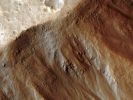
Kasei_Valles-PIA13265.jpgFeatures of Kasei Valles (EDM - Saturated Natural Colors; credits for the additional process. and color.: Dr Paolo C. Fienga - Lunexit Team)54 visiteThis observation from NASA's Mars Reconnaissance Orbiter (MRO) shows the very steep side of a Plateau, part of the Northern Limit of the Kasei Valles System, which is one of the largest Outflow Channel Systems on Mars. The difference in elevation here between the mostly flat Channel's Floor (bottom right) and the top of the Plateau (top left) is over 1300 meters (about 0,8 miles), comparable in height to the Grand Canyon Walls. The Kasei Valles System is much wider than the Grand Canyon, though, getting to be in places approx. 500 Km (such as about 300 miles) wide. (The Grand Canyon's maximum width is approx. 30 Km, or about 18 miles).
This EDM shows numerous paths with the appearance of dotted lines, criss-crossing the steep side of the Plateau. The carving agents can be found at the end of some of these paths: rocky blocks such as the ones in this subset, up to 2 meters (2,2 yards) across (4 meters or 4,4 yards across elsewhere in the image). Some of these blocks traveled downhill several hundred meters (yards) as they rolled and bounced leaving behind a trail of indentations or poke marks in the surface's fine-grained, light-toned soils. The raised borders in some of these poke marks indicate they are relatively recent features, unaffected by wind erosion, or that this soil has cohesive properties, such as if it was cemented.
The sound of these blocks falling did not travel very far, though. According to computer simulations sound in Mars travels only 1,5% (per-cent) the distance it would travel on Earth. (No Martian sound has ever been officially recorded) Hence, the same sound which would travel one Km (0,6 miles) on Earth, would travel only 15 meters (16 yards) on Mars. This is due to the lower Martian Atmospheric Pressure, which is approximately 1% of that of the Earth.MareKromium
|
|

PSP_002946_1765_RED_abrowse-01.jpgInterior Layered Deposits (ILD) in Juventae Chasma (EDM - Natural Colors; credits for the additonal process. and color.: Dr Paolo C. Fienga - Lunexit Team)54 visitenessun commentoMareKromium
|
|
| 2237 immagini su 187 pagina(e) |
|
|
|
|
|
|
|
|
|
186 |
|
|
|





