| Piú viste - Mars Reconnaissance Orbiter (MRO) |
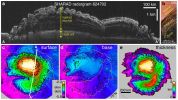
PIA12200.jpgRadar Mapping of Icy Layers Under Mars' North Pole54 visiteThis composite graphic illustrates the use of the Shallow Radar instrument on NASA's Mars Reconnaissance Orbiter for mapping underground ice-rich layers of the North Polar Layered Deposits existing on the North Pole of Mars.
The picture on top of the image-composite, is a radargram from the instrument, showing a cross-section of Mars' North Polar Cap, based on time lags of radio-wave echoes returning from different layers.
The penetrating radar reveals icy layered deposits overlying a basal unit in some areas.
The vertical dimension in the cross section is exaggerated one-hundred-fold compared with the horizontal dimension. The vertical scale bar is one kilometer (3281 feet).
The horizontal scale bar is 100 Km (62 miles).
The Shallow Radar instrument was provided by the Italian Space Agency. Its operations are led by the University of Rome and its data are analyzed by a joint U.S.-Italian science team. NASA's Jet Propulsion Laboratory, a division of the California Institute of Technology in Pasadena, manages the Mars Reconnaissance Orbiter for the NASA Science Mission Directorate, Washington. Lockheed Martin Space Systems, Denver, is the prime contractor for the project and built the spacecraft. The High Resolution Imaging Science Experiment is operated by the University of Arizona, Tucson, and the instrument was built by Ball Aerospace & Technologies Corp., Boulder, Colo.
MareKromium
|
|
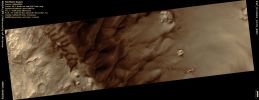
ESP_014426_2070_RED_abrowse.jpgNorthern Dunes (Natural Colors; credits: Lunexit)54 visitenessun commentoMareKromium
|
|
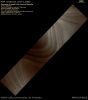
PSP_004650_0975_RED_abrowse.jpgExposure of South Polar Layered Deposits (Natural Colors; credits: Lunexit)54 visiteExtensive Layered Deposits are found in both Polar Regions of Mars and are thought to contain evidence of recent climate changes like ice ages on Earth.
Radar observations suggest that the NPLD - as well as the SPLD - are composed mostly of water ice, but many layered exposures, including this one, appear to be covered by a layer of dust that protects the underlying water ice from further erosion. The SPLD are more extensive than the NPLD, and have generally been less active recently.
The greater age of the SPLD is indicated by the higher density of craters on its Surface; as a matter of fact, a cluster of small craters is visible above center in this image. Also visible are widespread polygonal fractures, evidence of water ice expansion/contraction below the Surface.MareKromium
|
|

PSP_005609_1470_RED_abrowse-00.jpgInside Hale Crater (CTX Frame; Natural Color credits: Lunexit)54 visiteChannels associated with Impact Craters were once thought to be quite rare. Scientists proposed a variety of unusual circumstances to explain them, such as impacts by Comets or precipitation caused by the impact event. As more of Mars is photographed with High-Resolution imagery, more craters surrounded by Channel Systems are being discovered.
The Channels in this HiRISE image are from Hale Crater, an exceptionally well-preserved 125 x 150 Km (approx. 78 x 93 mile) Impact Crater located on the Northern Rim of the Argyre Basin.
Hale Crater is roughly 170 Km (a little more than 100 miles) to the South/East.MareKromium
|
|
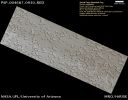
PSP_004687_0930_RED_abrowse.jpgSouth Polar Residual Cap Monitoring (Natural Colors; credits: Lunexit)54 visiteAs on Earth, the seasonal frost caps of Mars grow and recede each year. But seasonal frost on Mars is composed of Carbon Dioxide Ice (also known as Dry Ice), not water ice as on our Planet.
Near the South Pole of Mars, the seasonal CO2 frost never completely disappears, leaving a residual ice cap of CO2 ice throughout the Summer. This HiRISE image shows part of the South Polar Residual Cap, with many shallow Pits dubbed "Swiss Cheese Terrain". Because the Sun is always low in the sky at this latitude, the steep walls of the Pits receive more solar energy than the high-standing, flat areas between the Pits.
This causes the walls of the Pits to retreat several meters per year as Sunlight causes the CO2 ice to evaporate directly to gas, a process called "sublimation".
In some depressions, ridges or blocks of material a couple of meters (several feet) across are visible at the base of the depression walls, likely fallen from the walls during the sublimation and retreat process. At this rate, the layer of Carbon Dioxide ice could completely disappear in about 100 years from now, if not replenished.
Nota Lunexit: interessanti annotazioni. Peccato che la maggiore implicazione da esse derivante (quote: "...lo strato di CO2 che ricopre la Regione Sud Polare di Marte SCOMPARIRA' entro 100 anni da oggi, se non reintegrato...") non è stata minimamente toccata.
Stile NASA, of course. Nihil sub Sole novi, quindi...MareKromium
|
|

PSP_001942_2310_RED_abrowse-01.jpgSigns of Fluids and Ice in an Unnamed Crater in Acidalia Planitia (EDM - Absolute Natural Colors; credits for the additional process. and color.: Dr Paolo C. Fienga - Lunexit Team) 54 visiteThe South-looking (or Equator facing) walls of this Unnamed Crater are cut by numerous Gullies such as the ones shown here (500 x 600 mt or 550 x 650 yards), with well developed Alcoves, sinuous Channels and Terminal Fan Deposits.
These Gullies seem to originate at the same height, suggesting that the carving agent may have emanated from one single layer exposed in the Crater's Wall.
Contrastingly, no Gullies are observed in the North-looking (or Pole facing) wall of this Crater. Terrestrial Gullies very similar to the ones shown in this image are produced by surface water.
The arrows in this frame show fissures that may indicate detachment of surficial materials possibly held together by subsurface ice, sliding en masse down the crater's wall.MareKromium
|
|

PSP_002066_1425_RED_browse-01~0.jpgGullies and Ice-rich Material (EDM - Natural Colors; credits: Lunexit)54 visiteIn this EDM (approx. 500 mt across) we can notice that the crater floor is covered in boulders, dunes and textured material.
The boulders are likely a “sublimation lag” that provides evidence that material on the crater floor is, or once was, ice-rich. A sublimation lag forms when ice-rich material sublimates leaving the boulders and rocks behind. It is possible that the boulders on this crater floor represent such a process.
The pitted texture around boulders may also be an indicator of ice sublimation.MareKromium
|
|

PSP_001510_2195_RED_abrowse.jpgAlba Patera (Natural Colors; credits: Lunexit)54 visiteThis HiRISE image shows a small portion of the Rim of the Caldera at the top of the Volcano Alba Patera. This Volcano has shallower slopes than most of the other large Volcanoes on Mars. Unfortunately, this image is not able to help us understand what is unique about Alba Patera because of the thick Dust Cover that covers almost every surface detail but, instead, it shows that the Dust has been carved into streamlined shapes by the wind, cut by small Landslides.
Interestingly, there are some isolated patches that appear smooth and undisturbed by the wind.MareKromium
|
|
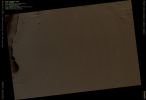
PSP_001408_1900_RED_abrowse.jpgFlows in Athabasca Valles (Natural Colors; credits: Lunexit)54 visiteThin Flows cover the Plains just North of the Source Region for the Athabasca Valles Channel System. The Flows are mostly confined by a Scarp (Cliff) that can be seen in the North-Western corner of the image.
The more heavily Cratered Terrain above the Scarp is part of a tectonic ridge known as a "Wrinkle Ridge". A few Flows can be seen atop the Wrinkle Ridge, but they are not as ubiquitous as those on the Plains below. The Flows on the Plains frequently intersect, with younger ones cutting across older ones.
The prominent dark swathes along their edges have particularly rough textures.
The darker shade is due to thousands of shadows cast by small bumps on the Surface, which HiRISE is able to resolve.
Dozens of bright, narrow Rifts (Cracks) zigzag across the Flows. They appear bright because they are filled with light-toned, windblown material. Wind-sculpted Knobs and Ridges of similar light-toned material are scattered throughout the imaged area.
The orientations of the Ridges indicate that the Winds primarily blow from the South-East. Several impact craters are captured in this image, the largest being about 50 meters (160 feet) in diameter. Many bear the distinctive bright rays characteristic of secondary craters associated with the larger impact crater, Zunil.
Some craters penetrated the surface of the Flows, and the boulders strewn around them suggest that the material they excavated was rocky.MareKromium
|
|

PSP_001414_2165_RED_abrowse.jpgThe Dichotomy Boundary (Natural Colors; credits: Lunexit)54 visiteThis observation crosses over a part of the so-called "Dichotomy Boundary" of Mars, which is a Region of the Red Planet that separates the low-lying Northern Plains from the older Southern Highlands.
In the northern part of the scene (Dx), much of the surface is covered with small boulders, most only 1 to 2 meters wide (1 meter is approx. 1 yard). In other areas, it appears that sand or dust has accumulated in depressions, forming light patches. These areas also show short sinuous or linear features, likely ripples formed from wind-blown material.
The southern part (Sx) contains an old valley, now mantled by later deposits, and has a pitted texture due to erosion.
It has been proposed that the Lowlands were once filled by an ocean. If that is the case, then several arcuate or linear features along the Boundary slope could be old shorelines - but this interpretation is still debated. The features have been modified by erosion, and in some cases appear to slope towards the Highlands.MareKromium
|
|
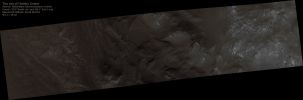
PSP_003710_1530_RED_browse~0.jpgHolden Crater's Rim (Natural Colors; credits: Lunexit)54 visiteThe formation of the approximately 150 Km diameter Holden Crater interrupted the Northward flowing Uzboi Vallis Channel System. Relief associated with the Rim of Holden effectively blocked the Channel.
HiRISE image PSP_003710_1530 covers the portion of Holden Crater's Rim where it was overtopped by water that had backed up in Uzboi Vallis to the South. Water flowing over the Rim in multiple locations eventually focused on a single Channel that then cut deeply into the Rim.
After the impounded water drained into the Crater, the steep Wall on the East side of the main Channel collapsed in a Landslide that remains visible along the Floor.
Several Outcroppings of variably bright material are visible in the scar produced by the Slide. MareKromium
|
|

PSP_001666_1530_RED.jpgHolden Crater (Natural Colors; credits: Lunexit)54 visitenessun commentoMareKromium
|
|
| 2237 immagini su 187 pagina(e) |
 |
|
|
|
|
|
|
|
185 | |
|





