| Piú viste - Mars Reconnaissance Orbiter (MRO) |
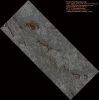
PSP_005095_0935_RED_browse~0.jpgSouth Pole Residual Cap (Swiss-Cheese Terrain Monitoring) - (Natural Colors; credits: Lunar Explorer Italia)54 visitenessun commentoMareKromium
|
|

PSP_003492_1405_RED_abrowse~0.jpgUnnamed Southern Mid-Latitude Crater with "unusually bright" Gullies (MULTISPECTRUM; credits: Lunexit)54 visiteThis image shows a Southern Mid-Latitude (unnamed) crater: it has bright landslides on its South-East and West walls, some of which have noticeable boulder tracks where boulders rolled down the slopes.
The most noticeable features of this crater are the gullies on the North wall. A couple of small gullies appear to emanate from an overhang.
The others originate at or near layers up-slope.
The layers are sturdy and resistant from erosion: the layers that appear to be decaying into resolvable boulders, instead of particles easily moved by the wind, are evidence of this.MareKromium
|
|

PSP_003538_1885_RED_browse.jpgAres Vallis' Cataract (Natural Colors; credits: Lunar Explorer Italia)54 visiteThis image shows a dry cataract within Ares Vallis. A cataract is a large waterfall where there is a high, steep drop. The presence of this large cataract in Ares Vallis confirms that this channel was carved by water, probably in one or many large catastrophic flooding events.
This feature has many of the same characteristics as the cataracts on Earth associated with the flood that carved the Channelled Scablands in Washington State, including horseshoe-shaped headcuts and longitudinal grooves. These grooves in the lower portion of the image lead up to the cataract, with the water flowing from the south to the north in this image. It then flowed down the cataract into the smaller incised channel.
The horseshoe-shaped headcut here is only part of a larger cataract system, and probably formed during the last stage of flooding. The inner channels are now filled with dunes formed by wind blowing along the channel floor.MareKromium
|
|

PSP_010429_1660_RED_abrowse.jpgUnnamed Southern Crater (Natural Colors; credits: Lunar Explorer Italia)54 visiteMars Local Time: 15:48 (middle afternoon)
Coord. (centered): 13,8° South Lat. and 113,5° East Long.
Spacecraft altitude: 276,4 Km (such as about 172,7 miles)
Original image scale range: 27,6 cm/pixel (with 1 x 1 binning) so objects ~ 83 cm across are resolved
Map projected scale: 25 cm/pixel
Map projection: EQUIRECTANGULAR
Emission Angle: 20,7°
Phase Angle: 46,6°
Solar Incidence Angle: 63° (meaning that the Sun is about 27° above the Local Horizon)
Solar Longitude: 143,0° (Northern Summer)
Credits: NASA/JPL/University of Arizona
Additional process. and coloring: Lunar Explorer ItaliaMareKromium
|
|
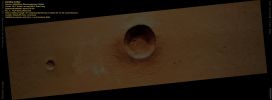
PSP_003608_1510_RED_abrowse-00.jpgThe VERY Deep Zumba Crater (Natural Colors; credits: Lunar Explorer Italia)54 visiteThis image taken at a high Sun Angle (a.k.a. "Phase Angle") shows the relatively unshadowed pristine and youthful rayed crater Zumba.
The crater’s rim-to-rim diameter is approx. 3 Km (about 1,85 miles) with a depth of about 620 mt (approx. 0,4 miles), and its rim rises about 200 mt (656 feet) above the surrounding lava-filled plains of Daedalia Planum, just South-West of the great Tharsis Volcanoes. Zumba is approximately 25% deeper than the average Martian Crater of this size – just one of several attributes that suggests it is a very fresh crater.
One estimate of Zumba’s age, generally accomplished by counting smaller superimposed craters on Zumba itself, suggests it may be 5 MY old. Even if such an estimate is off by 2-4 times, this is still a young geologic feature by Mars standards. Because Zumba is so young and so fresh, it is a perfect example of a simple crater. On Mars, a simple crater is generally less than 6-9 Km (about 3,7-5,6 miles) in diameter with a “simple” conical-bowl shape, minimal wall collapse and lacking a well-developed central feature (exx.: a peak, large pit, or ring).
By impacting into such hard durable rocks, the impact that created Zumba scattered greater than 10 million ejecta blocks at high speeds resulting in far-reaching ray segments and an impressive field of secondary impact craters. This pattern is hard to see in visible-light images, but “lights-up” spectacularly in nighttime thermal InfraRed images taken by THEMIS onboard the Mars Odyssey 2001 Orbiter. Scientists believe that some of these high-speed rocks may have even been expelled from Mars and even traveled to Earth.
Zumba is of considerable interest to scientists, whether it’s a source of Martian meteorites or not, as it possesses interesting features that are typically buried or eroded away in other older Martian Craters, and even within the freshest terrestrial craters (including Meteor crater in Arizona). These preserved and newly recognized features observed at the scale of HiRISE may reveal aspects of the impact process unknown to scientists from previous studies of craters on the terrestrial planets.
What is particularly intriguing is the presence of a pitted deposit giving Zumba the appearance that it has a relatively flat floor despite the pits. These crater-fill deposits are typically composed of lightly to highly damaged rock fragments and impact melts formed from the high temperatures achieved from the energy released by the impact event (on the order several to tens of megatons). The pits in the crater-fill deposits have not been recognized within lunar or terrestrial craters and appear to be unique to crater-fill deposits in only the freshest and best-preserved Martian Craters.
These pits may represent the result of the interactions of the very hot crater-fill deposits with water and water-ice that may have been present in the subsurface prior to impact. It is not well understood whether these pits form explosively (similar to terrestrial volcanic pits/craters formed from the interaction of hot lava with wet sediments/deposits), or by collapse from the drainage of impact melts or volatiles. The presence of pitted deposits in only the freshest and well-preserved craters suggests that they are likely related to the impact process.MareKromium
|
|
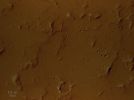
PSP_003608_1510_RED_abrowse-01.jpgProximities of Zumba Crater: Secondary Craters Field (Natural - but enhanced - Colors; credits: Lunar Explorer Italia)54 visitenessun commentoMareKromium
|
|

ESP_011898_1535_RED_abrowse.jpgPossible MSL Landing Site in Holden Crater (Natural Colors; credits: Lunar Explorer Italia)54 visitenessun commentoMareKromium
|
|
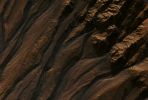
PSP_003583_1425_RED_browse-02.jpgGullies near Gorgonum Chaos (edm - Natural Colors; credits: Dr M. Faccin)54 visitePSP_003583_1425 shows incredible details of an Unnamed Crater with Gullies that provides strong evidence for gully formation involving fluid flow.
Of note is the variety of gully morphologies along the crater walls. The North and West Walls have Gullies, while the South Wall has only Landslides.
"Mass Wasting" is the more general term geologists use to describe Landslides, slumps, and other movements of the ground in response to gravity. It usually occurs on steep slopes when the force of gravity causes weak or loose material to travel downslope. Mass Wasting produces structures that are sometimes similar to gully channels, but which can usually be distinguished by their occurrence on steep slopes.
The Gullies on the North Wall have eroded all the way to the Crater Rim. They appear older than other nearby Gullies because they have existed long enough to be modified by permafrost processes as evidenced by the polgyonal fractures found on some of the channel and inter-gully walls.
Another noticeable difference among the gullies is channel lengths. The Gullies on the North Wall and the group just to the left of these have much shorter channels than the Gullies on the North-Western Wall. It is possible that the Gullies with shorter channels had less fluid flow through their systems. The Gullies appear to originate around a sequence of rocky layers near the Crater Rim.
Many of the gully channels appear to have boulders littered throughout. This is suggestive of a fluid flowing in these channels; a fluid would preferentially transport smaller particles and leave behind the larger ones, such as the boulders seen here.
There are many overprinted small channels in each gully, as can be seen in this edm. These are indicative of multiple flow events such that some channels experience flow, then are abandoned.
The edm also shows several channels merging.
Particularly interesting is the channel flowing from the top of the scene. There are several intertwining channels that merge into one just to the right of the center of the subimage. However, the way some channels truncate others suggests that there were at least three episodes of flow through this area. (written by Kerry Kolb)MareKromium
|
|

PSP_001367_1620_RED_abrowse.jpgGratteri Crater (Natural Colors; credits: Lunexit)54 visitenessun commentoMareKromium
|
|

PSP_001578_1425_RED_abrowse.jpgSouthern Crater with Gullies and a small Landslide (Natural Colors; credits: Lunexit)54 visitenessun commentoMareKromium
|
|

PSP_001348_1770_RED_abrowse-02.jpgUnusual Crater in Meridiani Planum (SuperEDM-JP2 - Natural Colors; credits: Dr M. Faccin & Lunar Explorer Italia)54 visitenessun commentoMareKromium
|
|

PSP_001348_1770_RED_abrowse-01.jpgUnusual Crater in Meridiani Planum (EDM-JP2; credits: Dr M. Faccin)54 visitenessun commentoMareKromium
|
|
| 2237 immagini su 187 pagina(e) |
 |
|
|
|
|
|
|
184 | |
|
|





