| Piú viste - Mars Reconnaissance Orbiter (MRO) |
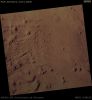
PSP_009304_2015_RED.jpgRidges in Olympus Mons Aureole (possible True Colors; credits: Lunar Explorer Italia)54 visiteMars Local Time: 15:21 (early afternoon)
Coord. (centered): 21,4° North Lat. and 221,3° East Long.
Spacecraft altitude: 283,8 Km (such as about 177,4 miles)
Original image scale range: 28,4 cm/pixel (with 1 x 1 binning) so objects ~85 cm across are resolved
Map projected scale: 25 cm/pixel
Map projection: EQUIRECTANGULAR
Emission Angle: 0,2°
Phase Angle: 46,1°
Solar Incidence Angle: 46° (meaning that the Sun is about 44° above the Local Horizon)
Solar Longitude: 101,7° (Northern Summer)
Credits: NASA/JPL/University of Arizona
Additional process. and coloring: Lunar Explorer ItaliaMareKromium
|
|

PSP_005392_0995_RED_abrowse-01~0.jpgImpact Crater on the South Polar Layered Deposits (EDM n.1; MULTISPECTRUM - credits: Lunexit)54 visiteA problem with using craters to determine age on the icy SPLD is that erosion of the icy substrate and relaxation of crater topography (i. e., relief becoming more gentle) is probably more rapid on ice than on harder rocky surfaces.
A detailed study of craters in ice will help better to understand this process of how craters in ice degrade, or deteriorate, with time.
Perhaps then we will know how to use the number and distribution of craters over the icy polar layered deposits in constraining the geologic and climate history of the Mars Polar Regions.MareKromium
|
|

PSP_005334_2170_RED_abrowse-00~0.jpgCollapse Pits near Alba Patera (MULTISPECTRUM; elab. Lunexit)54 visiteThis observation shows pits in Acheron Catena, a chain of circular depressions located South-East of Alba Patera, the widest and flattest volcano on Mars.
The layers seen around the pit rims are likely lava flows from Alba Patera or the nearby Tharsis Mons.
The pits probably formed by collapse into empty space beneath the surface as opposed to being formed by an impactor from space. Some of the pits have large piles of material in their centers. These piles are evidence of collapse of the walls, which may have occurred after the main collapse event that formed each pit. The second pit from the right has an indistinct north rim; it appears that there were at least two collapse events here.
A couple of the pits have oval shaped craters on their walls.
The craters were almost certainly circular when they formed, but time and gravity have allowed the deformation of their shape by mass wasting.MareKromium
|
|
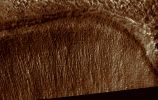
PSP_002545_1430_RED_browse-01~0.jpgJuncture of Two Branches of Dao Vallis (edm - possible True Colors; credits: Lunar Explorer Italia)54 visiteHiRISE images, such as this one (here, approximately 680 mt across), show that the mantled unit is textured and full of boulders, which contrasts with the smooth appearance of this material in MOC images.MareKromium
|
|
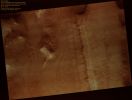
PSP_002545_1430_RED_browse-00~0.jpgJuncture of Two Branches of Dao Vallis (ctx frame - possible True Colors; credits: Lunar Explorer Italia)54 visiteMartian outflow channels are believed to be some of the largest features formed from the catastrophic flooding that scoured the landscape during ancient times. The source of the water likely originated in the subsurface and was somehow disturbed, depressurizing an aquifer, causing a sudden burst of water onto the surface.
This image shows multiple branches of the outflow channel Dao Vallis, which flows towards the West (down), ending near Hellas Basin. Although it is not clear exactly where the water that created these floods ended up, it is possible that Dao Vallis and its neighboring outflow channel, Niger Vallis, deposited water in Hellas Basin and formed a short-lived lake. Within the floor of Dao Vallis is material that appears striped, known as "lineated valley fill".
Valley fill material is thought to be ice-rich material that has flowed or been deposited onto the floor. Several lineations or "flow lines" appear to merge towards the upper left of the scene which supports this idea that the fill materials flowed, similar to slow-moving glacial material on Earth.
Also present in this scene is a mantling deposit which drapes much of the mid-latitudes of Mars. The deposit or "mantle" can be seen on south-facing slopes of positive-relief features, appearing as if its sliding off the walls. The mantle material is thought to be ice-cemented dust that was deposited during times when snowfall occurred on Mars.MareKromium
|
|

PSP_004071_1425_RED_browse-01.jpgMesas in Gorgonum Chaos (edm - possible True Colors; credits: Lunar Explorer Italia)54 visitePSP_004071_1425 shows mesas that are part of Gorgonum Chaos, a region of chaotic terrain, which is a jumble of mounds and mesas grouped together.
Chaotic terrain is most commonly found in Mars near the sources of the gigantic outflow channels. Gorgonum Chaos is one of the few exceptions.
Some of the troughs between the mesas appear to have V-shaped bottoms; there is no obvious flat floor in between. Others have dunes running down their centers probably indicating flat floors. It is possible that the mesas were once connected and that something caused fractures in the original mesa's surface that were then preferentially eroded.MareKromium
|
|
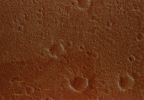
PSP_001521_2025_RED_abrowse-01.jpgThe Viking Lander 1 Landing Site - Thomas Mutch Memorial Station (edm - Natural Colors; credits: Lunar Explorer Italia)54 visiteM.L.T.: 15:20 (early afternoon)
Latitude (centered): 22,3° North and Longitude 312,1° East
Range to target site: 303,3 Km (approx. 189,5 miles)
Original image scale range: 30,3 cm/pixel (with 1 x 1 binning) so objects ~91 cm across are resolved
Map projected scale: 25 cm/pixel and North is up
Map projection: EQUIRECTANGULAR
Emission angle: 21,2°
Phase angle: 68,5°
Solar Incidence Angle: 48°, with the Sun about 42° above the Local Horizon
Solar Longitude: 139,4° (Northern Summer)MareKromium
|
|

PSP_001513_1655_RED_abrowse-00.jpgThe MER Spirit Landing Site (ctx frame - Natural Colors; credits: Lunar Explorer Italia)54 visiteThis HiRISE image shows the Landing Site of the Mars Exploration Rover Spirit. The impact crater in the upper left-hand portion of the image is "Bonneville Crater", which was investigated by Spirit shortly after landing. In the lower right-hand portion of the image is "Husband Hill", a large hill that Spirit climbed and where it spent much of its now nearly five-year mission.
M.L.T.: 15:29 (early afternoon)
Latitude (centered): 14,6° South and Longitude 175,5° East
Range to target site: 270,7 Km (approx. 169,2 miles)
Original image scale range: 27,1 cm/pixel (with 1 x 1 binning) so objects ~81 cm across are resolved
Map projected scale: 25 cm/pixel and North is up
Map projection: EQUIRECTANGULAR
Emission angle: 15,8°
Phase angle: 73,6°
Solar Incidence Angle: 60°, with the Sun about 30° above the Local Horizon
Solar Longitude: 139,1° (Northern Summer)MareKromium
|
|

PSP_001513_1655_RED_abrowse-01.jpgThe MER Spirit Landing Site (edm - Natural Colors; credits: Lunar Explorer Italia)54 visiteThe bright irregularly-shaped feature in area "A" of the image is Spirit's parachute, now lying on the Martian surface. Near the parachute is the cone-shaped "backshell" that helped protect Spirit's lander during its seven-month journey to Mars. The backshell appears relatively undamaged by its impact with the martian surface. Wrinkles and folds in the parachute fabric are clearly visible.
Area "B" of the image shows Spirit's lander. The crater in the upper left-hand portion of the image, just to the northwest of the lander, is the one that the Mars Exploration Rover team named "Sleepy Hollow".
Area "C" shows the damaged remnant of the heat shield that protected the vehicle during the high-speed entry through the Martian atmosphere. The heat shield impacted the surface after being separated from the vehicle during the final stages of the descent.
Area "D" of the image shows the current location of Spirit. Toward the top of the image is "Home Plate", a plateau of layered rocks that Spirit explored during the early part of its third year on Mars. Spirit itself is clearly seen just to the southeast of Home Plate. Also visible are the tracks made by the rover before it arrived at its current location.MareKromium
|
|

PSP_005571_0950_RED_abrowse-00~0.jpgSouth Polar Residual Cap Margin (context frame; MULTISPECTRUM - elab. Lunexit)54 visiteThis scene is about 2,7 Km (approx. 1,7 miles) long and shows part of the edge of the South Polar Residual Cap (...).
The relatively bright, grayish areas are the Residual Cap, and the darker, reddish areas are mostly likely covered by dust. The South Polar Residual Cap is made, for the most part, of Carbon Dioxide ice (commonly called "dry ice") and dust, with a little water ice in some places.MareKromium
|
|

PSP_005392_0995_RED_abrowse-00~0.jpgImpact Crater on the South Polar Layered Deposits (context frame; MULTISPECTRUM - credits: Lunexit)54 visiteThis image covers a portion of the ice-rich SPLD.
Layers in the Mars Polar Regions are of great interest because layers in ice on the Earth, as in the Antarctic and Greenland ice caps, are known to contain records of past atmospheric, environmental, and climate conditions. By studying Mars Polar Layers, we hope to be able to understand the past climate and history of water on the Red Planet.MareKromium
|
|

PSP_005424_1700_RED_abrowse~0.jpgAurorae Chaos (MULTISPECTRUM; credits: Lunexit)54 visiteThis observation shows a portion of Aurorae Chaos, chaotic terrain East of the Vallis Marineris Canyon System. Aurorae Chaos extends from Capri and Eos Chasmata on the West, into Hydraotes and Aureum Chaos on the North and East.
Chaotic terrain is thought to form from subsurface collapse following volatile release. It is possible that the Martian crust was at one time enriched in ices that became gases or liquid at relatively low temperatures upon encountering a heat source or was violently shaken. These ices existed in spaces between soil particles. If a large volume of volatiles is suddenly released, then there is a large portion of the soil volume missing. The soil cannot support itself, so it collapses.
Since chaotic terrain is often located at the head of the Martian outflow channels (giant flood plains), it is also possible that the Chaotic Regions are the source of the fluids that formed the outflow channels.
Aurorae Chaos connects to outflow channels via other Chaotic Regions.MareKromium
|
|
| 2237 immagini su 187 pagina(e) |
 |
|
|
|
|
|
183 | |
|
|
|





