| Piú viste - Mars Reconnaissance Orbiter (MRO) |

PSP_006538_1035_RED_abrowse-01.jpgSouthern Dunes and Spiders (extra-detail mgnf - MULTISPECTRUM; credits: Lunexit)54 visitenessun commentoMareKromium
|
|

PSP_006528_1120_RED_abrowse-02.jpgSources of Basaltic Sand (extra-detail mgnf n. 2; MULTISPECTRUM - credits: Lunexit)54 visiteThis rocky layer may originally have been a lava flow; Martian lava flows are predominantly composed of basalt, which would account for the dark color of the sand.
The polygonal pattern of the bright upper layer may be due to repeated freezing and thawing of the soil that buries the lava flow. The tracks of Dust-Devils are clearly visible on the smooth, sandy surface but largely vanish when they cross into the polygonally fractured terrain.MareKromium
|
|
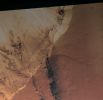
PSP_003545_2025_RED_abrowse-PCF-LXTT-01.jpgIntersection between Hyblaeus and Elysium Chasmata (EDM n.1 - Saturated Natural Colors; credits for the additional process. and color.: Dr Paolo C. Fienga - Lunexit Team)54 visiteA cross-section of Hyblaeus Chasma is visible in this first extra-detail mgnf).
The chasm seems to be filled with a resistant light-toned layer, about 200 mt thick (likely consisting of cemented windblown sand and dust) forming a mantling unit and overlying more resistant boulder-rich layers. The sand and dust was likely blown into Hyblaeus Chasma after it was formed by tectonic processes, possibly in combination with fluvial processes.
The chasmata were subsequently broadened by hillslope erosion: boulders are strewn along the top of this dusty mantling unit. Slumping, possibly caused by faulting, along the Southern Wall of Hyblaeus is visible at the intersection with Elysium Chasma.
This image also shows a number of dark streaks along the walls of Elysium Chasma, further to the south.MareKromium
|
|
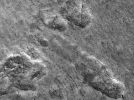
PSP_006690_2280_RED_abrowse-02.jpgFeatures of Acidalia Planitia (extra-detail mgnf)54 visiteThis HiRISE extra-detail mgnf (358 x 266 mt or 392 x 291 yards) shows incipient scalloped terrain in the Southern Slopes of the Crater.
Scalloped terrain — depressions with scalloped edges and polygonal fractures — has been interpreted as a sign of surface caving, perhaps due to sublimation (evaporation) of underlying ice.MareKromium
|
|

PSP_006891_1970_RED_abrowse-01.jpgAt the base of the Olympus... (EDM - Saturated Natural Colors; credits for the additional process. and color.: Dr Paolo C. Fienga - Lunexit Team)54 visiteThe bottom right part of the cutout has a much flatter and smoother surface. These are younger lava flows that have buried the lower part of the volcano. When lava flows form vast smooth sheets, they are called "flood" lavas.
In the bottom of the cutout, the flood lavas have odd, wiggly looking plateaus. These are parts of the lava crust that were lifted up when more liquid lava was injected into the middle of the slowly solidifying lava flow.
This process is called "inflation" and is seen on many lava flows on Earth. These younger lava flows are cut by two different sets of faults. One makes the branching valley in the flood lavas and the other creates the sinuous ridge and valley along the edge of the Olympus Mons lava flows.
Lower resolution images that cover a broader area suggest that the sinuous fault is an old buried structure that has been more recently reactivated.MareKromium
|
|
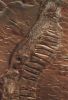
PSP_007219_1720_RED_abrowse-01.jpgFinely-Layered Rocks in Ius Chasma (extra-detail mgnf - MULTISPECTRUM; credits: Lunexit)54 visiteMuch of this Region has been covered by dust and sand, which appears brownish-red. This material is eroded by wind over time and allows us to see the light-toned rock underneath the surface.
There are also dunes that obscure portions of the outcrop.
Many outcrops within Ius Chasma and elsewhere on Mars are covered by such dunes and dust, but the high spatial resolution of instruments such as HiRISE and CRISM allow us to see the Geology and Mineralogy of regions between these dunes to help unravel the Geologic History of Mars.MareKromium
|
|
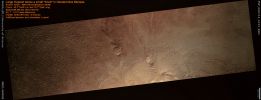
PSP_006714_2255_RED_abrowse.jpgLandslide Deposit below a small Knob in Deuteronilus Mensae (MULTISPECTRUM; credits: Lunexit)54 visiteThis image shows a possible Landslide Deposit originating from a mesa just East of the center of the scene in Deuteronilus Mensae.
The deposit is the lobe-shaped feature extending across the center of the image. Located at approx. 45° North, where ground ice is thought to be stable, it is possible that the deposit formed from "Mass Wasting" of ice-rich material.
Mass Wasting is a process driven by gravity that moves material downslope; the ice enhances the process.
The lobe has distinct textures. It is bouldery at some locations and pitted or wrinkled at others. The pitted texture may be due to desiccation (drying) of soil that can occur when ice from beneath the surface sublimates and leaves empty spaces into which the surface collapses.MareKromium
|
|

PSP_006284_1145_RED_abrowse-01.jpgOn the edge of the Dunefield... (MULTISPECTRUM; credits: Lunexit)54 visitenessun commentoMareKromium
|
|
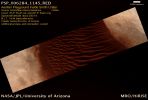
PSP_006284_1145_RED_abrowse-00.jpgLarge Dunefield inside Smith Crater (MULTISPECTRUM; credits: Lunexit)54 visiteThis image shows a Dark Dunefield in Smith Crater. The dark color of the dunes indicates that they are probably made of basaltic sand, a dark volcanic rock that is common on Mars. This is in contrast to dunes on Earth, which are dominated by quartz, a rare mineral on Mars.
The dunes here are “transverse dunes” that, based on analogy with similar features on Earth, form by winds that blow in a direction perpendicular to the crests. However, Secondary ripples on top of the dunes are oriented at right angles; that indicates a second wind regime that has redistributed the sand after the original dunes formed. The multiple orientations of the dunes may be partly caused by their location within the crater, whose own topography can act to redistribute regional wind patterns.
The dark streaks on the lighter terrain outside of the Dunefield are interpreted as DD tracks, where mini-tornadoes reveal darker ground beneath the bright dust of the surface.
Some long DD Tracks are visible in the southern part of the dune field and climb onto the troughs of the transverse dunes. There are also a few faded tracks at the northern part of the dune field.MareKromium
|
|
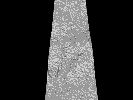
SHARAD-1.gifUnder the Ice... (1)54 visiteRadar Sounder Instruments orbiting Mars have looked beneath the Martian Surface and opened up the Third Dimension for Planetary Exploration.
The technique's success is prompting scientists to think of all the other places in the Solar System where they would like to use Radar Sounders.
The first Radar Sounder at Mars was the Mars Advanced Radar for Subsurface and Ionospheric Sounding (MARSIS) on the European Space Agency's Mars Express Orbiter. It has been joined by the complementary Shallow Subsurface Radar (SHARAD), operating at a different wavelength aboard NASA's Mars Reconnaissance Orbiter.
The data in this animation are from SHARAD.MareKromium
|
|
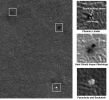
PSP_008585_2915_.jpgPhoenix Lander "Hardware" (Night-Time Frame)54 visiteCaption NASA:"MRO's HiRISE camera acquired this image of the Phoenix Landing Site 11 hours after landing. The image shows 3 unusual features, which were not present in the earlier, pre-landing HiRISE image.
We expect to find three main pieces of hardware: the Parachute attached to the Back-Shell, the Heat-Shield, and the Lander itself. The Parachute (lower right) is easy to identify because it is especially bright, although this image doesn't clearly reveal the Back-Shell.
The double dark marking at upper right seems most consistent with disturbance of the ground from impact and bouncing of the Heat-Shield, which fell from a height of about 13 Km.
The last object (upper left) appears to be a about the right size and height for the Lander and with dark objects on each side (to the East and West) consistent with the solar arrays.
This image was acquired in the nighttime, when the Arctic Sun was only 12° above the horizon to the North-East. Later images will be acquired in the daytime with the Sun higher in the sky and to the South-West, and could confirm our initial interpretations. North is about 7° to the left of straight up in this image.
These objects were later confirmed on the subsequent HiRISE observation acquired 22 hours after landing".MareKromium
|
|

PSP_008591_2485_cut_b.jpgPhoenix! (Natural Colors; credits: NASA/JPL/University of Arizona)54 visitenessun commentoMareKromium
|
|
| 2237 immagini su 187 pagina(e) |
 |
|
|
|
|
181 | |
|
|
|
|





