| Piú viste - Mars Reconnaissance Orbiter (MRO) |
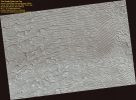
PSP_004820_0940_RED_browse.jpgFingerprint Terrain with Sawtooth Patterns in the South Polar Ice Cap (Natural Colors; credits for the additional process. and color.: Dr Paolo C. Fienga - Lunexit Team)54 visiteThis image shows a portion of the South Polar Ice Cap. The ice you see here is frozen CO2 rather than the frozen water you are used to here on Earth.
Even on Mars, where the temperatures are much lower than on Earth, CO2 ice is a volatile substance. As it is so unstable, large amounts can sublimate very quickly when heated. In this ice cap we can see icy features shrink in size by several meters per year as the ice that makes them up is removed by solar heating. Usually these icy features are almost circular as you get equal amounts of Sunlight from every direction when you are at the Pole.
However, in this location something strange has happened. Instead of the usual circular features we see features that are decidedly linear in shape. These sets of linear features have been dubbed "fingerprint terrain" by Planetary Scientists. They are seen in several locations in this ice cap and usually have a wavelength close to 90 mt (295 feet). It's hard to understand why linear features would form in this sort of environment by sublimation of ice alone.
It is possible that these features are formed instead by atmospheric processes. Either the features are sand dunes covered by a thin covering of frost or they might be made up of loose ice crystals that saltate like sand grains and have collected into ripples.
It would be a huge surprise to find sand dunes in this location, just as you wouldn't expect to see sand dunes on top of the Greenland ice sheet on Earth. To confirm that they are made of CO2 ice, HiRISE will image this location again at the end of the year and compare it to this image to look for changes.
Icy features should show large changes, but sand dunes move much more slowly. MareKromium
|
|

PSP_004989_0945_RED_browse.jpgSwiss Cheese Terrain in the South Polar Region54 visiteSince Mars is colder than Earth, there is not just water ice at the Poles, but also a concentration of Carbon Dioxide (CO2) ice. Some of the Carbon Dioxide ice at the South Pole is there all year long and called the "Residual Cap".
This image was taken near the South Pole of Mars and shows a characteristic "Swiss cheese" pattern.
This pattern is created when there is relatively high, smooth material that is broken up into these circular-shaped depressions forming the "Swiss cheese" terrain.
The depressions are thought to be caused by sublimation, which is when a material goes directly from a solid to a gas phase.
Repeated images are taken of areas like this so the changes in depression size and where they form can be monitored through the seasons.MareKromium
|
|
PSP_004847_1745_RED_browse-00.jpgThe "Martian Black Hole"...Again! (context frame)54 visiteVi invitiamo a leggere l'ultimo articolo sull'argomento (pubblicato su TruePlanets) dal titolo "Velvet Underground".MareKromium
|
|

PSP_003948_0935_RED_browse.jpgSouth Pole Residual Cap (Swiss-Cheese Terrain Monitoring)54 visiteLike Earth, Mars has concentrations of water ice at both Poles. Because Mars is so much colder however, Carbon Dioxide (CO2) ice is deposited at high latitudes in the Winter and is removed in the Spring, analogous to winter-time water ice/snow on Earth.
Around the South Pole there are areas of this CO2 ice that do not disappear every Spring, but rather survive Winter after Winter; this persistent CO2 ice is called the "South Pole Residual Cap".
The retention of CO2 ice throughout the year by the Southern Polar Cap is one characteristic that distinguishes it significantly from Mars' North Polar Cap.
As can be seen in this HiRISE image of the south pole residual cap, relatively high-standing smooth material is broken up by circular, oval, and blob-shaped depressions. This patterned terrain is called "swiss cheese" terrain. The high-standing areas are carbon dioxide ice with thicknesses of several to approximately 10 meters. The depressions are thought to be caused by the removal of this carbon dioxide ice by sublimation (the change of a material from solid directly to gas). As most depressions seem to have relatively flat floors, there is likely some layer below, possibly made of water ice, that cannot be as easily removed by sublimation. Complicated shapes arise when neighboring growing depressions intersect.
A previous Mars imaging system, the Mars Orbiter Camera (MOC), took images of the same places on the south pole residual cap every year for many years, and showed that there are annual changes taking place within it. By looking at different sizes and shapes of depressions in an image such as this, and by comparing images of the same place from year to year, the development of "swiss cheese" terrain can be described. The sublimation process may begin as a small, shallow depression in a smooth surface. This depression then deepens until reaching the resistant layer below, and continues to expand laterally in all directions, creating the generally round depressions we see today. Different heights and thicknesses of smooth areas, and different depths of depressions, may indicate that multiple episodes of accumulation and sublimation have occurred.
This is one of the locations previously monitored at lower resolution by MOC. With the high resolution and repeat-imaging capability of HiRISE, we intend to continue monitoring and better measure the amount of expansion of the depressions over one or more Mars years. This is one of the locations specifically targeted by HiRISE for this purpose.
Knowing the amount and rate of carbon dioxide removal can give us a better idea of the role of carbon dioxide (the main component of the Martian atmosphere) in polar and atmospheric processes, of current environmental and climatic conditions, and of how Mars climate may be changing.
In HiRISE images such as this one, it is evident on the slopes of the large, especially high mesa just above the center of the image that the carbon dioxide-rich material may be constructed of several individual horizontal layers. However, it also appears that as erosion eats into the mesa, pieces of a stronger mesa surface layer break off and are left strewn on the mesa slopes, where they may give the appearance of layering.
An interesting feature in this HiRISE image is the crisscrossing network of faint ridges and troughs on the upper smooth terrain. These may also be complexly involved in the sublimation and deposition of carbon dioxide ice. MareKromium
|
|
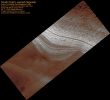
PSP_004742_0990_RED_browse.jpgGeologic History Recorded in the South Polar Layered Deposits (Extremely Enhanced Natural Colors; credits for the additional process. and color.: Dr Paolo C. Fienga - Lunexit Team)54 visiteThe Polar Layered Deposits on Mars are thought to be composed of varying amounts of water ice and dust. The variations in the relative amounts of ice and dust are probably caused by recent climate changes on Mars, similar to ice ages on Earth.
This image of the South Polar Layered Deposits shows many layers, some of which are cut off or truncated against other layers (near the center of the image). These truncations are probably due to periods of erosion separating periods of deposition.
After nearly horizontal layers are deposited, they can be partly eroded (perhaps by winds) before more layers are deposited over them. In this image, there is evidence for at least two such episodes of erosion and burial. These types of observations are useful to Mars scientists as they try to unravel the climate history of Mars. MareKromium
|
|
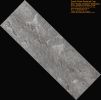
PSP_004739_0935_RED_browse.jpgSouth Pole Residual Cap - Swiss-Cheese Terrain Monitoring (Natural Colors; credits for the additional process. and color.: Dr Paolo C. Fienga - Lunexit Team)54 visitenessun commentoMareKromium
|
|
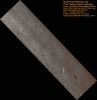
PSP_004673_0935_RED_browse.jpgSouth Pole Residual Cap - Swiss-Cheese Terrain Monitoring (Natural Colors; credits for the additional process. and color.: Dr Paolo C. Fienga - Lunexit Team)54 visitenessun commentoMareKromium
|
|
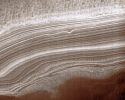
PSP_004917_1080_RED_browse-01.jpgComplex Geology in the South Polar Layered Deposits (extra-detail mgnf)54 visiteAbove and right of center, the layers appear wavy and in places, layers are cut off by other layers. Such structures may be formed by flow or faulting, but in this case they are more likely to be due to erosion of the lower part of the layered deposits before the upper part was laid down over it. For example, deposition may have halted long enough for channels to be eroded into the layered deposits.
When deposition resumes, new layers deposited in the channels could form the structures visible here. However, without more precise topographic information than is currently available, other hypotheses cannot be excluded.MareKromium
|
|
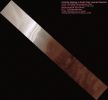
PSP_004917_1080_RED_browse-00.jpgComplex Geology in the South Polar Layered Deposits (context image)54 visiteThis section of the HiRISE image shows a scarp exposing the South Polar Layered Deposits, with illumination from the upper right (scarp slopes toward bottom). The Polar Layered Deposits probably contain a record of relatively recent climate changes on Mars, similar to ice ages on Earth.
The Deposits appear to be composed mostly of water ice, with variations in dust content controlling the erosion of the layers. This image shows that the history of the South Polar Layered Deposits has not been simple accumulation of horizontal layers.MareKromium
|
|
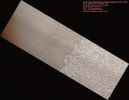
PSP_004778_0945_RED_browse.jpgSouth Pole Residual Cap - Swiss-Cheese Terrain Monitoring (Natural Colors; credits for the additional process. and color.: Dr Paolo C. Fienga - Lunexit Team)54 visitenessun commentoMareKromium
|
|
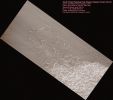
PSP_004765_0940_RED_browse.jpgSouth Pole Residual Cap - Swiss-Cheese Terrain Monitoring (Natural Colors; credits for the additional process. and color.: Dr Paolo C. Fienga - Lunexit Team)54 visiteLike Earth, Mars has concentrations of water ice at both Poles. Because Mars is so much colder however, CO2 ice is deposited at high latitudes in the Winter and is removed in the Spring, analogous to winter-time water ice/snow on Earth.
Around the South Pole there are areas of this CO2 ice that do not disappear every Spring, but rather survive Winter after Winter; this persistent CO2 ice is called the "South Pole Residual Cap". The retention of CO2 ice throughout the year by the Southern Polar Cap is one characteristic that distinguishes it significantly from Mars' North Polar Cap.
As can be seen in this HiRISE image of the South Pole Residual Cap, relatively high-standing smooth material is broken up by circular, oval, and blob-shaped depressions. This patterned terrain is called "Swiss Cheese" terrain.MareKromium
|
|

PSP_005155_1030_RED_browse.jpgExposure of South Polar Layered Deposits54 visiteA complex geologic history is on display in this image of the South Polar Layered Deposits. These layered deposits are a mixture of dust and water-ice. Each layer is thought to record information about the state of the Martian climate at the time of its deposition.
The original stack of layered ice has eroded to produce a scarp that exposes the internal layers. Smooth material was then deposited to cover this scarp before being in turn eroded. Deposition on top of an eroded surface like this produces what geologists call an "unconformity in the stratigraphic record". Remnants of this smooth material can be seen on the left of the image and draping the layered scarp near the image center.
Although it looks, at first glance, like this material has flowed down the scarp, that is unlikely to have happened. The extremely cold temperatures at the Martian Poles mean that ice in general does not flow like we see it do here on Earth. There are also no indications of some of the geomorphologic features that flowing ice typically acquires (such as crevasses, compressional ridges or moraines).
MareKromium
|
|
| 2237 immagini su 187 pagina(e) |
 |
|
|
|
|
179 | |
|
|
|
|





