| Piú viste - Mars Reconnaissance Orbiter (MRO) |
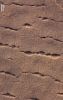
PSP_002202_2250_RED_browse-01.jpgPits, Cracks, and Polygons in Western Utopia Planitia (extra-detail mgnf) - elab. NASA54 visitenessun commentoMareKromium
|
|
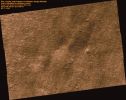
PSP_002202_2250_RED_browse-00.jpgPits, Cracks, and Polygons in Western Utopia Planitia (context image) - Elab. Lunexit54 visiteUtopia Planitia is part of the Great Northern Lowlands of Mars, where there may have been an ancient ocean.
The pits, cracks and polygons in Utopia have been interpreted as due to some combination of temperature variations in ice-rich ground, sublimation of ground ice, and collapse into subsurface voids.
This HiRISE image reveals many new details, including an abundance of boulders about 1 mt in diameter over the entire region (see the extr-detail mgnf).
The infrared color of HiRISE reveals two types of materials: the brighter and yellowish areas are probably dusty and the darker and bluer areas are probably coarser particles--sand and rocks.MareKromium
|
|
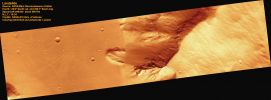
PSP_003516_1540_RED_browse.jpgLarge (and VERY Old) Landslide Deposit54 visiteThis HiRISE image is centered on a large landslide which formed the large lobe at the base of the steep slope. This is material which was transported in a massive rock-slide.
The landslide has several ridge-and-trough lineations in the direction of the flow. These occur in similar landslides on Earth as well. Comparing these features on Mars with similar examples on Earth helps geologists better understand how they work on both Planets.
In this case, the slide is relatively old.
The material has many impact craters superimposed. The steep slope, which was the source of the landslide, has undergone further erosion, so the landslide source area is no longer clear. MareKromium
|
|
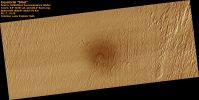
PSP_004030_1855_RED_browse.jpgBlast from the (Very Recent) Past54 visiteIn the center of this image is a very sharp-rimmed impact crater just 35 mt wide.
It lies in a bright, dust-covered region, but is surrounded by a slightly darker spot about 3 Km wide. The impact event created a blast of high winds that disturbed the dust and darkened the spot.
Since dust is constantly settling over the Region, the fact that we can still see the dark region means the impact event occurred of late, perhaps in recent decades. There are many dark streaks on topographic slopes over an even wider region surrounding the dark spot - these could be due to dust avalanches triggered by the impact, either from the air blast or from seismic shaking of the ground.
There are also rays of very small (approx. 1 mt in diameter) secondary craters extending radially outward from the 35-mt crater, created by the impact of rocks ejected from the main crater.
Thus a small impact crater has modified the surface over an area more then 10.000 times greater than that of the crater's interior.MareKromium
|
|
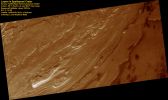
PSP_003442_1215_RED_browse-00.jpgLayers in Spallanzani Crater (context image)54 visiteThis image shows light-toned layered deposits along the floor of Spallanzani crater, a 72 Km (about 45 mile) diameter crater located just South-East of Hellas Planitia.
These layered deposits may be remnant sediments once deposited within the crater. Mechanisms for sediment deposition include windblown debris, airfall volcanic ash, or sediments that accumulated in a lake on the crater floor.
The slopes are covered in debris, and not fallen plates or blocks from the plateau edge.
This suggests that the layers are composed of weak materials that are protected by a stronger, more coherent surface.
The crater is named after the 18th Century Italian biologist, Lazzaro Spallanzani (1729-1799).
MareKromium
|
|
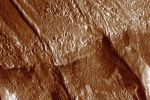
PSP_002620_1410_RED_browse-01.jpgGullies on the edge of Newton Basin (extra-detail mgnf)54 visiteThe gullies start near the top of the wall and can be traced across a break in slope partway down the wall (see here, 750 mt across). This break in slope occurs along the entire portion of the Crater wall in this image. The gullies appear shallower just above the break in slope, and deeper below the slope break.
This suggests that the fluid which eroded and carved out the wall materials forming the gullies, increased in velocity after the slope break, creating a deeper section of the gully.MareKromium
|
|
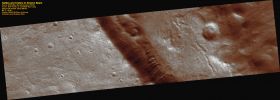
PSP_002620_1410_RED_browse-00.jpgGullies on the edge of Newton Basin (context image)54 visiteThis image shows a portion of two impact craters on the floor of Newton Basin where a smaller crater formed within a earlier larger one.
The larger crater's North rim can be seen diagonally (South-West/North-East) across the image and the smaller crater's north rim is near the right-side of the image.
Along the interior wall of the larger crater, several gullies have incised into the wall of the Crater. MareKromium
|
|

PSP_004000_1560_RED_browse.jpgLayers in Eberswalde Crater54 visiteThis image covers a portion of Eberswalde Crater, revealing a possible delta-lake transition. Water flowed into the crater through a series of tributary channels to the west of the crater and after the water entered, it formed a distributive network and partly filled the crater to form a lake (Eberswalde Crater is approx. 70 Km wide and 1,2 Km deep).
The bright layers are part of the terminal scarp at the eastern edge of the delta. Some of the steeper slopes visible at the edge of the fan may be coarser-grained resistant channel ridges. The CRISM instrument on board the Mars Reconnaissance Orbiter has detected phyllosilicates (clays) in the bright layers. One of the ways clays form on Earth is when water erodes rock and makes fine particles which settle out of water; this often occurs in river deltas and lake beds.
The delta in Eberswalde Crater and the detection of phyllosilicates provides evidence for possible persistent aqueous activity on Mars.MareKromium
|
|
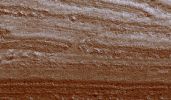
PSP_004708_1000_RED_browse-01.jpgFault in the South Polar Layered Deposits (EDM - Extremely Enhanced Natural Colors; credits for the additional process. and color.: Dr Paolo C. Fienga - Lunexit Team)54 visiteThe figure shown here is a cutout of the previous frame (1,8 Km across, or about 1,1 mile) showing a very interesting and smewhat rare feature: a fault. The fault is the thin, diagonal line that cuts through most of the image, from near the lower left corner to near the upper right corner. On each side of the fault, the layers that cross the fault are slightly off-set from one other; in other words, the layers don't line-up with each other anymore. The relationship between the angles at which the layers and fault are exposed and the movement along the fault is complex, but, in general, the layers on the left side of the fault are slightly lower than those on the right.MareKromium
|
|
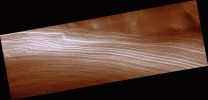
PSP_004708_1000_RED_browse-00.jpgFault in the South Polar Layered Deposits (CTX Frame - Extremely Enhanced Natural Colors; credits for the additional process. and color.: Dr Paolo C. Fienga - Lunexit Team)54 visiteThis image spans a section of the south polar layered deposits (SPLD). The SPLD are composed of layers of water ice mixed with impurities (mostly dust). The most similar terrestrial analog to the SPLD are ice sheets, like those covering most of Greenland and Antarctica.
Faults are created when rock (or, in this case, water ice) breaks due to some outside force and rocks (or ice) along either side of that break move in opposite directions. One of the most famous faults on Earth is the San Andreas Fault in California. There is a crack between the floor of the Pacific Ocean, plus a little bit of the California and Mexico coastline, and the rest of North America; the Pacific Ocean floor is moving northward along that crack, but North America is moving southward. Because the two sides are grinding against each other, they sometime stick together and then move again in jerky fashion, much like the way if you try to rub pieces of rough sand paper together. When movement along the fault occurs after a period of sticking together, this creates an earthquake.
For the case of this fault on Mars, it is unlikely that a "Marsquake" occurred when movement happened along this fault, because it is so small (over 1000 times shorter than the San Andreas Fault). This is interesting because faults are rare in the Martian polar layered deposits. The fault may have been created during widespread flow of the SPLD. Some of the stiffer ice could not flow and broke instead. Ice can only flow fast enough to create faults when it is relatively warm. Similarly, if you cool molasses enough, it becomes hard and doesn't flow. But the temperatures on Mars today are probably not warm enough to allow the creation of faults. This is why faults are so rare in the Martian ice. When were temperatures warm enough? This is still a mystery.
MareKromium
|
|
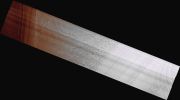
PSP_004664_0955_RED_browse.jpgOutcrops of Layers in the South Polar Layered Deposits54 visiteThis image spans a section of the South Polar Layered Deposits (SPLD). The SPLD are composed of layers of water ice mixed with impurities (probably mostly dust). The most similar terrestrial analog to the SPLD are ice sheets, like those covering most of Greenland and Antarctica.
The materials of ice sheets are deposited by freezing of atmospheric water vapor on dust particles and precipitation of those water/dust particles (snow), by direct condensation (freezing) of atmospheric water vapor onto the surface, and by fallout of dust. Together, these processes cause an ice sheet to undergo accumulation (build-up). Ablation (removal of material, also called erosion) of an ice sheet can also occur. If more accumulation happens than ablation, the ice sheet grows; if reversed, the ice sheet shrinks, as is the case for many of Earth’s glaciers due to global warming. Each year, the amount of accumulation and ablation varies, so layers of different thicknesses and different amounts of impurities (dust) will be deposited onto the ice sheet.
Volcanic eruptions anywhere on the planet can also potentially spew ash high into the atmosphere, where it can travel great distances and fall onto an ice sheet surface. Later accumulations of water ice can then trap this volcanic ash as a layer within the ice sheet. Thus, layers in an ice sheet can originate through a variety of means and occur at a variety of scales (thicknesses).
This particular image is interesting because many layers are exposed and because more than one outcrop (exposure of layering) is visible—at the top of the image and at the bottom. You can imagine the outcrops at the top and bottom of the image as if you are looking down on a staircase. The approximately horizontal lines are the edges of the layers (the risers), and the flat areas between them are the layer surfaces (the flat parts of the steps). The middle of the image is the top of the staircase. At the bottom, the staircase of layers goes down again.
The layers in this image are on the scale of meters (several to tens of feet) in thickness and are much thicker than one might expect from annual accumulation (which might be about 0.5 millimeters per year, or 0.02 inch per year). So the layers we see in this image may be packages of thinner, annual layers. The reason that we can distinguish between different packages of annual layers (in other words, the reason that we can see layering at this scale) is because the rates of accumulation and ablation change not only yearly, but also on much longer time scales. Imagine drilling into the SPLD and looking at the walls of the hole with a microscope. Within the large-scale layering we see in this image, we might see annual accumulation layers, dusty layers created during large dust storms, and maybe even volcanic ash layers.MareKromium
|
|

PSP_003252_1425_RED_browse-02.jpgBright Gully Deposit in Terra Sirenum (the "gully" - close-up; false colors)54 visiteThe bright gully deposit has a very fluid-like appearance, and has not been covered by other gullies or debris flows, indicating a young age. The brightness is a mystery; it could be due to minerals formed from water or ice.
Alternatively, the flow that made the gully may have removed a thin coating of relatively darker dust and soil, revealing a brighter substrate.
In any case, this feature is probably indicative of recent flow of water or water-rich material on Mars.MareKromium
|
|
| 2237 immagini su 187 pagina(e) |
 |
|
|
|
|
178 | |
|
|
|
|





