| Piú viste - Mars Reconnaissance Orbiter (MRO) |

TRA_000828_2495_IRB-1.jpgPolygonal Terrain (1)54 visiteA network of shallow surface troughs and fissures coalesce into polygonal patterns that are ubiquitous throughout this image. Polygonal patterned ground of this nature is quite common in permafrost regions of Earth, where seasonal thermal contraction of ice-cemented soil produces a honeycomb network of subsurface cracks. Cracks of this nature can also be produced by desiccation (mud cracks) or lava cooling (columnar joints), though typically on a smaller scale. The diameter of these martian polygons are dominantly 10-20 meters, analogous to terrestrial permafrost. The individual troughs are frequently only a couple of meters or less wide, and easily resolved at HiRISE resolution. Other characteristics, such as small ridges on either side of the troughs and the distribution of rocks in and around each polygon is also readily apparent. Small rocks and occasional larger boulders are also seen scattered throughout the image. Rocks protruding above the surface soil can be seen to cast shadows (solar illumination is from the lower left), which can aid in the determination of the rock's size and height. This image is located near an area under consideration as a landing site for the Mars Scout mission, Phoenix, planned for 2008. Examination of many factors including surface texture (roughness and morphology) and the size distribution of rocks will aid in final landing site selection.
|
|
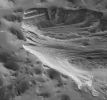
Juventae_Chasma_12m-00.jpgFeatures of Juventae Chasma (1)54 visiteCaption NASA originale:"This image shows a mound of layered rock within the large depression Juventae Chasma (3,5° South Lat. and 61,9° West Long.) known from data from the Omega spectrometer on the Mars Express mission to have sulfate minerals mixed within it. The clear expression of layering in the CTX image and the potential for correlation with MRO-CRISM hyper-spectral data open the possibility of relating specific beds to specific compositions, indicating the nature of the depositional environment and subsequent alteration".
|
|
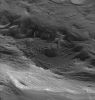
Juventae_Chasma_12m-01.jpgFeatures of Juventae Chasma (2)54 visiteCaption NASA originale:"Among the more interesting aspects of this image are the dunes of sand that appear to be migrating over the top of the mound, and a flat-surfaced, plateau/mesa forming unit covering the North-East side of the mound but also seen within valleys to the North and along the Southern margin of the mound. This unit may be the marker of an ancient erosional surface. In this image, North is towards the top and the Sun is coming from the left".
|
|

Juventae_Chasma_12m-02.jpgFeatures of Juventae Chasma (3)54 visitenessun commento
|
|

Elysium_Planitia-Tra_000867_1875_red-01.jpgFresh Crater Cluster in Elysium Planitia (EDM - False Colors)54 visiteImage TRA_000867_1875 was taken by the High Resolution Imaging Science Experiment (HiRISE) camera onboard the Mars Reconnaissance Orbiter spacecraft on October 3, 2006. The complete image is centered at 7,4° North Latitude and 157,3 East longitude. The range to the target site was 274,6 Km (171,6 miles).
At this distance the image scale ranges from 54,9 cm/pixel (with 2 x 2 binning) to 109,9 cm/pixel (with 4 x 4 binning).
The image has been map-projected to 50 cm/pixel and north is to the right.
The image was taken at a Local Mars Time of 3:26 PM and the scene is illuminated from the West with a solar incidence angle of 52°, thus the Sun was about 38° above the horizon.
At a Solar Longitude of 115,1°, the season on Mars is Northern Summer.MareKromium
|
|

Psp_001497_2480_red-01.jpgThe Northern Lakes: Lake "Ginny" (EDM - False Colors)54 visiteEd una volta operato un extra-detail mgnf a noi pare che non ci possano essere più dubbi di sorta: sul fondo di questo Cratere c'è un deposito di ghiaccio (l'albedo del ghiaccio d'acqua non tradisce!) e quindi, come già fatto in passato, possiamo parlare tranquillamente di Frozen Lake.
E poi, dato che NASA ed ESA non vedono (e se hanno visto, non hanno detto nulla), noi, in qualità di "scopritori" di questo Terzo Lago Marziano, abbiamo deciso di battezzarlo con il nome di "Lake Ginny".
Attenzione: noi lo sappiamo che la IAU non approverà mai queste nostre decisioni nè avallerà mai queste nostre scoperte (almeno non finchè saremo vivi...).
Tuttavia, se in un futuro (lontano) ci verrà resa un pò di giustizia, forse qualcuno dei nomi che abbiamo dato ad alcuni rilievi Lunari e Marziani che, tutto sommato ed a ragion veduta, riteniamo legittimamente di aver individuato per primi, potrebbe anche essere confermato. E nel dubbio, operando con entusiasmo e con il cuore pieno di speranza...Noi "battezziamo"!MareKromium
|
|

Martian_Lakes_in_Vastitas_Borealis_and_Solis_Planum.jpgWet Craters and Dry Craters: a Visual Comparison54 visitenessun commento
|
|

PSP_001948_1425_red.jpgGorgonum Chaos (Original NASA/JPL/University of Arizona b/w Frame)54 visitePSP_001948_1425 shows part of Gorgonum Chaos, a large cluster of chaotic terrain found in the Southern Hemisphere.
Many regions of chaotic terrain are found at the head of large outflow channels that were scoured by ancient floods. Gorgonum Chaos is one region that is not associated with an outflow channel. Chaotic terrain can form when subsurface volatiles (such as water) are catastrophically released and the overlying surface collapses. It is not known whether isolated chaotic terrain — such as that shown in this image — formed in the same way that the chaotic terrain near the outflow channels did. Wind erosion might play a role in their formation.
Gorgonum Chaos is an especially interesting area because gullies thought to have been eroded by liquid water are located on its mesas. The gullies have a wide range of orientations and many appear to emanate from a distinct layer in the mesas.
It is not known why gullies form on one slope rather than another, but insolation (amount of sunlight received), availability of water, and regional slope are possible contributing factors.
|
|

PSP_002244_1720_red.jpgWhite Rock (Enhanced Absolute Natural Colors; credits for the additional process. and color.: Dr Paolo C. Fienga - Lunexit Team)54 visiteThis image shows a portion of a relatively bright landform named "White Rock" on the floor of Pollack Crater in the Sinus Sabaeus Region of Mars.
Data from the Mars Global Surveyor Thermal Emission Spectrometer (TES) indicates that this landform is not anomalously bright, relative to other bright Martian Regions. Further, the apparent brightness seen here is due to contrast with other materials on the crater floor.
Dunes and ripples are visible in the dark material between the bright ridges. Their orientations appear to be influenced by wind directionally channeled by the ridges. Material appears to have been shed from the white landform and deposited on the darker bedforms indicating that the light-toned outcrops break down into fine materials.
Its high albedo and location in a topographic basin have led to suggestions that White Rock is an erosional remnant of an ancient lacustrine evaporate deposit.
Other interpretations include an eroded accumulation of compacted or weakly cemented aeolian sediment.
|
|

PSP_002917_2175_RED_browse.jpgCrater Cluster in the Northern (Mid-Latitude) Plains54 visiteA Northern Mid-Latitude scene consisting of craters, intercrater plains and mantled material is seen in PSP_002917_2175. The mantled material seen here covers much of the Middle Latitudes in both Hemispheres of Mars; it has been visibly removed in some locations. It's called "mantled" because it looks as if it's just draped over, or mantling, the topography underneath. The mantled material is what causes the craters to have a muted, softened appearance. It's thought to be ice-rich material deposited in a climate different from that of today.
The mantled unit is dissected here, meaning that is not pristine and has likely undergone modification since it was originally laid down. The intercrater plains have a pitted texture that is thought to be caused by water ice sublimating and leaving depressions behind.
Unlike that of Earth, the obliquity (tilt of the planet's rotation axis) of Mars changes wildly.
Earth has the Moon to keep its axis stable, but Mars' satellites, Phobos and Deimos, are not massive enough to do the same.
Today Mars' obliquity (25.19°) is similar to that of Earth's (23.45°), but this has not always been the case. As the obliquity changes, the portions of Mars that receive the most sunlight shift. During periods of high obliquity, polar regions receive the most sunlight. This causes polar ices, including water ice and carbon dioxide ice, to sublimate (evaporate) into the atmosphere. They would then potentially be re-deposited in the mid-latitudes, similar to where this image is located. It is believed that this process is responsible for the mid-latitude mantled unit.
MareKromium
|
|

PSP_003464_1380_RED_browse-01.jpgGullies and Dunes in a Crater in Newton Basin (extra-detail mgnf)54 visiteThis extra-detail mgnf (~1 Km across) shows several generations of dunes interacting with the protruding rock.
MareKromium
|
|
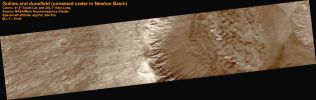
PSP_003464_1380_RED_browse-00.jpgGullies and Dunes in a Crater in Newton Basin (context image)54 visiteThis frame shows gullies associated with distinct layers located at multiple elevations along one crater wall as well as multiple generations of dunes that are eroding or covering a more coherent rock structure. The gullies in this crater appear to originate at the layers that cover a large extent of the slope. Gullies can be seen emanating from layers in two distinct sets, each at a different elevation. Gullies are often, but not always, form near layers.
Many of the gullies seen here have sinuous, or wavy, channels.
The bends are called meanders and, on Earth, meanders form in streams that have sustained and/or repeated flow. Not all of the gullies seen in this image extend the same distance downslope. This could result from differences in water supply, sediment supply, slope angle, and time of formation, among other factors.
Dunes are also visible in this image; they indicate the prevailing wind direction.
What is particularly interesting about this dune field is that there is exposed rock in the middle of it. This rock is either being exposed as the wind moves the dunes away from it or it is being covered. The dunes appear to outline the shape of the rock, which suggests that the rock has been uncovered long enough for dunes to form around it.
As the dunes shift over time, they will probably expose more of the underlying rock.MareKromium
|
|
| 2237 immagini su 187 pagina(e) |
 |
|
|
|
|
177 | |
|
|
|
|





