| Piú viste - Mars Reconnaissance Orbiter (MRO) |

PSP-20081120_spirit.jpgSpirit from orbit55 visiteThe solar system's most celebrated team of off-planet drivers cheered when they heard the news. Spirit had phoned home from Mars, ending four days of silence. The team had kept the rover safe, with help from a friend named "Marci."
Spirit had survived a fierce and sudden dust storm that had driven solar power to all-time lows. Without being able to notify Earth, Spirit had followed instructions the team sent to protect the rover.
The team had received warning from scientists who keep tabs on Martian weather with MARCI -- short for Mars Color Imager. From orbit, the instrument showed thick, swirling dust clouds advancing from the west. Engineers responded with instructions to conserve energy. They told Spirit to turn off a heater and do only two things each day -- check battery power and dust in the atmosphere.
As directed, Spirit contacted Earth on Nov. 13, 2008. MareKromium
|
|
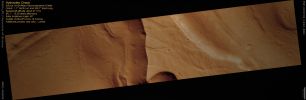
Psp_009709_1810_red.jpgA "segment" of Hydraotes Chaos (natural colors; credits: Lunexit)55 visiteHydraotes Chaos is an Equatorial Region of Chaotic Terrain located near some of the large outflow channels on Mars. Chaotic terrain near the Outflow Channels (ancient flood channels) is thought to form when ices beneath the surface rapidly become liquid or gaseous and escapes, and the remaining solid material collapses.
Chaotic terrain is called “chaotic” because it consists of a large jumble of randomly shaped Mesas (Hills) and Troughs. Many regions of Chaotic Terrain are located at the head (start) of the outflow channels, suggesting that the origins of the two classes of feature might be related to each other.
The Mesa located in the center of the image has elongated depressions that might be evidence of past fluvial activity.
Nota: questo dettaglio si riferisce ad una zona "famosa" per gli Eso-Archeologi...Quale?
Ma è la zona su cui dovrebbe sorgere la famosa "Città di Hydraotes Chaos", la Città del Bacino Alluvionale che è stata "vista" da illustri personaggi quali il Dr J. Skipper, il Dr R. Hoagland ed il nostrano Ing. E. Piccaluga.
Ora, avendo questa immagine davanti (che PARLA DA SOLA!), noi ci aspetteremmo due reazioni da questi personaggi:
1) se vogliono essere coerenti, allora devono dire che l'immagine è falsa o che è stata taroccata, per nascondere la "Città" oppure
2) se vogliono essere onesti devono cospargersi il capo di cenere, chiedere scusa alle migliaia di Appassionati presi per il fondo-schiena e quindi dedicarsi ad altra professione.
Purtroppo, però, costoro non faranno nulla di tutto ciò: costoro ignoreranno l'immagine e continueranno per la loro strada, fatta di bugie, traveggole e speculazioni pseudo-scientifiche a sfondo commerciale.MareKromium
|
|
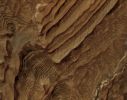
PSP_004078_2015_RED_browse-01.jpgLayered Rocks within Becquerel Crater (enhanced natural colors; credits: Lunar Explorer Italia)55 visiteRhythmic bedding in sedimentary bedrock within Becquerel Crater on Mars is suggested by the patterns in this image from the High Resolution Imaging Science Experiment (HiRISE) camera on NASA's Mars Reconnaissance Orbiter.
Three dimensional analysis based on stereo pairs of images confirmed the regularity of repetition in the thickness of the beds. In the left half of this image, some of the rhythm is apparent as a series of bundles of about 10 individual layers per bundle. By corresponding to a known 10-to-one pattern in changes in the tilt of Mars' Rotation Axis, this pattern suggests the periodicity in the rock layers results from cyclical changes in the Planet's tilt.
This view covers an area about 1150 meters (0,7 miles) wide. Individual layers in the scence average 3,6 meters (12 feet) thick. The view is presented in enhanced natural colors emphasizing the differing compositions of surface material. Sand trapped in relative low points in the terrain appears grey-blueish. Sedimentary rocks appear brown.
Faulting apparent in the image suggests that the deposits are hardened rock, not softer material. Tilting of the layers in different ways and the surface topography made the three-dimensional analysis necessary for determining the thickness of layers.
This image is a portion of the HiRISE image catalogued as PSP_004078_2015, taken on June 10, 2007.
The location of the imaged area is at 22° North Latitude, 352° East Longitude, within the Arabia Terra Region.MareKromium
|
|
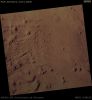
PSP_009304_2015_RED.jpgRidges in Olympus Mons Aureole (possible True Colors; credits: Lunar Explorer Italia)55 visiteMars Local Time: 15:21 (early afternoon)
Coord. (centered): 21,4° North Lat. and 221,3° East Long.
Spacecraft altitude: 283,8 Km (such as about 177,4 miles)
Original image scale range: 28,4 cm/pixel (with 1 x 1 binning) so objects ~85 cm across are resolved
Map projected scale: 25 cm/pixel
Map projection: EQUIRECTANGULAR
Emission Angle: 0,2°
Phase Angle: 46,1°
Solar Incidence Angle: 46° (meaning that the Sun is about 44° above the Local Horizon)
Solar Longitude: 101,7° (Northern Summer)
Credits: NASA/JPL/University of Arizona
Additional process. and coloring: Lunar Explorer ItaliaMareKromium
|
|

Psp_009346_1985_red.jpgThila Crater (extremely enhanced natural colors; credits: Lunar Explorer Italia)55 visiteMars Local Time: 15:24 (early afternoon)
Coord. (centered): 18,1° North Lat. and 155,5° East Long.
Spacecraft altitude: 284,2 Km (such as about 177,6 miles)
Original image scale range: 28,4 cm/pixel (with 1 x 1 binning) so objects ~85 cm across are resolved
Map projected scale: 25 cm/pixel
Map projection: EQUIRECTANGULAR
Emission Angle: 6,0°
Phase Angle: 42,3°
Solar Incidence Angle: 48° (meaning that the Sun is about 42° above the Local Horizon)
Solar Longitude: 103,1° (Northern Summer)
Credits: NASA/JPL/University of Arizona
Additional process. and coloring: Lunar Explorer ItaliaMareKromium
|
|

Psp_009353_1550_red~0.jpgLadon Valles (possible True Colors; credits: Lunar Explorer Italia)55 visiteMars Local Time: 15:30 (middle afternoon)
Coord. (centered): 24,6° South Lat. and 329,1° East Long.
Spacecraft altitude: 261,2 Km (such as about 163,3 miles)
Original image scale range: 52,3 cm/pixel (with 1 x 1 binning) so objects ~1,57 mt across are resolved
Map projected scale: 50 cm/pixel
Map projection: EQUIRECTANGULAR
Emission Angle: 2,5°
Phase Angle: 72,6°
Solar Incidence Angle: 71° (meaning that the Sun is about 19° above the Local Horizon)
Solar Longitude: 103,4° (Northern Summer)
Credits: NASA/JPL/University of Arizona
Additional process. and coloring: Lunar Explorer ItaliaMareKromium
|
|
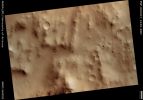
Psp_009437_1650_red.jpgUnnamed Craters with Bright Ejecta Blankets (possible True Colors; credits: Lunar Explorer Italia)55 visiteMars Local Time: 15:29 (early afternoon)
Coord. (centered): 14,9° South Lat. and 194,7° East Long.
Spacecraft altitude: 263,1 Km (such as about 164,5 miles)
Original image scale range: 26,3 cm/pixel (with 1 x 1 binning) so objects ~79 cm across are resolved
Map projected scale: 25 cm/pixel
Map projection: EQUIRECTANGULAR
Emission Angle: 0,2°
Phase Angle: 64,4°
Solar Incidence Angle: 64° (meaning that the Sun is about 26° above the Local Horizon)
Solar Longitude: 106,3° (Northern Summer)
Credits: NASA/JPL/University of Arizona
Additional process. and coloring: Lunar Explorer ItaliaMareKromium
|
|
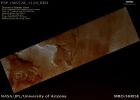
PSP_006528_1120_RED_abrowse-00~0.jpgSources of Basaltic Sand (context frame; MULTISPECTRUM - credits: Lunexit)55 visiteSand dunes are among the most prominent wind-formed features found on Mars. Their morphologies depend on the winds and also on the local supply of sand grains, so they provide clues to the nature of both the Martian Atmosphere and Surface.
Dunes form through the accumulation of coarse sand grains carried by the wind by means of saltation, or bouncing along the surface. Monitoring the present day dune activity can help determine the timescale over which Martian rocks are eroded, as the impacting grains sandblast the surface over time. The sands of Mars must be continually replenished as the coarse grains are ground into fine dust by repeated impacts. Finding the hidden sources of fresh sand is a challenge for HiRISE.MareKromium
|
|
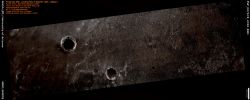
PSP_007678_2050_RED_abrowse~0.jpgProposed MSL Landing Site in Mawrth Vallis (MULTISPECTRUM; credits: Lunexit)55 visiteMawrth Vallis has a rich mineral diversity, including clay minerals that formed by the chemical alteration of rocks or loose “regolith” (soil) by water.
The CRISM instrument on the MRO Spacecraft has detected a variety of clay minerals here that could signify different processes of formation. The high resolution of the HiRISE camera helps us to see and trace out layers, polygonal fractures and, with CRISM, examine the distribution of various minerals across the surface.
This surface is scientifically compelling for the Mars Science Laboratory (MSL) Rover, although some of the terrain might be somewhat rough. Scientists use HiRISE images to find the safest possible Landing Site for the Rover.
This is one of four candidate landing sites in the Mawrth Vallis region.MareKromium
|
|

Psp_010344_2655_red.jpgScarp-Fed Dark Dunes (possible True Colors; credits: Lunar Explorer Italia)55 visiteMars Local Time: 09:59 (middle morning hours)
Coord. (centered): 85,7° South Lat. and 179,4° East Long.
Spacecraft altitude: 330,6 Km (such as about 206,6 miles)
Original image scale range: 66,1 cm/pixel (with 1 x 1 binning) so objects ~1,98 mt across are resolved
Map projected scale: 50 cm/pixel
Map projection: EQUIRECTANGULAR
Emission Angle: 17,4°
Phase Angle: 84,6°
Solar Incidence Angle: 70° (meaning that the Sun is about 20° above the Local Horizon)
Solar Longitude: 139,7° (Northern Summer)
Credits: NASA/JPL/University of Arizona
Additional process. and coloring: Lunar Explorer ItaliaMareKromium
|
|
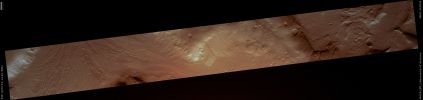
Psp_009719_2230_red.jpgFretted Terrain in Protonilus Mensae (possible True Colors; credits: Lunar Explorer Italia)55 visiteCaption NASA:"This observation shows Fretted Terrain in valleys located in Protonilus Mensae near the so-called "Crustal Dichotomy", such as the Region that separates the Southern Hemisphere Highlands from the Northern Hemisphere Lowlands.
Fretted Terrain is thought to involve movement of ice-rich material in its formation. The speckled texture of the valley fill (i.e. the Fretted Terrain) is probably due to sublimation, when ice goes directly from a solid to a gas, leaving behind empty space under the soil into which overlying material can collapse.
The linear striations in the valley fill mark the direction of movement. For example, in the valley near the top of the image (left), the material was moving across the scene.
Also in this scene, are several small craters in various stages of degradation".
§§§
Mars Local Time: 15:20 (early afternoon)
Coord. (centered): 42,4° North Lat. and 48,1° East Long.
Spacecraft altitude: 295,4 Km (such as about 184,6 miles)
Original image scale range: 59,1 cm/pixel (with 1 x 1 binning) so objects ~1,77 mt across are resolved
Map projected scale: 50 cm/pixel
Map projection: EQUIRECTANGULAR
Emission Angle: 0,4°
Phase Angle: 46,0°
Solar Incidence Angle: 46° (meaning that the Sun is about 44° above the Local Horizon)
Solar Longitude: 116,4° (Northern Summer)
Credits: NASA/JPL/University of Arizona
Additional process. and coloring: Lunar Explorer ItaliaMareKromium
|
|
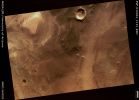
PSP_010063_2135_RED.jpgIsmenius Lacus (possible True Colors; credits: Lunar Explorer Italia)55 visiteMars Local Time: 14:16 (early afternoon)
Coord. (centered): 33,2° North Lat. and 17,4° East Long.
Spacecraft altitude: 296,7 Km (such as about 185,5 miles)
Original image scale range: 29,7 cm/pixel (with 1 x 1 binning) so objects ~59,4 cm across are resolved
Map projected scale: 25 cm/pixel
Map projection: EQUIRECTANGULAR
Emission Angle: 6,9°
Phase Angle: 54,4°
Solar Incidence Angle: 47° (meaning that the Sun is about 43° above the Local Horizon)
Solar Longitude: 129,0° (Northern Summer)
Credits: NASA/JPL/University of Arizona
Additional process. and coloring: Lunar Explorer ItaliaMareKromium
|
|
| 2237 immagini su 187 pagina(e) |
 |
|
|
|
|
176 | |
|
|
|
|





