| Piú viste - Mars Reconnaissance Orbiter (MRO) |

PSP_009192_1890_RED-01.jpgRelatively Recent Slope Streak started from a Dust Devil (edm - natural colors; credits: Lunexit)55 visitenessun commentoMareKromium
|
|
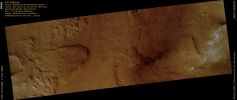
Psp_009368_1720_red.jpgIus Chasma (natural colors; credits: Lunexit)55 visiteThis image spans the floor of Ius Chasma’s Southern Trench. Ius Chasma is located in the Western Region of Valles Marineris, the Solar System’s largest canyon. This canyon is well known for its fine stratigraphic layers modified by wind and water.
The outcrops contain interchanging layers of dark and bright rocks. The layered deposits consist of dark basalt lava flows and bright sedimentary layers. The sediments are likely to be from atmospheric dust, sand, or alluvium from an ancient water source. The layers are visible on the gentle slopes above the canyon floor, in pitted areas, and in small mesa buttes. The floor of the canyon is littered with megaripples that are aligned in a North-South direction.
Ius Chasma is believed to have been shaped by a process called "sapping" that occurred when water seeped from the layers of the cliffs and evaporated before it reached the canyon floor. This process is thought to have dominated during the Amazonian Period.
Ius Chasma also has several structural features such as East trending normal Faults and Grabens that deformed the canyons. Recent geomorphological events include Mass Wasting (Avalanches) and minor Sapping from Gullies that continued to erode the canyon walls.MareKromium
|
|

Psp_008719_1815_red.jpgCharacterize Surface Hazards and Science of MSL Rover Landing Site - Equatorial Regions/Meridiani Planum (natural colors; credits: Lunexit)55 visitenessun commentoMareKromium
|
|
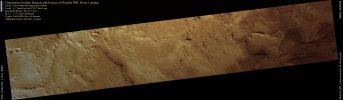
Psp_008706_1765_red.jpgCharacterize Surface Hazards and Science of Possible MSL Rover Landing Site - Equatorial Regions/Meridiani Planum (natural colors; credits: Lunexit)55 visitenessun commentoMareKromium
|
|
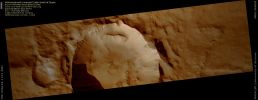
Psp_008238_1555_red.jpgWell-Preserved Unnamed Crater South of Gusev Crater (natural colors; credits: Lunexit)55 visitenessun commentoMareKromium
|
|

PSP_006659_1460_RED_abrowse~0.jpgGullies in Dao Vallis (MULTISPECTRUM; credits: Lunexit)55 visiteGullies on the North-West side of Dao Vallis, a Martian outflow channel, are the focus of this observation. The outflow channels are thought to have been carved by gigantic, ancient floods.
Gullies are largely thought to be the result of water flow, but the origin of the water is much debated.
One theory proposes that melting snowpack, or a mantling (blanketing) unit, forms gullies. Such a mantling unit is visible here between some of the gullies, in the full high-resolution image. Some alcove-shaped features appear to have mantling material in them.
If the mantling unit is indeed related to gully formation, then gullies are potentially forming here.
MareKromium
|
|

PIA10148-LizardSkinTerrain~0.jpgLizard-Skin Surface Texture (natural colors; elab. Lunexit)55 visite The South Polar Region of Mars is covered seasonally with translucent CO2 ice.
In the Spring, gas subliming (evaporating) from the underside of the seasonal layer of ice bursts through weak spots, carrying dust from below with it, to form numerous Dust Fans aligned in the direction of the prevailing wind.
The dust gets trapped in the shallow grooves on the surface, helping to define the small-scale structure of the surface. The surface texture is reminiscent of lizard skin.MareKromium
|
|

PSP_009488_1745_RED_abrowse-03.jpgMartian Caves (edm n. 3 - possible natural colors; credits: Lunexit)55 visiteCave environments can also protect organic life from extremely harsh conditions on the Martian Surface, and may provide future human explorers with secure habitats. Accordingly, caves are considered among the most promising locations to find preserved evidence of past or present microbial life.
Furthermore, the challenges associated with Mars cave exploration may inspire a full range of new technologies, such as advanced robotics and target-specific landing capabilities.MareKromium
|
|

PSP_010180_2645_RED_abrowse-01.jpgSmall and young Impact Crater in the NPLD (edm - natural colors; credits: Lunexit)55 visiteThe Impact Crater is about 66 meters (215 feet) in diameter. Ejecta from this Crater can be seen extending primarily to the North-West.
The asymmetry in the crater ejecta can be an effect of atmospheric winds associated with the impact itself but, in this case, is most likely the result of an oblique impact (a low impact angle with respect to the horizontal).
As impact angles decrease, the ejecta blanket is increasingly offset downrange.
The impactor that formed this crater approached the surface from the South-East. The slightly elliptical shape of the crater is also a result of an oblique impact.MareKromium
|
|

PSP_006487_1580_RED.jpgCollapse Features in Tyrrhena Patera (natural colors; credits: Lunexit)55 visiteIn this image you can notice a set of craters around the rim of Tyrrhena Patera. Tyrrhena Patera is a volcano in the Southern Highlands with shallow slopes, and only 2 Km (about 1,2 miles) of vertical relief.
The craters are aligned and are known as Pit Crater Chains. These are common in Volcanic Regions on Mars.
They are not formed by a meteorite impact, but by collapse into some void space underground.
Because the Pit Crater Chains and Concentric Fractures are generally aligned, these are most likely due to extension in the Region, where parts of the Martian Crust pull apart during growth of the volcano or emplacement of dikes.
Another way pit crater chains can occur is when Lava Tubes partially collapse forming chains of holes along the roof of the Lava Tubes themselves.
A third possibility is that these may be associated with collapse of the underground magma chamber.MareKromium
|
|

PSP_005632_1225_RED_abrowse~0.jpgPartially Exhumed Crater in Amphitrites Patera (MULTISPECTRUM; elab. Lunexit)55 visiteThe terrain in this image is located in Amphitrites Patera, South-West of Hellas Basin. This area constitutes the interior of an ancient impact crater that was filled by a layer of smooth material, possibly composed of ash and dust, mixed with interstitial ice (ice filling spaces between dust and ash grains).
The curved ridge toward the lower left of the image is a remnant of the crater rim that was exhumed by erosion of the filling material. The morphology (appearance and shape) of the small, scalloped depressions, which we observe within the smooth material, suggests that the erosion process was sublimation (the process of a material going directly from a solid state to a gaseous state).
Scalloped depressions are a typical feature of the Mid-Latitudes of Mars between 40 and 60°. They usually have a steep pole-facing scarp (cliff), displaying series of small pits and fractures and a gentler, smoother, equator-facing slope. This asymmetry is most likely due to differences in solar heating.
The large scalloped depressions appear to have formed from the coalescing of multiple, smaller scalloped depressions. Their formation may be an ongoing process, although no definitive evidence has been uncovered so far.MareKromium
|
|

PSP_010169_2650_RED_abrowse-03.jpgDunes and other Surface Features in Chasma Boreale (edm n. 2 - natural colors; credits: Lunexit)55 visiteLe dune che vedete in questo dettaglio extramagnificato del panorama relativo alla Regione di Chasma Boreale SEMBRANO essere collegate da una frattura longitudinale, semi-irregolare ed a bordi frastagliati. Questa "frattura", se sovrasaturiamo l'immagine ed operiamo una ulteriore magnificazione, mostra delle leggere differenze di colore e di albedo e, alla fine, pare assomigliare davvero molto ad un canale di drenaggio (una sorta di fiumiciattolo, per dirla semplicemente).
Rilievi similari li abbiamo già incontrati su Titano e, se per i drainage channels della Luna Nebbiosa non paiono esserci più dubbi sul fatto che un qualche tipo di liquido scorra nel loro letto, per quanto attiene Marte ancora tutto tace.
In realtà, il fatto che questa specie di "frattura" superficiale possa essere un piccolo canale (che si inserisce in un ampio reticolo di canali - osservate il ctx frame per capire il contesto di riferimento) e che all'interno di esso scorra qualcosa, è pura speculazione; ma che la "frattura" (rectius: il network di fratture) sia oltremodo recente, è un fatto (basta osservare il dettaglio magnificato con una minima attenzione per capirlo).
La NASA, nel commentare questo frame, non si sofferma su queste "curiose" fratture del suolo e non ci offre alcuna idea/spiegazione delle stesse.
Peccato.MareKromium
|
|
| 2237 immagini su 187 pagina(e) |
 |
|
|
|
|
175 | |
|
|
|
|





