| Piú viste - Mars Reconnaissance Orbiter (MRO) |
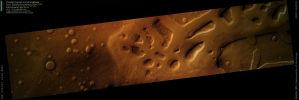
PSP_006567_2220_RED_abrowse-00.jpgFlooded Terrain in Terra Sabaea (MULTISPECTRUM; credits: Lunexit)55 visiteTwo distinctly different terrain types are visible in this image of the Northern Lowlands of Mars: an older, heavily cratered landscape has been inundated by much younger flows.
The valley floors are filled with flows that have relatively smooth surfaces and very few superposed impact craters.
In contrast, the mesas and hills making up the older terrain have blocky surfaces, perhaps fragmented by ancient impacts. MareKromium
|
|
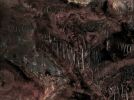
PSP_007055_2015_RED_abrowse-4.jpgVolcanic and Clay Materials near Nili Fossae (edm n. 3 - natural colors; credits: Lunexit)55 visiteChe ne dite di queste "dune"? "Curiose", vero? MareKromium
|
|
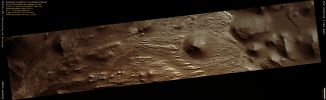
PSP_008708_1780_RED_abrowse.jpgGeologic Contacts in Juventae Chasma (MULTISPECTRUM-2; credits Lunexit)55 visiteMany of the Troughs of Valles Marineris contain mounds composed of light-toned Layered Deposits and Scientists have been debating both the origin of these Layered Deposits and their age of deposition relative to the Troughs themselves.
Some scientists think that the Layered Deposits formed first and then were covered by lava flows that make up the plains. Later, formation of the troughs of Valles Marineris created large openings through the plains that exposed the buried Layered Deposits.
Others have argued that the light-toned Layered Deposits formed after the Troughs and filled up portions of the canyons.
The chaotic terrain in Juventae is believed to have formed when subsurface water in the ground flowed away, causing collapse of the ground and leaving behind numerous hills along the floor of the Trough.
In this HiRISE image, the geologic contacts between the wallrock (darker units on the left - Sx - of the image), light-toned Layered Deposits, and darker hills of the chaotic terrain are visible. By studying the image, scientists hope to determine what are the relative ages of these different units in order to decipher the Geologic History of this Region.
(note: a stereo image of this location could be even more helpful because it will show the three-dimensional relationships between the different units, thus revealing more information about their relative ages)
MareKromium
|
|
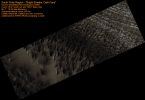
PIA10144-DarkFans~0.jpgBright Streaks and Dark Fans (MULTISPECTRUM; credits: Lunexit)55 visiteThe South Polar Region of Mars is covered every year by a layer of Carbon Dioxide (CO2) ice. In a Region called the "cryptic terrain", the ice is translucent and sunlight can penetrate through the ice to warm the surface below.
The ice layer sublimates (evaporates) from the bottom. The Dark Fans of dust seen in this image come from the surface below the layer of ice, carried to the top by gas venting from below. The translucent ice is "visible" by virtue of the effect it has on the tone of the surface below, which would otherwise have the same color and reflectivity as the Fans.
Bright streaks in this image are fresh frost. The CRISM team has identified the composition of these streaks to be Carbon Dioxide.
Nota Lunexit: questa è la surface feature che ha "stimolato" l'immaginazione di Joseph Skipper e Richard Hoagland. Secondo costoro, le "dark features" sarebbero alberi simili ai "pioppi" terrestri... Ogni ulteriore commento ci sembra davvero inutile.MareKromium
|
|

PIA10141-AraneiformTerrain~0.jpgAraneiform and Lace Terrains (MULTISPECTRUM; credits: Lunexit)55 visiteThe South Polar Terrain on Mars contains landforms unlike any that we see on Earth, so much that a new vocabulary is required to describe them. The word "araneiform" means "spider-like".
There are radially organized channels on Mars that look spider-like, but we don't want to confuse anyone by talking about "spiders" when we really mean "channels", not "bugs."
This picture shows an example of "connected araneiform topography", such as terrain that is filled with spider-like channels whose arms branch and connect to each other. Gas flows through these channels until it encounters a vent, where is escapes out to the atmosphere, carrying dust along with it. The dark dust is blown around by the prevailing wind.
This image also shows a different Region where the channels are not radially organized. In this Region they form a dense tangled network of tortuous strands. We refer to this as "lace". MareKromium
|
|

PIA10140-DarkFans~0.jpgBright Streaks and Dark Fans (MULTISPECTRUM; credits: Lunexit)55 visiteIn a Region of the South Pole known informally as "Ithaca", numerous Fans of dark frost form every Spring. HiRISE collected a time lapse series of these images, starting at Ls = 185 and culminating at Ls = 294. "Ls" is the way we measure time on Mars: at Ls = 180 the Sun passes the Equator on its way South; at Ls = 270 it reaches its maximum subsolar latitude and Summer begins.
We believe that the bright streaks are fine frost condensed from the gas exiting the vent. The conditions must be just right for the bright frost to condense. MareKromium
|
|

Psp_008779_1905_red.jpgThe Head of Athabasca Valles (natural colors; credits: Lunexit)55 visiteThis observation is located at the head of the Athabasca Valles Channel System, which lies just North of Mars’ Equator, in a low-elevation Region known as Elysium Planitia.
Athabasca Valles has an interesting geologic history. It was probably carved by one or more catastrophic floods of water, but more recently, a flood of lava coursed through the channel system. Both the water and the lava erupted from a few discrete points (or “vents”) along the Cerberus Fossae, a 1600-Km(1000-mile) long network of extensional (or “normal”) faults. The two prominent troughs that cut across the Southern end of this HiRISE image are part of the Cerberus Fossae. They are distinct fault segments that overlap at their tips, as one tapers in and the other pinches out.
They were not always as wide as they are today. Erosional processes have widened the troughs over time. Major eruptions occurred along both of the fault segments seen in this image, though they occurred to either side of the imaged area itself. Lava that erupted from the western vent covers the northern half of the image. The lava has raised, lobate margins and is slightly darker in tone than the older cratered plains it embays. The lava also has a banded appearance of subtly contrasting lighter and darker tones, that correspond to variations in surface roughness.
The bands are concentric to a vent located immediately west of the imaged area. Unfortunately, vents along the Cerberus Fossae are not well preserved.MareKromium
|
|

PSP_008839_2575_RED-01.jpgDunes and Polygons (edm - natural colors; credits: Lunexit)55 visitenessun commentoMareKromium
|
|

PSP_006271_2210_RED_abrowse.jpgPrimary and Secondary Craters in Arcadia Planitia (MULTISPECTRUM; credits: Lunexit)55 visiteThese unusual craters were spotted in Arcadia Planitia, which is part of an extensive region of Mars blanketed by a thick layer of bright dust.
Light southeasterly winds during southern spring and summer blow the dust towards the northwest (top left of the picture in the cutout above). The dust is trapped temporarily in the lee of crater rims, both inside the craters and along the outside rims where they form streamers that resemble St. Nick’s beard.
MareKromium
|
|

PSP_005410_1115_RED_abrowse.jpgPolar Pit Gullies (MULTISPECTRUM; credits: Lunexit)55 visiteThis image shows Polar Pit Gullies in a depression. The gullies do not appear to have been active recently, as their channels and alcoves are covered with polygonal fractures and ripples that have formed over time. The alcoves contain boulders from eroding layers up-slope. Several of the alcoves extend to the slope rim, suggesting head-ward erosion.
The rest of the scene contains abundant polygonal ground, thought to have formed by processes involving ground ice. This image is at a High Latitude where polygonal terrain is common. This feature is not found in Equatorial Regions, which supports a relationship with ground ice because ground ice is not stable near the equator today.
There are several muted circles on the plains in the lower half of the image; these are possibly relaxed craters. If a crater forms in ice-rich ground, the ice enhances the degradation of the crater and gives the crater a “softened” appearance.MareKromium
|
|

PSP_009160_2350_RED.JPGFresh Double-Layered Ejecta Crater (natural colors; credits: Lunexit)55 visiteThis scene features a High Latitude, Northern Hemisphere Crater with double-layered ejecta. The sharp rim and lack of small superposed craters indicates that this Crater is relatively young.
The semi-circular feature that parallels the Crater Rim is a terrace that probably formed as part of the Crater wall collapsed into the center. The circular mound in the center likely formed at the same time as the Crater itself.
Large craters on Mars can have central peaks; this Crater looks like it was on the cusp of having one. The linear features surrounding the Crater on its ejecta are striations that formed during the impact as material and wind exploded out from the center.
On the right side (Dx) of the scene, is a very distinct ejecta flow lobe (Lobate Ejecta). Lobate Ejecta is thought to form when an impact occurs on a surface with lots of volatiles — such as ices that quickly turn to gas when they are heated. The gases help make the ejecta flow like a fluid.MareKromium
|
|
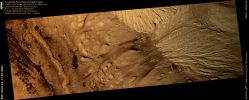
PSP_009149_1750_RED.jpgInverted Riverbed in Gale Crater (False Colors; credits: Lunexit)55 visiteGale Crater is a large, approximately 152 Km-diameter impact crater that lies near the Martian Equator. Contained within the crater is a massive central mound of layered material. With an average vertical thickness of almost 4 Km (about 2,4 miles), the Gale Crater Layered Deposits are twice as thick as the layers exposed along the Grand Canyon on Earth. Shown here is a portion of the mound with an inverted fluvial or river channel.
Topographic inversion occurs when sediments are cemented together, forming a harder layer that is resistant to later erosion. This later erosion has preferentially removed material outside the channel, leaving the former riverbed exposed as a ridge — such as a topographic high.
This inverted channel was originally detected by scientists using Mars Orbiter Camera (MOC) images onboard the Mars Global Surveyor Spacecraft.
Color variations visible in this image are mostly due to variable amounts of loose dark sediment that has accumulated unevenly across the scene.MareKromium
|
|
| 2237 immagini su 187 pagina(e) |
 |
|
|
|
|
174 | |
|
|
|
|





