| Piú viste - Mars Reconnaissance Orbiter (MRO) |

PSP_005682_1035_RED_abrowse-01.jpgBasal Exposure of South Polar Layered Deposits (extra-detail mgnf; possible natural colors - elab. Lunexit)55 visiteSome layers have an irregular wavy appearance that may have been caused by flow of the ice in the past when the now-exposed ice was still buried.
It is currently too cold at the surface in the South Polar Region of Mars for significant flow to be occurring today.
Other layers appear to be converging and some are truncated and may represent the so-called "unconformities" (see here).
Unconformities form when a previous episode of erosion removes all or part of a layer and is later followed by more deposition.MareKromium
|
|
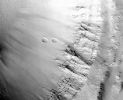
PSP_005343_2170_RED_abrowse-01.jpgScarp with Landslides and Boulder Tracks (extra-detail mgnf)55 visiteThis subimage - or extra-detail mgnf - (approx. 480 meters across) shows boulder tracks from the landslide scar on the left side of the image.
Some boulders can be seen forming trails along the slope at the top part of the subimage, while others can be seen at the end of their trails (...).MareKromium
|
|

PSP_005813_2150_RED_abrowse.jpgUnusual Depression near Elysium Mons (MULTISPECTRUM; elab. Lunexit)55 visiteThis unusual depression and the associated concentric rings are situated within an area thought to have been deposited as a mud flow. Due to the lack of a distinctive, raised rim or other impact-related features, this crater is thought to have formed by the loss of material below the surface and subsequent collapse, rather than by an impact from space.
The exact mechanism for the loss of material is not fully understood, although the missing material was likely water in some form. This feature is near a large volcano, so perhaps there were explosive magma-water interactions that violently removed the water and some magma, followed by surface collapse. Or, less violently, there could have been simple melting of subsurface ice and then collapse of the surface into the resulting void. The rays emanating from the depression suggest some amount of violence before the surface collapse that sprayed material far from the depression.
Some aspects of this and other, nearby features are similar to the collapse pits associated with Grímsvötn volcano in Iceland, which erupts beneath an ice-cap. However, there are no rays formed during the eruptions at Grímsvötn.
MareKromium
|
|

PSP_001374_1805_RED_browse-00~0.jpgLayering in Exhumed Crater at Meridiani Planum Region (context image - MULTISPECTRUM; credits: Lunexit)55 visite...Noi, detto senza falsa modestia, sfidiamo la NASA a fare di meglio...MareKromium
|
|

PSP_005388_1975_RED_abrowse-01.jpgPang Boche Crater (EDM; False Colors; credits for the additional process.: Dr Paolo C. Fienga - Lunexit Team)55 visiteThe interior of Pang Boche Crater contains material that likely slumped off the walls during late stages of its formation. The north wall of the crater has material that has not slumped to the floor, instead forming a terrace.
Also noteworthy is the abundance of small craters that surround, but do not occur within, Pang Boche. These are mostly Secondary Craters that formed when ejecta from an impact hit the surface. If the small craters were Primary Craters (formed from an impactor from space), then they would be expected to be within Pang Boche as well. Secondaries commonly occur in clumps as seen in this extra-detail mgnf (which is approx. 2 km across).
The strong clustering indicates that these craters are Secondaries.MareKromium
|
|
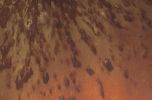
PSP_004313_1760_RED_abrowse-01.jpgWinslow Crater - extra-detail mgnf from frame n. 1: the "Herringbone Pattern" (MULTISPECTRUM; credits: Lunexit)55 visitenessun commentoMareKromium
|
|
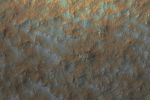
PSP_006538_1035_RED_abrowse-02.jpgSouthern Dunes and Spiders (extra-detail mgnf - MULTISPECTRUM; credits: Lunexit)55 visitenessun commentoMareKromium
|
|
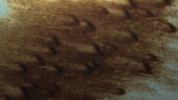
PSP_006538_1035_RED_abrowse-01.jpgSouthern Dunes and Spiders (extra-detail mgnf - MULTISPECTRUM; credits: Lunexit)55 visitenessun commentoMareKromium
|
|

PSP_006528_1120_RED_abrowse-02.jpgSources of Basaltic Sand (extra-detail mgnf n. 2; MULTISPECTRUM - credits: Lunexit)55 visiteThis rocky layer may originally have been a lava flow; Martian lava flows are predominantly composed of basalt, which would account for the dark color of the sand.
The polygonal pattern of the bright upper layer may be due to repeated freezing and thawing of the soil that buries the lava flow. The tracks of Dust-Devils are clearly visible on the smooth, sandy surface but largely vanish when they cross into the polygonally fractured terrain.MareKromium
|
|
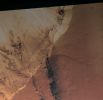
PSP_003545_2025_RED_abrowse-PCF-LXTT-01.jpgIntersection between Hyblaeus and Elysium Chasmata (EDM n.1 - Saturated Natural Colors; credits for the additional process. and color.: Dr Paolo C. Fienga - Lunexit Team)55 visiteA cross-section of Hyblaeus Chasma is visible in this first extra-detail mgnf).
The chasm seems to be filled with a resistant light-toned layer, about 200 mt thick (likely consisting of cemented windblown sand and dust) forming a mantling unit and overlying more resistant boulder-rich layers. The sand and dust was likely blown into Hyblaeus Chasma after it was formed by tectonic processes, possibly in combination with fluvial processes.
The chasmata were subsequently broadened by hillslope erosion: boulders are strewn along the top of this dusty mantling unit. Slumping, possibly caused by faulting, along the Southern Wall of Hyblaeus is visible at the intersection with Elysium Chasma.
This image also shows a number of dark streaks along the walls of Elysium Chasma, further to the south.MareKromium
|
|

PSP_006891_1970_RED_abrowse-01.jpgAt the base of the Olympus... (EDM - Saturated Natural Colors; credits for the additional process. and color.: Dr Paolo C. Fienga - Lunexit Team)55 visiteThe bottom right part of the cutout has a much flatter and smoother surface. These are younger lava flows that have buried the lower part of the volcano. When lava flows form vast smooth sheets, they are called "flood" lavas.
In the bottom of the cutout, the flood lavas have odd, wiggly looking plateaus. These are parts of the lava crust that were lifted up when more liquid lava was injected into the middle of the slowly solidifying lava flow.
This process is called "inflation" and is seen on many lava flows on Earth. These younger lava flows are cut by two different sets of faults. One makes the branching valley in the flood lavas and the other creates the sinuous ridge and valley along the edge of the Olympus Mons lava flows.
Lower resolution images that cover a broader area suggest that the sinuous fault is an old buried structure that has been more recently reactivated.MareKromium
|
|
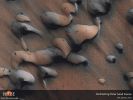
PSP_007043_2650-BLUE-MarsPolarDunes2_hirise_big-01.jpgSand Dunes Thawing on Mars (Natural Colors; credits: Lunexit)55 visitenessun commentoMareKromium
|
|
| 2237 immagini su 187 pagina(e) |
 |
|
|
|
|
172 | |
|
|
|
|





