| Piú viste - Mars Reconnaissance Orbiter (MRO) |

ESP_011605_1170_RGB.jpgDefrosting Malea Patera (edm - possible True Colors; credits: Dr M. Faccin)56 visitenessun commentoMareKromium
|
|
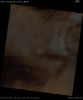
PSP_010420_2505_RED_abrowse.jpgSummer Ice in Vastitas Borealis (Natural Colors; credits: Lunar Explorer Italia)56 visiteMars Local Time: 15:02 (early afternoon)
Coord. (centered): 70,3° North Lat. and 341,4° East Long.
Spacecraft altitude: 317,0 Km (such as about 198,1 miles)
Original image scale range: 31,7 cm/pixel (with 1 x 1 binning) so objects ~ 95 cm across are resolved
Map projected scale: 25 cm/pixel
Map projection: EQUIRECTANGULAR
Emission Angle: 7,3°
Phase Angle: 68,5°
Solar Incidence Angle: 62° (meaning that the Sun is about 28° above the Local Horizon)
Solar Longitude: 142,7° (Northern Summer)
Credits: NASA/JPL/University of Arizona
Additional process. and coloring: Lunar Explorer ItaliaMareKromium
|
|
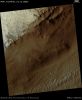
PSP_010430_2115_RED_abrowse.jpgOlivine Deposits (Natural Colors; credits: Lunar Explorer Italia)56 visiteMars Local Time: 15:35 (middle afternoon)
Coord. (centered): 30,8° North Lat. and 79,7° East Long.
Spacecraft altitude: 289,8 Km (such as about 181,1 miles)
Original image scale range: 29,0 cm/pixel (with 1 x 1 binning) so objects ~ 87 cm across are resolved
Map projected scale: 25 cm/pixel
Map projection: EQUIRECTANGULAR
Emission Angle: 7,4°
Phase Angle: 44,2°
Solar Incidence Angle: 52° (meaning that the Sun is about 38° above the Local Horizon)
Solar Longitude: 143,1° (Northern Summer)
Credits: NASA/JPL/University of Arizona
Additional process. and coloring: Lunar Explorer ItaliaMareKromium
|
|

PSP_010425_1435_RED_abrowse.jpgSouthern Craters (Natural Colors; credits: Lunar Explorer Italia)56 visiteMars Local Time: 15:47 (middle afternoon)
Coord. (centered): 236,1° South Lat. and 224,2° East Long.
Spacecraft altitude: 251,9 Km (such as about 157,5 miles)
Original image scale range: 50,4 cm/pixel (with 1 x 1 binning) so objects ~ 1,51 mt across are resolved
Map projected scale: 50 cm/pixel
Map projection: EQUIRECTANGULAR
Emission Angle: 0,3°
Phase Angle: 74,1°
Solar Incidence Angle: 74° (meaning that the Sun is about 16° above the Local Horizon)
Solar Longitude: 142,9° (Northern Summer)
Credits: NASA/JPL/University of Arizona
Additional process. and coloring: Lunar Explorer ItaliaMareKromium
|
|

SouthPolarSpiders-PIA11857.jpgSouth Polar Fans (Natural Colors; credits: Lunar Explorer Italia)56 visiteCaption NASA:"Every Winter, Mars' Polar Region is covered with a layer of seasonal CO2 (Carbon Dioxide ice - a.k.a. "dry ice"). In the Spring, jets of gas carry dust from the ground up through openings in the ice.
The dust gets carried downwind by the prevailing wind and falls on top of the Seasonal Ice Layer in a fan-shaped deposit. Many jets appear to be active at the same time since numerous Fans are all deposited in the same direction.
This image from the High Resolution Imaging Science Experiment (HiRISE) camera on NASA's Mars Reconnaissance Orbiter appears to show several times at which jets were active. At the top of this image the Fans are oriented in one direction while at the bottom they are going in a different direction. This suggests that as the ice layer thins, a set of gas jets becomes active, they die down, then further away another set starts up at a later time with a different prevailing wind direction.
This is a reduced-resolution image from the HiRISE Observation observation catalogued as ESP_011934_0945, taken on Feb. 11, 2009. The observation is centered at 85,4° South Latitude and 104,0° East Longitude.
The image was taken at a Local Mars Time of 18:12 and the scene is illuminated from the West, with a Solar Incidence Angle of 79° (meaning that the Sun was about 11° above the Local Horizon).
At a Solar Longitude of 207,9°, the season on Mars is Northern Autumn".MareKromium
|
|

ESP_011580_1255_RED_abrowse.jpgThe Dunes of Russel Crater (Natural Colors; credits: Lunar Explorer Italia)56 visitenessun commentoMareKromium
|
|

SouthPole-PIA11988.jpgThe South Pole of Mars in Spring (2)56 visitenessun commentoMareKromium
|
|
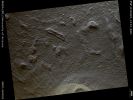
PSP_010426_2155_RED_abrowse.jpgErebus Montes (Natural Colors; credits: Lunar Explorer Italia)56 visiteMars Local Time: 15:31 (middle afternoon)
Coord. (centered): 35,3° North Lat. and 187,4° East Long.
Spacecraft altitude: 295,3 Km (such as about 184,6 miles)
Original image scale range: 59,1 cm/pixel (with 1 x 1 binning) so objects ~1,77 mt across are resolved
Map projected scale: 50 cm/pixel
Map projection: EQUIRECTANGULAR
Emission Angle: 1,6°
Phase Angle: 52,8°
Solar Incidence Angle: 51° (meaning that the Sun is about 39° above the Local Horizon)
Solar Longitude: 142,9° (Northern Summer)
Credits: NASA/JPL/University of Arizona
Additional process. and coloring: Lunar Explorer ItaliaMareKromium
|
|
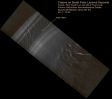
PSP_002882_0940_RED_browse~0.jpgFresh Craters on the South Polar Layered Deposits (Natural Colors; credits: Lunar Explorer Italia)56 visiteThis image was taken in the Southern Spring, when the surface was completely covered by Carbon Dioxide frost. Therefore, most of the brightness variations in this scene are caused by topography.
The Polar Layered Deposits are broken into blocks by fractures in two directions. Neither set of fractures is parallel to the current scarp face, suggesting that they were not formed as the scarp was eroded, but instead are due to pre-existing weaknesses in the Polar Layered Deposits.
The (small?) craters that can be seen at about 23:00 - approx. in the central portion of the frame - appear to have formed at the same time by an impactor that broke up as it entered the Martian Atmosphere.
The presence of many craters such as these on the South Polar Layered Deposits indicates that they are not as young as the North Polar Layered Deposits, which have very few craters on them.MareKromium
|
|
PSP_010505_2725_RED_abrowse.jpgNorth Polar Residual Cap (Natural Colors; credits: Lunar Explorer Italia)56 visitenessun commentoMareKromium
|
|

ESP_012941_0930_RED_abrowse.jpgLandforms on the South Polar Residual Cap (Natural Colors; credits: Lunar Explerer Italia)56 visiteThis HiRISE image is located on the Carbon-Dioxide (CO2) rich Residual South Polar Ice Cap near 86° South Lat. and 353° East Long.
These rounded landforms evolve relatively quickly and erode into the surface of the Ice Cap (approximately 4-5 meters or 15 feet per year).
Their interesting shapes make for a striking appearance on the Surface.MareKromium
|
|
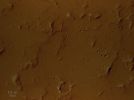
PSP_003608_1510_RED_abrowse-01.jpgProximities of Zumba Crater: Secondary Craters Field (Natural - but enhanced - Colors; credits: Lunar Explorer Italia)56 visitenessun commentoMareKromium
|
|
| 2237 immagini su 187 pagina(e) |
 |
|
|
|
|
171 | |
|
|
|
|





