| Piú viste - Mars Reconnaissance Orbiter (MRO) |
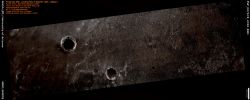
PSP_007678_2050_RED_abrowse~0.jpgProposed MSL Landing Site in Mawrth Vallis (MULTISPECTRUM; credits: Lunexit)56 visiteMawrth Vallis has a rich mineral diversity, including clay minerals that formed by the chemical alteration of rocks or loose “regolith” (soil) by water.
The CRISM instrument on the MRO Spacecraft has detected a variety of clay minerals here that could signify different processes of formation. The high resolution of the HiRISE camera helps us to see and trace out layers, polygonal fractures and, with CRISM, examine the distribution of various minerals across the surface.
This surface is scientifically compelling for the Mars Science Laboratory (MSL) Rover, although some of the terrain might be somewhat rough. Scientists use HiRISE images to find the safest possible Landing Site for the Rover.
This is one of four candidate landing sites in the Mawrth Vallis region.MareKromium
|
|
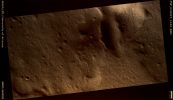
PSP_010025_1410_RED.jpgDark Area in Hartwig Crater (possible True Colors; credits: Lunar Explorer Italia)56 visiteMars Local Time: 15:39 (middle afternoon)
Coord. (centered): 38,2° South Lat. and 344,1° East Long.
Spacecraft altitude: 256,7 Km (such as about 160,4 miles)
Original image scale range: 51,4 cm/pixel (with 1 x 1 binning) so objects ~1,54 mt across are resolved
Map projected scale: 50 cm/pixel
Map projection: EQUIRECTANGULAR
Emission Angle: 6,6°
Phase Angle: 82,8°
Solar Incidence Angle: 78° (meaning that the Sun is about 12° above the Local Horizon)
Solar Longitude: 127,6° (Northern Summer)
Credits: NASA/JPL/University of Arizona
Additional process. and coloring: Lunar Explorer ItaliaMareKromium
|
|
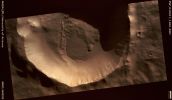
PSP_010017_1460_RED.jpgRelatively Flat Crater Floor bounded By sharp change in Slope (possible True Colors; credits: Lunar Explorer Italia)56 visiteMars Local Time: 15:42 (middle afternoon)
Coord. (centered): 33,7° South Lat. and 202,9° East Long.
Spacecraft altitude: 253,3 Km (such as about 158,3 miles)
Original image scale range: 50,7 cm/pixel (with 1 x 1 binning) so objects ~1,52 mt across are resolved
Map projected scale: 50 cm/pixel
Map projection: EQUIRECTANGULAR
Emission Angle: 5,2°
Phase Angle: 71,8°
Solar Incidence Angle: 75° (meaning that the Sun is about 15° above the Local Horizon)
Solar Longitude: 127,3° (Northern Summer)
Credits: NASA/JPL/University of Arizona
Additional process. and coloring: Lunar Explorer ItaliaMareKromium
|
|

Psp_010344_2655_red.jpgScarp-Fed Dark Dunes (possible True Colors; credits: Lunar Explorer Italia)56 visiteMars Local Time: 09:59 (middle morning hours)
Coord. (centered): 85,7° South Lat. and 179,4° East Long.
Spacecraft altitude: 330,6 Km (such as about 206,6 miles)
Original image scale range: 66,1 cm/pixel (with 1 x 1 binning) so objects ~1,98 mt across are resolved
Map projected scale: 50 cm/pixel
Map projection: EQUIRECTANGULAR
Emission Angle: 17,4°
Phase Angle: 84,6°
Solar Incidence Angle: 70° (meaning that the Sun is about 20° above the Local Horizon)
Solar Longitude: 139,7° (Northern Summer)
Credits: NASA/JPL/University of Arizona
Additional process. and coloring: Lunar Explorer ItaliaMareKromium
|
|
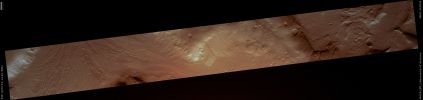
Psp_009719_2230_red.jpgFretted Terrain in Protonilus Mensae (possible True Colors; credits: Lunar Explorer Italia)56 visiteCaption NASA:"This observation shows Fretted Terrain in valleys located in Protonilus Mensae near the so-called "Crustal Dichotomy", such as the Region that separates the Southern Hemisphere Highlands from the Northern Hemisphere Lowlands.
Fretted Terrain is thought to involve movement of ice-rich material in its formation. The speckled texture of the valley fill (i.e. the Fretted Terrain) is probably due to sublimation, when ice goes directly from a solid to a gas, leaving behind empty space under the soil into which overlying material can collapse.
The linear striations in the valley fill mark the direction of movement. For example, in the valley near the top of the image (left), the material was moving across the scene.
Also in this scene, are several small craters in various stages of degradation".
§§§
Mars Local Time: 15:20 (early afternoon)
Coord. (centered): 42,4° North Lat. and 48,1° East Long.
Spacecraft altitude: 295,4 Km (such as about 184,6 miles)
Original image scale range: 59,1 cm/pixel (with 1 x 1 binning) so objects ~1,77 mt across are resolved
Map projected scale: 50 cm/pixel
Map projection: EQUIRECTANGULAR
Emission Angle: 0,4°
Phase Angle: 46,0°
Solar Incidence Angle: 46° (meaning that the Sun is about 44° above the Local Horizon)
Solar Longitude: 116,4° (Northern Summer)
Credits: NASA/JPL/University of Arizona
Additional process. and coloring: Lunar Explorer ItaliaMareKromium
|
|
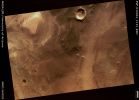
PSP_010063_2135_RED.jpgIsmenius Lacus (possible True Colors; credits: Lunar Explorer Italia)56 visiteMars Local Time: 14:16 (early afternoon)
Coord. (centered): 33,2° North Lat. and 17,4° East Long.
Spacecraft altitude: 296,7 Km (such as about 185,5 miles)
Original image scale range: 29,7 cm/pixel (with 1 x 1 binning) so objects ~59,4 cm across are resolved
Map projected scale: 25 cm/pixel
Map projection: EQUIRECTANGULAR
Emission Angle: 6,9°
Phase Angle: 54,4°
Solar Incidence Angle: 47° (meaning that the Sun is about 43° above the Local Horizon)
Solar Longitude: 129,0° (Northern Summer)
Credits: NASA/JPL/University of Arizona
Additional process. and coloring: Lunar Explorer ItaliaMareKromium
|
|
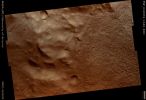
PSP_010059_1640_RED.jpgOlivine Deposits (possible True Colors; credits: Lunar Explorer Italia)56 visiteMars Local Time: 15:38 (middle afternoon)
Coord. (centered): 16,1° South Lat. and 133,7° East Long.
Spacecraft altitude: 259,9 Km (such as about 162,5 miles)
Original image scale range: 26 cm/pixel (with 1 x 1 binning) so objects ~1,04 mt across are resolved
Map projected scale: 25 cm/pixel
Map projection: EQUIRECTANGULAR
Emission Angle: 3,2°
Phase Angle: 61,9°
Solar Incidence Angle: 64° (meaning that the Sun is about 26° above the Local Horizon)
Solar Longitude: 128,9° (Northern Summer)
Credits: NASA/JPL/University of Arizona
Additional process. and coloring: Lunar Explorer ItaliaMareKromium
|
|

Psp_010695_2225_red.jpgFlow near the Central Peak of Moreux Crater (possible True Colors; credits: Lunar Explorer Italia)56 visiteThis image is of a flow feature within Moreux Crater, located at about 42° North Lat. and 44,6° East Long., on the edge of Mars’ Highlands/Lowlands Boundary. The Crater itself is roughly 135 Km in diameter.
During the impact that forms craters, a roughly bowl shaped volume is excavated from the Martian Crust. In craters larger than about 7 Km in diameter, a Central Peak (or Mound) forms on the floor of the crater. This image focuses on a portion of the Moreux Central Peak that apparently broke off and slid away, forming a type of Giant Landslide.
Interesting hummocks, swirls and ridges are found on the surface of the Landslide. There are also distinct, almost circular depressions of unknown origin near the foot of the flow.
Both light and dark toned dunes later formed on this landform.
§§§
Mars Local Time: 15:43 (middle afternoon)
Coord. (centered): 42,0° North Lat. and 44,7° East Long.
Spacecraft altitude: 322,4 Km (such as about 201,5 miles)
Original image scale range: 32,2 cm/pixel (with 1 x 1 binning) so objects ~97 cm across are resolved
Map projected scale: 25 cm/pixel
Map projection: EQUIRECTANGULAR
Emission Angle: 22,5°
Phase Angle: 35,7°
Solar Incidence Angle: 58° (meaning that the Sun is about 32° above the Local Horizon)
Solar Longitude: 153,6° (Northern Summer)
Credits: NASA/JPL/University of Arizona
Additional process. and coloring: Lunar Explorer ItaliaMareKromium
|
|

PSP_005392_0995_RED_abrowse-01~0.jpgImpact Crater on the South Polar Layered Deposits (EDM n.1; MULTISPECTRUM - credits: Lunexit)56 visiteA problem with using craters to determine age on the icy SPLD is that erosion of the icy substrate and relaxation of crater topography (i. e., relief becoming more gentle) is probably more rapid on ice than on harder rocky surfaces.
A detailed study of craters in ice will help better to understand this process of how craters in ice degrade, or deteriorate, with time.
Perhaps then we will know how to use the number and distribution of craters over the icy polar layered deposits in constraining the geologic and climate history of the Mars Polar Regions.MareKromium
|
|
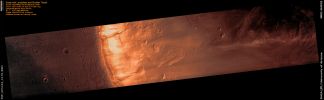
PSP_005343_2170_RED_abrowse-00~0.jpgScarp with Landslides and Boulder Tracks (context frame; natural colors - elab. Lunexit)56 visiteThis observation shows an equatorial scarp (cliff) with possible landslides and boulder tracks.
The cliff has several distinct layers visible near its top. There is a smoother, possibly fine-grained layer on top, underlain by a relatively bright and a dark layer. It is possible that the entire cliff face consists of layers but that erosion has not exposed others yet.
There are two main landslide scars, locations where a landslide has carved into the slope. Both of the scars have boulder tracks, several of which have boulders at their ends as they progress down the slope or reach the end of the slope.MareKromium
|
|
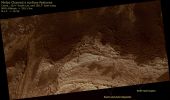
Psp_001443_1695_red~0.jpgFeatures of Melas Chasma (possible True Colors; credits: Lunar Explorer Italia)56 visitenessun commentoMareKromium
|
|
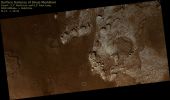
Psp_001440_1820_red~0.jpgFeatures of Sinus Meridiani (possible True Colors; credits: Lunar Explorer Italia)56 visitenessun commentoMareKromium
|
|
| 2237 immagini su 187 pagina(e) |
 |
|
|
|
|
169 | |
|
|
|
|





