| Piú viste - Mars Reconnaissance Orbiter (MRO) |

PSP_009708_2205_RED_abrowse-01.jpgHills in Acidalia Planitia (EDM - Enhanced Natural Colors; credits for the additional process. and color.: Dr Paolo C. Fienga - Lunexit Team)56 visiteThis edm frame (375x250 meters, or 410x273 yards) of the HiRISE depicts in detail the rocky layers existing in one of these hills.
CRISM, another of the instruments onboard Mars Reconnaissance Orbiter, has acquired data over this same region showing that the rocky outcrops contain clays. Clays of similar composition form in terrestrial environments favorable for life, where volcanic rocks are in close contact with water.MareKromium
|
|
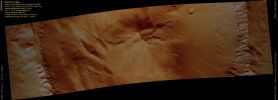
Psp_009677_2135_red.jpgBacolor Crater (natural colors; credits: Lunexit)56 visiteBacolor Crater is a pristine crater in the Northern Hemisphere. The linear striations visible at both sides (Sx and Dx) of the image are from the blast of the formation impact. This crater has a Central Peak, other mounds and terraces on its floor.
All of these features appeared during the final stages of crater formation.
The Northern Wall of the crater has landslides which have sculpted the Crater Rim. The Southern Wall has Gullies, thought to form by fluvial processes.
The Gullies here are more incised (cut into the slope) than the landslides are.MareKromium
|
|

PIA10148-LizardSkinTerrain~0.jpgLizard-Skin Surface Texture (natural colors; elab. Lunexit)56 visite The South Polar Region of Mars is covered seasonally with translucent CO2 ice.
In the Spring, gas subliming (evaporating) from the underside of the seasonal layer of ice bursts through weak spots, carrying dust from below with it, to form numerous Dust Fans aligned in the direction of the prevailing wind.
The dust gets trapped in the shallow grooves on the surface, helping to define the small-scale structure of the surface. The surface texture is reminiscent of lizard skin.MareKromium
|
|

PSP_009488_1745_RED_abrowse-03.jpgMartian Caves (edm n. 3 - possible natural colors; credits: Lunexit)56 visiteCave environments can also protect organic life from extremely harsh conditions on the Martian Surface, and may provide future human explorers with secure habitats. Accordingly, caves are considered among the most promising locations to find preserved evidence of past or present microbial life.
Furthermore, the challenges associated with Mars cave exploration may inspire a full range of new technologies, such as advanced robotics and target-specific landing capabilities.MareKromium
|
|

PSP_009488_1745_RED_abrowse-00.jpgMartian Caves (ctx frame - possible natural colors; credits: Lunexit)56 visitePit Craters exist in Volcanic Regions across Mars, and form when surface materials collapse into large underground cavities. Such pits are generally bowl-shaped, filled with sediment, and are relatively shallow when compared with their diameters.
Recently, a small number of anomalous Pit Craters were identified with strikingly different visible and thermal characteristics such as: sheer cliff walls; deep interiors that can extend out-of-sight beneath the surface and temperature fluctuations that behave unlike any known feature on Mars.MareKromium
|
|

Psp_009654_2245_red.jpgPedestal Crater in Deuteronilus Mensae (natural colors; credits: Lunexit)56 visiteThis crater with spectacular ejecta is located in the Northern Mid-Latitudes in the Deuteronilus Mensae, located near the dichotomy boundary, where the Southern Highlands transition into the Northern Lowlands.
The crater has raised, fluidized ejecta. Scientists think that fluidized ejecta forms when an impact occurs into ice-rich material. The interior of the crater shows some material, particularly on the West wall, that has detached and is flowing into the crater center. This suggests the presence of ground ice.MareKromium
|
|
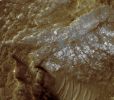
PSP_010012_2225_RED_abrowse-01.jpgDeep Rocks Unveiled at Bonestell Crater (edm; natural colors; credits: Lunexit)56 visiteThis edm (437x500 mt or 479x547 yards) of the HiRISE image shows a portion of Bonestell's Central Peak. HiRISE reveals details in the structure and color of these deep rocks that will help scientists decipher the origin and history of the Northern Lowlands.MareKromium
|
|
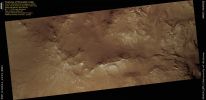
PSP_010012_2225_RED_abrowse-00.jpgDeep Rocks Unveiled at Bonestell Crater (ctx frame; natural colors; credits: Lunexit)56 visiteImpact craters are sometimes nicknamed “Mother Nature's drill holes” because, thanks to them, deep rock formations are exposed at the surface. Bonestell Crater is a good example.
This image depicts part of the floor of this relatively young impact crater located in the Northern Lowlands. The Northern Lowlands occupy most of the northern half of Mars. They are younger than the Southern Highlands, as shown by the lower number of impact craters, and well below the Planet’s Average Elevation. Their origin is still a mystery.
Bonestell is about 42 Km (approx. 26 miles) in diameter and about 1250 meters (4100 feet) deep. The rocky hills on the floor of this crater constitute its “Central Peak”.
Central peaks form due to elastic rebound of subsurface materials immediately after impact. The rocks in Bonestell's Central Peak may have been 4-to-8 Km below the surface before impact.MareKromium
|
|

PSP_010180_2645_RED_abrowse-01.jpgSmall and young Impact Crater in the NPLD (edm - natural colors; credits: Lunexit)56 visiteThe Impact Crater is about 66 meters (215 feet) in diameter. Ejecta from this Crater can be seen extending primarily to the North-West.
The asymmetry in the crater ejecta can be an effect of atmospheric winds associated with the impact itself but, in this case, is most likely the result of an oblique impact (a low impact angle with respect to the horizontal).
As impact angles decrease, the ejecta blanket is increasingly offset downrange.
The impactor that formed this crater approached the surface from the South-East. The slightly elliptical shape of the crater is also a result of an oblique impact.MareKromium
|
|
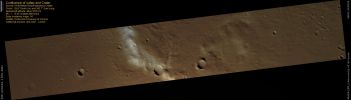
Psp_009669_1500_red.jpgConfluence of Valley and Crater (natural colors; credits: Lunexit)56 visiteThis image shows the South-Eastern Rim of a large degraded Impact Crater where a Valley breaches the Crater Rim. The Valley itself, no longer pristine, is difficult to locate in the image.
However, it appears to be in the center, near the right of the Crater Rim. It is possible that this Valley transported water into the Crater, forming a lake in the ancient past.
The scene is peppered with craters of various sizes and states of degradation, indicating that the surface is not young.
A few craters are young enough to still have raised rims. One of these, located on the floor of the larger crater, has distinct raised ejecta radiating out from it.
The crater also has dunes on its floor, indicating that aeolian processes have modified it since it formed.MareKromium
|
|
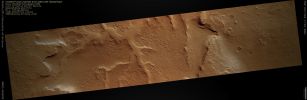
PSP_007394_1750_RED_abrowse~0.jpgInverted Fluvial Channels and Craters with Ejecta Rays (natural colors; credits: Lunexit)56 visiteThe lower part of this image shows well-defined overlapping channels, which have inverted topography (i.e.: they were once low spots that have been filled in with sediments and now eroded in a such a way that they appear as topographically high regions).
The channels have a winding and intersecting geometry indicating the shifting of the channels over time, a feature consistent with the flow of water in rivers. The channels have small craters that have excavated the channel materials and ejected them to form well-defined rays. There are dark slope streaks (toward the top of the image) showing transport of fine dust down the slope of an eroded bedrock terrain.MareKromium
|
|

PSP_006487_1580_RED.jpgCollapse Features in Tyrrhena Patera (natural colors; credits: Lunexit)56 visiteIn this image you can notice a set of craters around the rim of Tyrrhena Patera. Tyrrhena Patera is a volcano in the Southern Highlands with shallow slopes, and only 2 Km (about 1,2 miles) of vertical relief.
The craters are aligned and are known as Pit Crater Chains. These are common in Volcanic Regions on Mars.
They are not formed by a meteorite impact, but by collapse into some void space underground.
Because the Pit Crater Chains and Concentric Fractures are generally aligned, these are most likely due to extension in the Region, where parts of the Martian Crust pull apart during growth of the volcano or emplacement of dikes.
Another way pit crater chains can occur is when Lava Tubes partially collapse forming chains of holes along the roof of the Lava Tubes themselves.
A third possibility is that these may be associated with collapse of the underground magma chamber.MareKromium
|
|
| 2237 immagini su 187 pagina(e) |
 |
|
|
|
|
168 | |
|
|
|
|





