| Piú viste - Mars Reconnaissance Orbiter (MRO) |
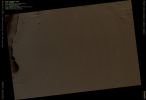
PSP_001408_1900_RED_abrowse.jpgFlows in Athabasca Valles (Natural Colors; credits: Lunexit)57 visiteThin Flows cover the Plains just North of the Source Region for the Athabasca Valles Channel System. The Flows are mostly confined by a Scarp (Cliff) that can be seen in the North-Western corner of the image.
The more heavily Cratered Terrain above the Scarp is part of a tectonic ridge known as a "Wrinkle Ridge". A few Flows can be seen atop the Wrinkle Ridge, but they are not as ubiquitous as those on the Plains below. The Flows on the Plains frequently intersect, with younger ones cutting across older ones.
The prominent dark swathes along their edges have particularly rough textures.
The darker shade is due to thousands of shadows cast by small bumps on the Surface, which HiRISE is able to resolve.
Dozens of bright, narrow Rifts (Cracks) zigzag across the Flows. They appear bright because they are filled with light-toned, windblown material. Wind-sculpted Knobs and Ridges of similar light-toned material are scattered throughout the imaged area.
The orientations of the Ridges indicate that the Winds primarily blow from the South-East. Several impact craters are captured in this image, the largest being about 50 meters (160 feet) in diameter. Many bear the distinctive bright rays characteristic of secondary craters associated with the larger impact crater, Zunil.
Some craters penetrated the surface of the Flows, and the boulders strewn around them suggest that the material they excavated was rocky.MareKromium
|
|

PSP_001410_2210_RED_abrowse.jpgUnnamed Craters with Layered Deposits in Utopia Planitia (Natural Colors; credits: Lunexit)57 visiteThis image shows an Unnamed Impact Crater located in Utopia Planitia (Northern Hemisphere of Mars) that is filled with layered material.
The layered character of these Deposits is consistent with episodic deposition. Each distinct layer represents a period of sediment deposition. The layers are parallel to each other, indicating that deposition occurred by material settling onto the Surface, rather than being blown across the Surface in Sand Dunes.
The hummocky texture of these deposits suggests that volatiles (such as Carbon Dioxide Ice) are mixed in with the rocky sediment.MareKromium
|
|
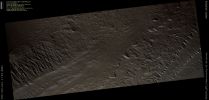
PSP_001422_1750_RED_abrowse.jpgLayers in Gale Crater Central Mound (Natural Colors; credits: Lunexit)57 visiteThis image shows a portion of the Central Mound in the Gale Crater (Central Mound that is of interest to scientists because of the light-toned Layered Deposits that can be found inside it).
The Layered Deposits could have formed in a water environment if, for instance, a lake - once - filled the Crater. Alternatively, particles suspended in the Atmosphere, such as Dust or Volcanic Ashes, could have built up the Layers over time.
By using HiRISE images to see details in the Layers, such as how their thicknesses vary horizontally and vertically, scientists can narrow down the potential origins.
The paucity of Impact Craters on the Layered Deposits indicates that either the Deposits are very young, or more likely that they are being eroded up to the point where such (alleged) Impact Craters were erased.
Wind Erosion modified the Layers after they formed, creating both sharp corners and rounded depressions along the Surface.
A few meter-size Boulders are visible at the base of some steep Cliffs, but the really poor amount of visible Boulders elsewhere suggests that most of the erosion occurred (and it is still occurring) because of eolic processes (such as wind action) rather than downslope movement of material.MareKromium
|
|
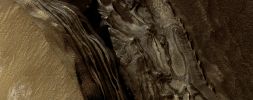
PSP_001334_2645_RED_abrowse-01.jpgNorth Polar Layered Deposits in Head Scarp of Chasma Boreale (EDM - Natural Colors; credits: Lunexit)57 visiteThis EDM shows the NPLD at top and darker materials at bottom exposed in a Scarp at the head of Chasma Boreale, a large canyon eroded into the Layered Deposits.
The Polar Layered Deposits appear of a brown/reddish color because of dust mixed within them, but they are ice-rich as indicated by previous observations. The water ice in the Layered Deposits is probably responsible for the pattern of fractures seen near the top of the scarp.
The darker material below the Layered Deposits may have been deposited as sand dunes, as indicated by the cross-bedding (truncation of curved lines) seen near the middle of the Scarp.
It appears that brighter, ice-rich layers were deposited between the dark dunes in places.
Exposures such as these are useful in understanding the recent climate variations that are likely recorded in the Polar Layered Deposits.MareKromium
|
|
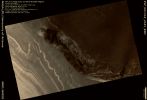
PSP_001334_2645_RED_abrowse-00.jpgNorth Polar Layered Deposits in Head Scarp of Chasma Boreale (CTX Frame - Natural Colors; credits: Lunexit)57 visitenessun commentoMareKromium
|
|
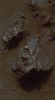
PSP_002101_1875_red-01.jpgMojave Crater Floor and Central Uplift (EDM - Natural Colors; credits: Lunexit)57 visiteThis HiRISE sub-image shows a portion of the Central Uplift structure in Mojave Crater.
Central Uplifts are a typical feature of large impact craters on the Earth, the Moon and Mars; craters larger than 6 or 7 Km in diameter on Mars typically form this mountain-like peak in the central portion of the crater interior.
This peak consists of rocks originating from several kilometers beneath the pre-impact surface. Mojave has a very prominent Central Uplift as it has a diameter of approx. 60 Km (about 37 miles).
In this image, Boulders as large as 15 mt (50 feet) across have been eroded from the massive uplifted rock and have rolled downslope.
Fine-grained Debris has also collected in the topographic lows and has been shaped by the wind into Dunes and Ripples. Notably absent from this image are the striking Drainage Channels and Alluvial Fans that are abundant on the Wall-Terraces and Ejecta of Mojave Crater (see PSP_001415_1875).
These features were likely formed by Surface Runoff of liquid water, which may have been released from the Subsurface during the impact event that formed Mojave.
Previously, it had been suggested that a brief, torrential downpour over Mojave Crater delivered the water. However, Mars Orbiter Camera's (MOC) images of Mojave's Central Uplift have previously shown no evidence for Surface Runoff, and the higher resolution of this HiRISE image (2.4 MB) confirms that this part of the Crater appears untouched by liquid water.
So the question remains: by what means was the water, in the form of Runoff, supplied to Mojave? This question, in addition to several others regarding this phenomenon, are currently being investigated by the HiRISE team and their collaborators.MareKromium
|
|
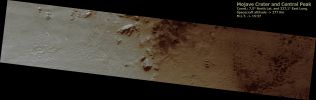
PSP_002101_1875_red-00~0.jpgMojave Crater Floor and Central Uplift (CTX Frame - Natural Colors; credits: Lunexit)57 visiteThis full HiRISE image shows that the Crater Floor - South of the Central Uplift - is densely pitted and fractured. These Pits, many of which are partially filled with dark sand, lack raised rims and a circular form.
This suggests that they are not impact craters. In fact, very few definite impact craters are seen on the Floor and Walls of Mojave, implying that it is incredibly young and relatively well preserved for a crater of its size.
HiRISE images covering Mojave Crater and the surrounding Region are yielding new insights into impact processes on Mars. MareKromium
|
|
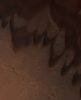
ESP_014404_1765_RED_abrowse-01.jpgEquatorial Martian Barchans (EDM - Natural Colors; credits: NASA/JPL/Univ. of Arizona)57 visiteBarchan Dunes are common on both Earth and Mars. These Dunes are very distinctive in shape, and are important because they can tell scientists about the environment in which they formed.
Barchans form in wind regimes that blow in one Dominant Direction. The ridged arcs of sand that define the Barchan Dunes end in horns that point downwind. Sand is transported up the broad, relatively shallow windward slopes and once it overtops the Dune Crest, the sand falls down a shorter steeper slope between the horns, known as the "Slip Face". Over time, the Barchans migrate downwind, following their horns.
This HiRISE image shows an example of several Barchans merging to form an even larger Barchan Dune. This can happen through a variety of circumstances, such as when smaller, faster dunes collide with larger, slower-moving dunes that absorb them, resulting in single, larger dunes. The distance between the merging horns of the large dune in this highlighted region is a little over 500 meters (about 1600 feet).
Coord.: 3,3° South Lat. and 307,6° East Long.
Spacecraft altitude: about 268 Km
M.L.T.: 14:17 (early afternoon)
S.I.A.: 36° (with the Sun about 54° abov the Local Horizon)
MareKromium
|
|

ESP_013951_1955_RED_abrowse-00.jpgDark Syrtis Major (CTX Frame - Natural Colors; credits: Dr Paolo C. Fienga - Lunexit Team)57 visiteOn 13 October 1659, Dutch Astronomer Christiaan Huygens turned one of his telescopes towards a bright orange spot in the sky and produced what Percival Lowell would later call “the first drawing of Mars worthy of the name ever made by man”.
Huygens included a "dark spot" in his drawing that is thought to represent Syrtis Major, a small sliver of which is visible in this HiRISE image.
Syrtis Major is a Shield Volcano and its dark color comes from the dark Basaltic Rock present in the area, visible because it lacks the Dust that paints the rest of the Planet its distinct, rusty orangish color. By tracking this "dark spot" in repeated observations, Huygens concluded that Mars rotated every 24 hours: a time not too far off from its true rotation period of approx. 24 hours and 39,58 minutes.MareKromium
|
|
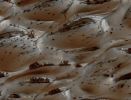
PSP_007962_2635_RED_abrowse-01.jpgNorthern Dunes (EDM - Possible Natural Colors; credits: NASA/JPL/Univ. of Arizona and Dr Paolo C. Fienga - Lunexit Team)57 visiteIn this EDM, falling material has kicked up a small cloud of dust. The color of the ice surrounding adjacent streaks of material suggests that dust has settled on the ice at the bottom after similar events.
Also discernible here are Polygonal Cracks in the ice formed on the Dunes (of course the cracks shall disappear when the ice is gone).MareKromium
|
|
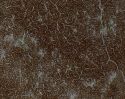
ESP_016160_2485_cut1.jpgPhoenix Lander in Springtime (Natural Colors; credits: Dr Paolo C. Fienga - Lunexit Team)57 visiteWith early Spring at the Phoenix Landing Site comes the progressive sublimation of the Carbon Dioxide frost that has blanketed the Lander and surrounding terrain throughout the Winter.
During the long Polar-Winter Night, atmospheric CO2 freezes onto the Surface building up a layer of frost roughly 30 cm (about one foot) thick.
In the Spring this frost returns to the Atmosphere as gas (sublimates) over the course of several months. This image, part of a seasonal frost monitoring sequence, shows some areas of bare ground are beginning to be exposed. However, extensive frost patches remain in the topographic lows, such as the Troughs of the local polygonally patterned surface.
Even when the frost has completely sublimated, it must be underlined that the Dust deposited during the Winter could actually obscure (and "erase", in a view from atop) any and all the "Man-Made Features" that are still barely visible here (Backshell and Parachute, Heat-Shield and Lander).
The Parachute that is attached to the Backshell, in fact, is not apparent in this image, and we'll see if it reappears in later images.
Also gone are the dark halos around Lander, Backshell and Heat-Shield - again, this is due to seasonal frost and/or dust.
This and future images will help calibrate expectations for finding the Mars Polar Lander hardware which encountered Mars in 1999.MareKromium
|
|
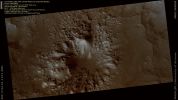
ESP_016136_1525_RED_abrowse-00.jpgColourful Streaks (CTX Frame - Natural Colors; credits: NASA/JPL/Univ. of Arizona and Dr Paolo C. Fienga - Lunexit Team)57 visiteThis is an image of the Central Pit of an Unnamed Impact Crater located in the ancient Southern Highlands.
The Central Uplifts of large Impact Craters often collapse to form Pits on Mars, but they are still structural Uplifts and often expose deep Bedrock with diverse rock types which, like in this case (see the EDM that follows) may show a variety of colors.MareKromium
|
|
| 2237 immagini su 187 pagina(e) |
 |
|
|
|
|
166 | |
|
|
|
|





