| Piú viste - Mars Reconnaissance Orbiter (MRO) |

ESP_014083_0945_RED_abrowse-02.jpgActive Geyser on Mars: the "Mouth" (Natural Colors; credits: Dr M. Faccin & Lunexit)57 visitenessun commentoMareKromium
|
|
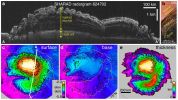
PIA12200.jpgRadar Mapping of Icy Layers Under Mars' North Pole57 visiteThis composite graphic illustrates the use of the Shallow Radar instrument on NASA's Mars Reconnaissance Orbiter for mapping underground ice-rich layers of the North Polar Layered Deposits existing on the North Pole of Mars.
The picture on top of the image-composite, is a radargram from the instrument, showing a cross-section of Mars' North Polar Cap, based on time lags of radio-wave echoes returning from different layers.
The penetrating radar reveals icy layered deposits overlying a basal unit in some areas.
The vertical dimension in the cross section is exaggerated one-hundred-fold compared with the horizontal dimension. The vertical scale bar is one kilometer (3281 feet).
The horizontal scale bar is 100 Km (62 miles).
The Shallow Radar instrument was provided by the Italian Space Agency. Its operations are led by the University of Rome and its data are analyzed by a joint U.S.-Italian science team. NASA's Jet Propulsion Laboratory, a division of the California Institute of Technology in Pasadena, manages the Mars Reconnaissance Orbiter for the NASA Science Mission Directorate, Washington. Lockheed Martin Space Systems, Denver, is the prime contractor for the project and built the spacecraft. The High Resolution Imaging Science Experiment is operated by the University of Arizona, Tucson, and the instrument was built by Ball Aerospace & Technologies Corp., Boulder, Colo.
MareKromium
|
|
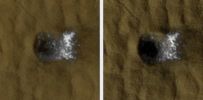
SubsurfaceIce-PIA12219.jpgSubsurface Ice (Natural Colors; credits: Lunexit)57 visiteThis 12-meter-wide (39-foot-wide) Impact Crater located in Mid-Latitude Northern Mars was created by an impact that occurred between July 3, 2004, and June 28, 2008, as bracketed by before-and-after images (not shown here).
The images shown here were taken by the High Resolution Imaging Science Experiment camera on NASA's Mars Reconnaissance Orbiter on Nov. 19, 2008, (left) and on Jan. 8, 2009. Each image is about 35 meters (115 feet) across.
The impact that dug the Crater excavated water ice from below the Surface. It is the bright material visible in this pair of images. This Crater is at 46,16° North Latitude and 188,51° East Longitude.MareKromium
|
|

SubsurfaceIce-PIA12217.jpgSubsurface Ice (Natural Colors; credits: Lunexit)57 visiteThe High Resolution Imaging Science Experiment camera on NASA's Mars Reconnaissance Orbiter took these images of a fresh, 6-meter-wide (20-foot-wide) crater on Mars on Oct. 18, 2008, (left) and on Jan. 14, 2009. Each image is about 35 meters (115 feet) across.
This crater's depth is estimated to be 1,33 meters (4,4 feet).
Images (not shown here) taken by the Thermal Emission Imaging System camera on NASA's Mars Odyssey orbiter and by the Context Camera on the Mars Reconnaissance Orbiter show that the impact that excavated this crater occurred sometime between Dec. 22, 2008 and July 5, 2008.
The impact exposed water ice from below the Surface. It is the bright material visible in this pair of images. The change in appearance from the earlier image to the later one resulted from some of the ice sublimating away during the Martian Northern-Hemisphere Summer, leaving behind dust that had been intermixed with the ice. The thickening layer of dust on top obscured the remaining ice.
This crater is at 43,28° North Latitude and 164,22° East Longitude.MareKromium
|
|

SubsurfaceIce-PIA12214.jpgSubsurface Ice is EVERYWHERE!57 visiteThis map shows five locations where fresh impact cratering has excavated water ice from just beneath the Surface of Mars (sites 1 through 5) and the Viking Lander 2 Landing Site (VL2), in the context of color coding to indicate estimated depth to ice.
The map covers an area from 40 to 60° North Latitude and from 130 to 190° East Longitude. Estimates of the depth to water-ice come from a computer model and observations of the brightness and temperature of the Surface. The model matches the ice-exposing crater observations by NASA's Mars Reconnaissance Orbiter and data from the neutron spectrometer on NASA's Mars Odyssey Orbiter.
Analysis of the observations of ice-exposing fresh craters at sites 1 through 5, reported by Byrne et al. in a Sept. 25, 2009, paper in the journal Science, leads the paper's authors to calculate that if NASA's Viking Lander 2 had been able to dig slightly deeper than the 10-to 15-centimeter-deep (4-to-6-inch-deep) trench that it excavated in 1976, it would have hit water ice.
The color coding indicates depths to the top of a water-ice-containing layer, ranging from 1 cm (about 0,5") in dark-blue coded locations to 10 meters (33 feet) in red-coded locations.MareKromium
|
|
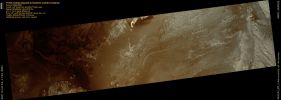
ESP_014154_1730_RED_abrowse.jpgFerric Oxide-Rich Deposit in East Candor Chasma (Natural Colors; credits: Lunexit)57 visitenessun commentoMareKromium
|
|

SubsurfaceIce-PIA12216.jpgFading Fresh Craters with Subsurface Ice (Natural Colors; credits: Lunexit)57 visiteThis series of images spanning a period of 15 weeks shows a pair of fresh, middle-latitude craters on Mars in which some bright, bluish material apparent in the earliest images disappears by the later ones. Each panel is 75 meters (246 feet) across. The two craters are each about 4 meters (13 feet) in diameter and half a meter (1,5 feet) deep.
The bright material is water ice that was uncovered by the meteorite impact that excavated these small craters less than 15 weeks before the initial image of this series. Sublimation of the ice during the Martian Summer leaves behind a dust layer that gradually thickens to the point where it obscures the ice.
The High Resolution Imaging Science Experiment (HiRISE) camera on NASA's Mars Reconnaissance Orbiter took these images of this site at 46,33° North Latitude and 176,90° East Longitude. The HiRISE camera's targeting of the site was prompted by two earlier images from the Context Camera on the Mars Reconnaissance Orbiter, which showed that the impact responsible for these craters had not yet occurred by June 4, 2008, but had occurred by Aug. 10, 2008.
The dates when these six HiRISE images were taken were (left to right, top row; then left to right, bottom row): Sept. 12, 2008; Sept. 28, 2008; Oct. 9, 2008; Oct. 14, 2008; Nov. 22, 2008; and Dec. 25, 2008. The span of time corresponded to a period from mid to late Summer in Mars' Northern Hemisphere. The images are subframes of the observations made on those dates.
The full-frame images are online (same order) at http://hirise.lpl.arizona.edu/PSP_009978_2265;
http://hirise.lpl.arizona.edu/PSP_010189_2265; http://hirise.lpl.arizona.edu/PSP_010334_2265;
http://hirise.lpl.arizona.edu/PSP_010400_2265; http://hirise.lpl.arizona.edu/PSP_010901_2265; and
http://hirise.lpl.arizona.edu/ESP_011323_2265.MareKromium
|
|
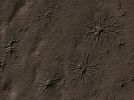
ESP_014413_0930_RED_abrowse-01.jpgRadial Channels carved by CO2 - a.k.a.: The "Spiders" (EDM - Natural Colors; credits: Lunexit)57 visiteIn this EDM we can see, now that all the seasonal frost is gone, the actual appearence of the "Spiders" and we can both use stereo images (when available) or shadows (if any) to measure the depth of the Channels carved into the ground (which, by the way, are usually 1 or 2 meters deep).MareKromium
|
|

ESP_014181_0920_RED_abrowse.jpgThe South Polar Residual Cap (Natural Colors; credits: Lunexit)57 visitenessun commentoMareKromium
|
|
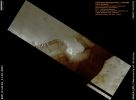
ESP_014190_1130_RED_abrowse.jpgUSGS Dune Database Entry Number 0403-669 (Natural Colors; credits: Lunexit)57 visitenessun commentoMareKromium
|
|
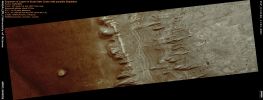
ESP_014186_1745_RED_abrowse.jpgExposures of Layers in South Gale Crater (Natural Colors; credits: Lunexit)57 visitenessun commentoMareKromium
|
|
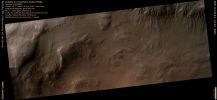
ESP_014187_2230_RED_abrowse.jpgGullies in a Northern Crater Walls (Natural Colors; credits: Lunexit)57 visitenessun commentoMareKromium
|
|
| 2237 immagini su 187 pagina(e) |
 |
|
|
|
|
165 | |
|
|
|
|





