| Piú viste - Mars Reconnaissance Orbiter (MRO) |
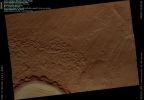
PSP_010100_2165_RED_abrowse.jpgEjecta Blanket (Natural Colors; credits: Lunar Explorer Italia)57 visiteThis image of a crater in the Utopian Region can be described as what happens when heat produced from an impact comes into contact with Mars’ icy Surface.
Since the Surface Temperature of Mars is well below the freezing point of water, Mars’ soil is a mixture of soil and permafrost. When this impact occurred, a great deal of energy in the form of heat was released onto the Surface, creating a melted feature in the bright icy soil. This melting and then refreezing of the ice (as the impact cooled) caused what is known as a "Periglacial Formation". This is depicted towards the middle of the image where the Ejecta Blanket lays.
This is likely a geologically newer surface since the only impacts disrupting the image are a few small craters that are mostly towards the bottom left-hand side of the full image.
The fact the Ejecta Blanket is still intact and not fully collapsed supports the idea that is it a newer surface feature as it has not been affected by erosional processes.MareKromium
|
|

ESP_012195_1750_RED_abrowse.jpgMartian Grand Canyon! (Natural Colors; credits: Lunar Explorer Italia)57 visitenessun commentoMareKromium
|
|

ESP_011917_1790_RED_abrowse.jpgEmbayed Crater in Elysium Planitia (Natural Colors; credits: Lunar Explorer Italia)57 visitenessun commentoMareKromium
|
|

ESP_011732_1595_RED_abrowse-00.jpgLarge Cluster of Small Craters near Maadim Vallis (ctx frame - Natural Colors; credits: Lunar Explorer Italia)57 visitenessun commentoMareKromium
|
|

ESP_011910_1825_RED_abrowse.jpgUnnamed Crater with Layering in Meridiani Planum (Natural Colors; credits: Lunar Explorer Italia)57 visitenessun commentoMareKromium
|
|

ESP_011903_1465_RED_abrowse.jpgOld Features (Natural Colors; credits: Lunar Explorer Italia)57 visitenessun commentoMareKromium
|
|

ESP_012198_0975_RED_abrowse.jpgSouth Polar Icy Features (Natural Colors; credits: Lunar Explorer Italia)57 visitenessun commentoMareKromium
|
|
T-TRA_000853_1900_RED_MarteValles_01.jpgSeepage in Marte Vallis (Natural Colors; credits: Lunar Explorer Italia)57 visitenessun commentoMareKromium
|
|

ESP_011732_1595_RED_abrowse-01.jpgLarge Cluster of Small Craters near Maadim Vallis (edm - Natural Colors; credits: Dr M. Faccin & Lunar Explorer Italia)57 visitenessun commentoMareKromium
|
|
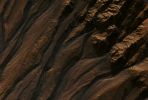
PSP_003583_1425_RED_browse-02.jpgGullies near Gorgonum Chaos (edm - Natural Colors; credits: Dr M. Faccin)57 visitePSP_003583_1425 shows incredible details of an Unnamed Crater with Gullies that provides strong evidence for gully formation involving fluid flow.
Of note is the variety of gully morphologies along the crater walls. The North and West Walls have Gullies, while the South Wall has only Landslides.
"Mass Wasting" is the more general term geologists use to describe Landslides, slumps, and other movements of the ground in response to gravity. It usually occurs on steep slopes when the force of gravity causes weak or loose material to travel downslope. Mass Wasting produces structures that are sometimes similar to gully channels, but which can usually be distinguished by their occurrence on steep slopes.
The Gullies on the North Wall have eroded all the way to the Crater Rim. They appear older than other nearby Gullies because they have existed long enough to be modified by permafrost processes as evidenced by the polgyonal fractures found on some of the channel and inter-gully walls.
Another noticeable difference among the gullies is channel lengths. The Gullies on the North Wall and the group just to the left of these have much shorter channels than the Gullies on the North-Western Wall. It is possible that the Gullies with shorter channels had less fluid flow through their systems. The Gullies appear to originate around a sequence of rocky layers near the Crater Rim.
Many of the gully channels appear to have boulders littered throughout. This is suggestive of a fluid flowing in these channels; a fluid would preferentially transport smaller particles and leave behind the larger ones, such as the boulders seen here.
There are many overprinted small channels in each gully, as can be seen in this edm. These are indicative of multiple flow events such that some channels experience flow, then are abandoned.
The edm also shows several channels merging.
Particularly interesting is the channel flowing from the top of the scene. There are several intertwining channels that merge into one just to the right of the center of the subimage. However, the way some channels truncate others suggests that there were at least three episodes of flow through this area. (written by Kerry Kolb)MareKromium
|
|

ESP_013329_1070_RED_abrowse.jpgSouth Polar Layered Deposits (Natural Colors; credits: Lunar Explorer Italia)57 visiteThe Ice Caps on Mars are surrounded by a thick stack of Layered Deposits. HiRISE and other instruments have shown that these layers are composed of dusty ice. Now imagine this stack of layers as a cake with alternating layers.
What happens if someone comes and takes a big scoop out of the middle of the cake? Well, while our first reaction might be to get mad at them for ruining the cake, take a moment to think what the pattern would look like: it would have rings going round and round the hole. This is what we are seeing in this image of Mars.
The same pattern that you can see HERE!
Therefore, what you see in this frame is just the consequence of some erosional process which has scooped a big hole into the Layered Deposits.MareKromium
|
|

ESP_012912_1320_RED_abrowse.jpgGullies in Noachis Terra (Natural Colors; credits: Lunar Explorer Italia)57 visiteGeologically young Gullies are a prime target for the HiRISE camera. Gullies are located in a variety of settings and are found all over Mars.
This "Ring Trough" or "Eroded Pit Crater", is located in the rugged Southern Highland Terrain known as Noachis Terra. The HiRISE image shows the layered, boulder-rich wall rock facing to the North-East and Gullies that are transporting material downslope.
The material collects into debris aprons along the walls, which often exhibit narrow channels along its surface.MareKromium
|
|
| 2237 immagini su 187 pagina(e) |
 |
|
|
|
|
163 | |
|
|
|
|





