| Piú viste - Mars Reconnaissance Orbiter (MRO) |

ESP_011732_1595_RED_abrowse-01.jpgLarge Cluster of Small Craters near Maadim Vallis (edm - Natural Colors; credits: Dr M. Faccin & Lunar Explorer Italia)57 visitenessun commentoMareKromium
|
|
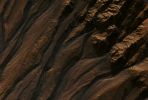
PSP_003583_1425_RED_browse-02.jpgGullies near Gorgonum Chaos (edm - Natural Colors; credits: Dr M. Faccin)57 visitePSP_003583_1425 shows incredible details of an Unnamed Crater with Gullies that provides strong evidence for gully formation involving fluid flow.
Of note is the variety of gully morphologies along the crater walls. The North and West Walls have Gullies, while the South Wall has only Landslides.
"Mass Wasting" is the more general term geologists use to describe Landslides, slumps, and other movements of the ground in response to gravity. It usually occurs on steep slopes when the force of gravity causes weak or loose material to travel downslope. Mass Wasting produces structures that are sometimes similar to gully channels, but which can usually be distinguished by their occurrence on steep slopes.
The Gullies on the North Wall have eroded all the way to the Crater Rim. They appear older than other nearby Gullies because they have existed long enough to be modified by permafrost processes as evidenced by the polgyonal fractures found on some of the channel and inter-gully walls.
Another noticeable difference among the gullies is channel lengths. The Gullies on the North Wall and the group just to the left of these have much shorter channels than the Gullies on the North-Western Wall. It is possible that the Gullies with shorter channels had less fluid flow through their systems. The Gullies appear to originate around a sequence of rocky layers near the Crater Rim.
Many of the gully channels appear to have boulders littered throughout. This is suggestive of a fluid flowing in these channels; a fluid would preferentially transport smaller particles and leave behind the larger ones, such as the boulders seen here.
There are many overprinted small channels in each gully, as can be seen in this edm. These are indicative of multiple flow events such that some channels experience flow, then are abandoned.
The edm also shows several channels merging.
Particularly interesting is the channel flowing from the top of the scene. There are several intertwining channels that merge into one just to the right of the center of the subimage. However, the way some channels truncate others suggests that there were at least three episodes of flow through this area. (written by Kerry Kolb)MareKromium
|
|

ESP_013329_1070_RED_abrowse.jpgSouth Polar Layered Deposits (Natural Colors; credits: Lunar Explorer Italia)57 visiteThe Ice Caps on Mars are surrounded by a thick stack of Layered Deposits. HiRISE and other instruments have shown that these layers are composed of dusty ice. Now imagine this stack of layers as a cake with alternating layers.
What happens if someone comes and takes a big scoop out of the middle of the cake? Well, while our first reaction might be to get mad at them for ruining the cake, take a moment to think what the pattern would look like: it would have rings going round and round the hole. This is what we are seeing in this image of Mars.
The same pattern that you can see HERE!
Therefore, what you see in this frame is just the consequence of some erosional process which has scooped a big hole into the Layered Deposits.MareKromium
|
|

ESP_012912_1320_RED_abrowse.jpgGullies in Noachis Terra (Natural Colors; credits: Lunar Explorer Italia)57 visiteGeologically young Gullies are a prime target for the HiRISE camera. Gullies are located in a variety of settings and are found all over Mars.
This "Ring Trough" or "Eroded Pit Crater", is located in the rugged Southern Highland Terrain known as Noachis Terra. The HiRISE image shows the layered, boulder-rich wall rock facing to the North-East and Gullies that are transporting material downslope.
The material collects into debris aprons along the walls, which often exhibit narrow channels along its surface.MareKromium
|
|

ESP_011884_2045_RED_abrowse-00.jpgUnusual Translucent Surface on the edge of a candidate Collapse Pit (context frame - Natural Colors; credits: Lunar Explorer Italia)57 visiteChe la Regione Marziana di Mawrth Vallis costituisca una priorità nelle investigazioni orbitali poste in essere dalla NASA tramite la Sonda MRO, è un fatto; un altro fatto è che sarà un'area di questa Regione quella che costituirà, con ogni probabilità, la destinazione finale del Rover denominato Mars Science Laboratory.
Ufficialmente, Mawrth Vallis è una Regione che presenta delle caratteristiche mineralogicdhe superficiali talmente variegate e straordinarie, che l'investigazione ravvicinata delle medesime appare - effettivamente - un passaggio obbligato per la piena e corretta comprensione della Superficie del Pianeta Rosso, ivi inclusa la sua Storia ed il suo Presente.
Tuttavia, dopo aver attentamente esaminato alcune (poche, ma riteniamo significative) porzioni di Mawrth Vallis attraverso i frames MRO in formato JP2000, ci siamo convinti che la questione mineralogica, per quanto importante possa essere, non è certo l'unico motivo per cui la NASA si è fissata in maniera così evidente su questa Regione. C'è dell'altro, evidentemente.
Abbiamo individuato, ad esempio, alcuni rilievi superficiali COMPLETAMENTE ANOMALI ED INESPLICABILI (almeno da un punto di vista geomorfologico), sui quali la NASA e gli Scienziati Convenzionali hanno deciso di "glissare" completamente (insomma: dato che escludiamo l'ipotesi per cui non li abbiano notati, diciamo pure che costoro non hanno intenzione di parlarne). Beh, Voi lo sapete: noi NON SIAMO la NASA e NON SIAMO Scienziati Convenzionali e quindi...
Nel successivo detail mgnf (edm), infatti, osservando la parete Sud-Est di un rilievo che riteniamo essere un pozzo da collasso di modestissime dimensioni, potrete notare una bizzarra Superficie Translucida la quale, in particolar modo nella elaborazione in Falsi Colori (curata dal Dr Faccin), ma anche in quella in Colori Naturali (curata dal Dr Fienga), si evidenzia in tutta la sua originale complessità.
Vi risparmiamo, in questa sede ed in questo momento, le ipotesi sulla possibile Natura del dettaglio, ma Vi invitiamo ad osservarlo con ESTREMA ATTENZIONE ed APERTURA MENTALE, poichè esso rappresenta l'espressione visibile di quelle che, a nostro parere sono le vere ed uniche Surface Features che rendono Marte un Mondo Alieno, tutt'altro che "vicino" e "familiare" alla nostra Cara e Vecchia Terra...MareKromium
|
|

ESP_012570_1670_RED_abrowse.jpgLight and Intermediate-Toned Material near Morava Valles (Natural Colors; credits: Lunar Explorer Italia)57 visitenessun commentoMareKromium
|
|
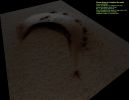
PSP_007080_2565.jpgBarchan Dune in Vastitas Borealis (Perspective View and Natural Colors; credits: Dr G. Barca)57 visitenessun commentoMareKromium
|
|
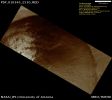
PSP_010345_2510_RED_abrowse.jpgUnnamed Crater in Vastitas Borealis (Natural Colors; credits: Lunar Explorer Italia)57 visitenessun commentoMareKromium
|
|

PSP_009470_1965_RED_abrowse.jpgBeautiful Gullies (Natural Colors; credits: Lunexit)57 visitenessun commentoMareKromium
|
|

ESP_013954_1780_RED_abrowse-01.jpgOpportunity near Victoria Crater (by Dr M. Faccin)57 visitenessun commentoMareKromium
|
|

PSP_001348_1770_RED_abrowse-02.jpgUnusual Crater in Meridiani Planum (SuperEDM-JP2 - Natural Colors; credits: Dr M. Faccin & Lunar Explorer Italia)57 visitenessun commentoMareKromium
|
|

PIA12194.jpgGullies at the Edge of Hale Crater (Natural Colors; credits: NASA/JPL/Univ. of Arizona)57 visiteThis image from the High Resolution Imaging Science Experiment (HiRISE) camera on NASA's Mars Reconnaissance Orbiter shows Gullies near the edge of Hale Crater on Southern Mars. The view covers an area about 1 Km (0,6 miles) across and was taken on Aug. 3, 2009.
Martian Gullies carved into hill slopes and the walls of impact craters were discovered several years ago. Scientists are excited to study these features because, on Earth, they usually form through the action of liquid water -- long thought to be absent on the Martian Surface. Whether liquid water carves gullies under today's cold and dry conditions on Mars is a major question that planetary scientists are trying to answer.
The Gullies pictured here are examples of what a typical Martian Gully looks like. You can see wide V-shaped channels running downhill (from top to bottom) where the material that carved the gully flowed. At the bottom of the channel this material empties out onto a fan-shaped mound. The fans from each gully overlap one other in complicated ways. At the tops of the channels, large amphitheater-shaped alcoves are carved in the rock. The material removed from these alcoves likely flowed downhill to the aprons through the Gullies.
The terrain in this image is at 36,5° South Latitude and 322,7° East Longitude.
Gullies at this site are especially interesting because scientists recently discovered actively changing examples at similar locations. Images separated by several years showed changes in the appearance of some of these Gullies. Today, planetary scientists are using the HiRISE camera to examine Gullies such as the one in this image for change that might provide a clue about whether liquid water occurs on the Surface of Mars.
Full-frame images, catalogued as ESP_014153_1430, are at http://hirise.lpl.arizona.edu/ESP_014153_1430.
The image was taken at 2:21 p.m. Local Mars Time, with the sun 54° above the horizon (S.I.A. = 36°).
The season was Summer in the Southern Hemisphere of Mars.MareKromium
|
|
| 2237 immagini su 187 pagina(e) |
 |
|
|
|
|
162 | |
|
|
|
|





