| Piú viste - Mars Reconnaissance Orbiter (MRO) |
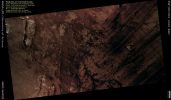
PSP_007095_2020_RED_abrowse~0.jpgInverted Dendritic Stream Channels in Antoniadi Crater (MULTISPECTRUM; credits: Lunexit)57 visiteThis observation is centered within Antoniadi Crater. This crater, even prior to the MRO mission, was identified as a likely ancient lake (now dry) that was supplied by both surface water and ground water.
The image provides further tantalizing evidence of a water-rich past. Most of the flat parts of the image have a polygonal texture, which commonly forms when mud dries. In the center of the image are branched (“dendritic”) features that connect Southward to a larger trunk-shaped landform; the branches resemble stream channels on Earth. Unlike active channels with water, these features are “inverted”, or elevated above the surrounding terrain.
Again, in analogy with such features seen on our Planet, these probably formed when materials deposited by the streams, such as coarse gravel, or chemical cementation after removal of the water, caused the channel bottoms to become resistant. Over time, natural erosion from wind and other processes left the inverted channels elevated above the surrounding terrain.
The branched features are probably remnants of small tributary streams that fed the larger trunk-shaped stream. It appears that the inverted streams lie on top of, and are therefore younger, than the polygons. This area may have first had a lake that later dried to form the polygons, followed by episodes of stream flow and erosion.MareKromium
|
|

PSP_005571_0950_RED_abrowse-00~0.jpgSouth Polar Residual Cap Margin (context frame; MULTISPECTRUM - elab. Lunexit)57 visiteThis scene is about 2,7 Km (approx. 1,7 miles) long and shows part of the edge of the South Polar Residual Cap (...).
The relatively bright, grayish areas are the Residual Cap, and the darker, reddish areas are mostly likely covered by dust. The South Polar Residual Cap is made, for the most part, of Carbon Dioxide ice (commonly called "dry ice") and dust, with a little water ice in some places.MareKromium
|
|

PSP_005392_0995_RED_abrowse-00~0.jpgImpact Crater on the South Polar Layered Deposits (context frame; MULTISPECTRUM - credits: Lunexit)57 visiteThis image covers a portion of the ice-rich SPLD.
Layers in the Mars Polar Regions are of great interest because layers in ice on the Earth, as in the Antarctic and Greenland ice caps, are known to contain records of past atmospheric, environmental, and climate conditions. By studying Mars Polar Layers, we hope to be able to understand the past climate and history of water on the Red Planet.MareKromium
|
|
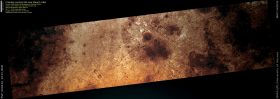
PSP_006610_2035_RED_abrowse~0.jpgPotential MSL Landing Site near Mawrth Vallis (MULTISPECTRUM; credits: Lunexit)57 visiteMawrth Vallis contains clay minerals that formed by chemical alteration of rocks by water. It is one of the short list of potential sites that the Mars Science Laboratory Rover will land at, and the HiRISE team is working to find a safe place to land in this area.
This observation shows a wide variety of scientifically interesting terrains as well as some potential hazards for landing. The central part of the image is dominated by light-toned materials with curving fractures of many different sizes. These fractures do not have a preferred orientation, indicating that they did not form in response to some regional stress pattern.
Instead, they formed by some more uniform process, possibly the drying of a thick mud deposit or the gradual rebound of the area as the overlying material was eroded away. The scattered mounds and sand dunes may or may not prove to be a danger, but it is reassuring to see that many of the impact craters have been smoothed out with a filling of wind-blown sand.MareKromium
|
|
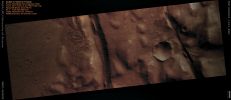
PSP_006695_1415_RED_abrowse~0.jpgGullies in Sirenum Fossae (MULTISPECTRUM; credits: Lunexit)57 visiteThis image shows parts of Sirenum Fossae that are southwest of Gorgonum Chaos. Some of the troughs (Fossae) have gullies on their walls. Gullies are incised slope features that are thought to have formed by liquid water flowing down the slopes.
It is unknown whether the water came from the subsurface or above the surface. The plains around the troughs have a number of mesas and hills that might have formed from erosion of a once-larger rock unit.
The left side of the image shows some dark linear features which MIGHT BE Dust Devil Tracks.MareKromium
|
|

PSP_005424_1700_RED_abrowse~0.jpgAurorae Chaos (MULTISPECTRUM; credits: Lunexit)57 visiteThis observation shows a portion of Aurorae Chaos, chaotic terrain East of the Vallis Marineris Canyon System. Aurorae Chaos extends from Capri and Eos Chasmata on the West, into Hydraotes and Aureum Chaos on the North and East.
Chaotic terrain is thought to form from subsurface collapse following volatile release. It is possible that the Martian crust was at one time enriched in ices that became gases or liquid at relatively low temperatures upon encountering a heat source or was violently shaken. These ices existed in spaces between soil particles. If a large volume of volatiles is suddenly released, then there is a large portion of the soil volume missing. The soil cannot support itself, so it collapses.
Since chaotic terrain is often located at the head of the Martian outflow channels (giant flood plains), it is also possible that the Chaotic Regions are the source of the fluids that formed the outflow channels.
Aurorae Chaos connects to outflow channels via other Chaotic Regions.MareKromium
|
|

ESP_011351_0945_RED_abrowse.jpgFans on Ice (Natural Colors; credits: Lunar Explorer Italia)57 visiteEvery Southern Winter the South Polar Region of Mars is covered with an approximately 1 meter deep layer of frozen CO2 (dry ice). In the Spring, when the Sun begins to warm the surface below the translucent ice, gas flow under the ice carries loose dust from the surface up onto the top.
The dust falls to the surface in "Fans", whose orientation is determined by the direction of the local wind flow. Fans from one source region pointing in multiple directions show how the wind direction has changed. Narrow Fans pointing in just one direction are the most recent. Alternatively, the vent from the surface may have re-annealed, such that these Fans were formed over a very limited time span.
Mars Local Time: 18:19 (sunset - early evening)
Coord. (centered): 85,2° South Lat. and 181,6° East Long.
Spacecraft altitude: 247,4 Km (such as about 154,6 miles)
Original image scale range: 99,0 cm/pixel (with 1 x 1 binning) so objects ~2,97 mt across are resolved
Map projected scale: 1 mt/pixel
Map projection: EQUIRECTANGULAR
Emission Angle: 4,2°
Phase Angle: 86,4°
Solar Incidence Angle: 90° (meaning that the Sun is about 0° on the Local Horizon)
Solar Longitude: 181,2° (Northern Autumn)
Credits: NASA/JPL/University of Arizona
Additional process. and coloring: Lunar Explorer ItaliaMareKromium
|
|
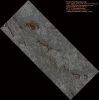
PSP_005095_0935_RED_browse~0.jpgSouth Pole Residual Cap (Swiss-Cheese Terrain Monitoring) - (Natural Colors; credits: Lunar Explorer Italia)57 visitenessun commentoMareKromium
|
|

ESP_011765_1780_RED_abrowse-00.jpgRipples in Meridiani Planum (ctx frame - Natural Colors; credits: Lunar Explorer Italia)57 visiteMars Local Time: 15:46 (middle afternoon)
Coord. (centered): 2,1° South Lat. and 354,5° East Long.
Spacecraft altitude: 276,0 Km (such as about 172,5 miles)
Original image scale range: 27,6 cm/pixel (with 1 x 1 binning) so objects ~83 cm across are resolved
Map projected scale: 25 cm/pixel
Map projection: EQUIRECTANGULAR
Emission Angle: 12,5°
Phase Angle: 69,0°
Solar Incidence Angle: 57° (meaning that the Sun is about 33° above the Local Horizon)
Solar Longitude: 200,0° (Northern Autumn)
Credits: NASA/JPL/University of Arizona
Additional process. and coloring: Lunar Explorer ItaliaMareKromium
|
|

ESP_011648_1730_RED_abrowse-01.jpgOval Mesa on Ganges Mensa (and another "mistery" solved) - Full image, map projected, RAW b/w57 visitenessun commentoMareKromium
|
|

ESP_011605_1170_RGB.jpgDefrosting Malea Patera (edm - possible True Colors; credits: Dr M. Faccin)57 visitenessun commentoMareKromium
|
|
PSP_010432_2380_RED_abrowse.jpgCentral Peak of an Unnamed Crater of Vastitas Borealis (Natural Colors; credits: Lunar Explorer Italia)57 visiteMars Local Time: 15:22 (early afternoon)
Coord. (centered): 57,9° North Lat. and 19,8° East Long.
Spacecraft altitude: 310,5 Km (such as about 194,0 miles)
Original image scale range: 31,1 cm/pixel (with 1 x 1 binning) so objects ~ 963 cm across are resolved
Map projected scale: 25 cm/pixel
Map projection: EQUIRECTANGULAR
Emission Angle: 0,7°
Phase Angle: 56,7°
Solar Incidence Angle: 57° (meaning that the Sun is about 33° above the Local Horizon)
Solar Longitude: 143,1° (Northern Summer)
Credits: NASA/JPL/University of Arizona
Additional process. and coloring: Lunar Explorer ItaliaMareKromium
|
|
| 2237 immagini su 187 pagina(e) |
 |
|
|
|
|
160 | |
|
|
|
|





