| Piú viste - Mars Reconnaissance Orbiter (MRO) |
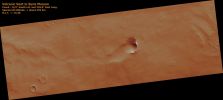
Psp_001840_1660_red.jpgVolcanic Vent in Syria Planum (natural colors; credits: Lunar Explorer Italia)57 visitePrevious images of this area by other space missions indicate that this is a shield volcano with very shallow slopes. What HiRISE reveals is that it is completely covered by a blanket of dust.
While volcanic featues remain obscure, the dust does exhibit some very strange patterns. As you zoom into the middle of the image, the ground appears covered with a fine network of light and dark polygons. But at full resolution, it can be seen that these polygons are actually the edges of small scallops.
The dust is apparently held together by some unknown means, giving it sufficient strength to be carved into this strange pattern.MareKromium
|
|
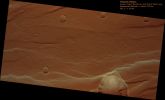
Psp_001840_2000_red.jpgTharsis' Plains (natural colors; credits: Lunar Explorer Italia)57 visiteThis HiRISE image samples the plains between the large shelf volcanoes in the Tharsis Region of Mars.
The long scarps in the area have been formed by faults as the ground was pulled apart. The large circular depression on the edge of the image is a giant collapse pit that appears to be related to the opening up of crust.
If you look at this image carefully, much of the plains appears blurry, as if the picture was out of focus. But HiRISE remains in perfect focus and it is Mars that is actually this blurry. Soft wind-blown dust mutes all the features in the area to create this effect.MareKromium
|
|

Psp_001860_1685_red.jpgLight-colored terrain in the Southern Highlands (possible True Colors; credits: Lunar Explorer Italia)57 visiteThis HiRISE image shows part of the floor of a large impact crater in the southern highlands, north of the giant Hellas impact basin. Most of the crater floor is dark, with abundant small ripples of wind-blown material. However, a pit in the floor of the crater has exposed light-toned, fractured rock.
The light-toned material appears fractured at several different scales. These fractures are called joints, and result from stresses on the rock after its formation.
Joints are similar to faults, but have undergone virtually no displacement. With careful analysis, joints can provide insight into the forces that have affected a unit of rock, and thus into its geologic history. The fractures appear dark; this may be due to trapping of dark, wind-blown sand in the crack, to precipitation of different minerals along the fracture, or both.MareKromium
|
|
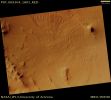
PSP_009304_1805_RED.jpgEquatorial Rocky Terrain (possible True Colors; credits: Lunar Explorer Italia)57 visiteMars Local Time: 15:25 (early afternoon)
Coord. (centered): 0,6° North Lat. and 223,9° East Long.
Spacecraft altitude: 269,2 Km (such as about 168,2 miles)
Original image scale range: 53,9 cm/pixel (with 1 x 1 binning) so objects ~1,62 mt across are resolved
Map projected scale: 50 cm/pixel
Map projection: EQUIRECTANGULAR
Emission Angle: 0,0°
Phase Angle: 55,1°
Solar Incidence Angle: 55° (meaning that the Sun is about 35° above the Local Horizon)
Solar Longitude: 101,7° (Northern Summer)
Credits: NASA/JPL/University of Arizona
Additional process. and coloring: Lunar Explorer ItaliaMareKromium
|
|

PSP_005514_1360_RED_abrowse~0.jpgDunefield inside Rabe Crater (False Colors - elab. Lunexit)57 visiteThis image shows part of the floor of Rabe Crater, a large (about 108 Km, or approx. 67 miles in diameter) impact crater in the Southern Highlands.
Dark dunes — accumulations of wind blown sand — cover part of crater's floor and contrast with the surrounding bright-colored outcrops. The extreme close-up view reveals a thumbprint-like texture of smaller ridges and troughs covering the surfaces of the larger dunes.
These smaller ripples are also formed and shaped by blowing wind in the thin atmosphere of Mars.
One puzzling question is why the dunes are dark compared with the relative bright layered material contained within the Crater.
The probable answer is that the source of the dark sand is not local to this Crater; rather, this topographic depression has acted as a sand trap that has collected material being transported by winds blowing across the plains outside the Crater. MareKromium
|
|

Psp_009342_2650_red.jpgNorthern Dunes (possible True Colors; credits: Lunar Explorer Italia)57 visiteMars Local Time: 13:43 (early afternoon)
Coord. (centered): 84,9° North Lat. and 234,4° East Long.
Spacecraft altitude: 319,4 Km (such as about 199,6 miles)
Original image scale range: 32,0 cm/pixel (with 1 x 1 binning) so objects ~96 cm across are resolved
Map projected scale: 25 cm/pixel
Map projection: EQUIRECTANGULAR
Emission Angle: 6,5°
Phase Angle: 55,9°
Solar Incidence Angle: 61° (meaning that the Sun is about 29° above the Local Horizon)
Solar Longitude: 103,0° (Northern Summer)
Credits: NASA/JPL/University of Arizona
Additional process. and coloring: Lunar Explorer ItaliaMareKromium
|
|
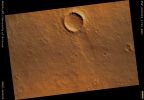
PSP_009391_1755_RED.jpgPeri-Equatorial Dusty Terrain (possible True Colors; credits: Lunar Explorer Italia)57 visiteMars Local Time: 15:30 (middle afternoon)
Coord. (centered): 4,5° South Lat. and 10,0° East Long.
Spacecraft altitude: 271,7 Km (such as about 169,8 miles)
Original image scale range: 27,2 cm/pixel (with 1 x 1 binning) so objects ~82 cm across are resolved
Map projected scale: 25 cm/pixel
Map projection: EQUIRECTANGULAR
Emission Angle: 9,5°
Phase Angle: 51,6°
Solar Incidence Angle: 59° (meaning that the Sun is about 31° above the Local Horizon)
Solar Longitude: 104,7° (Northern Summer)
Credits: NASA/JPL/University of Arizona
Additional process. and coloring: Lunar Explorer ItaliaMareKromium
|
|
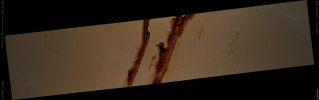
Psp_009557_1905_red.jpgChannels in Athabasca Valles (Natural Colors; credits for the additional process. and color.: Dr Paolo C. Fienga - Lunar Explorer Italia)57 visiteMars Local Time: 15:32 (middle afternoon)
Coord. (centered): 10,3° North Lat. and 157,0° East Long.
Spacecraft altitude: 292,6 Km (such as about 182,9 miles)
Original image scale range: 29,3 cm/pixel (with 1 x 1 binning) so objects ~88 cm across are resolved
Map projected scale: 25 cm/pixel
Map projection: EQUIRECTANGULAR
Emission Angle: 19,7°
Phase Angle: 35,8°
Solar Incidence Angle: 52° (meaning that the Sun is about 38° above the Local Horizon)
Solar Longitude: 110,6° (Northern Summer)
Credits: NASA/JPL/University of Arizona
Additional process. and coloring: Lunar Explorer ItaliaMareKromium
|
|
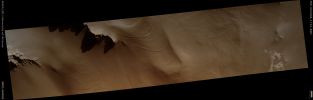
Psp_009408_1715_red.jpgShadowland (possible True Colors; credits: Lunar Explorer Italia)57 visiteMars Local Time: 15:31 (middle afternoon)
Coord. (centered): 8,3° South Lat. and 266,4° East Long.
Spacecraft altitude: 263,4 Km (such as about 164,6 miles)
Original image scale range: 52,7 cm/pixel (with 1 x 1 binning) so objects ~1,58 mt across are resolved
Map projected scale: 50 cm/pixel
Map projection: EQUIRECTANGULAR
Emission Angle: 10,5°
Phase Angle: 53,3°
Solar Incidence Angle: 61° (meaning that the Sun is about 29° above the Local Horizon)
Solar Longitude: 105,3° (Northern Summer)
Credits: NASA/JPL/University of Arizona
Additional process. and coloring: Lunar Explorer ItaliaMareKromium
|
|
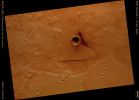
Psp_009427_2190_red.jpgSmall and "fresh" Crater in Utopia Planitia (possible True Colors; credits: Lunar Explorer Italia)57 visiteMars Local Time: 15:16 (early afternoon)
Coord. (centered): 38,5° North Lat. and 100,3° East Long.
Spacecraft altitude: 297,4 Km (such as about 185,9 miles)
Original image scale range: 29,8 cm/pixel (with 1 x 1 binning) so objects ~89 cm across are resolved
Map projected scale: 25 cm/pixel
Map projection: EQUIRECTANGULAR
Emission Angle: 4,4°
Phase Angle: 48,1°
Solar Incidence Angle: 44° (meaning that the Sun is about 46° above the Local Horizon)
Solar Longitude: 106,0° (Northern Summer)
Credits: NASA/JPL/University of Arizona
Additional process. and coloring: Lunar Explorer ItaliaMareKromium
|
|

Psp_009460_2665_red.jpgSmall Crater on the North Polar Permanent Cap (possible True Colors; credits: Lunar Explorer Italia)57 visiteMars Local Time: 12:06 (early afternoon)
Coord. (centered): 86,5° North Lat. and 227,9° East Long.
Spacecraft altitude: 317,5 Km (such as about 198,4 miles)
Original image scale range: 31,8 cm/pixel (with 1 x 1 binning) so objects ~95 cm across are resolved
Map projected scale: 25 cm/pixel
Map projection: EQUIRECTANGULAR
Emission Angle: 0,2°
Phase Angle: 62,6°
Solar Incidence Angle: 62° (meaning that the Sun is about 28° above the Local Horizon)
Solar Longitude: 107,2° (Northern Summer)
Credits: NASA/JPL/University of Arizona
Additional process. and coloring: Lunar Explorer ItaliaMareKromium
|
|
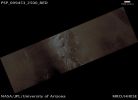
Psp_009453_2500_red.jpgThe Southern Rim of Louth Crater (possible True Colors; credits: Lunar Explorer Italia)57 visiteMars Local Time: 14:57 (early afternoon)
Coord. (centered): 69,9° North Lat. and 103,3° East Long.
Spacecraft altitude: 313,8 Km (such as about 196,1 miles)
Original image scale range: 62,8 cm/pixel (with 1 x 1 binning) so objects ~1,88 mt across are resolved
Map projected scale: 50 cm/pixel
Map projection: EQUIRECTANGULAR
Emission Angle: 0,5°
Phase Angle: 53,1°
Solar Incidence Angle: 53° (meaning that the Sun is about 37° above the Local Horizon)
Solar Longitude: 106,9° (Northern Summer)
Credits: NASA/JPL/University of Arizona
Additional process. and coloring: Lunar Explorer ItaliaMareKromium
|
|
| 2237 immagini su 187 pagina(e) |
 |
|
|
|
|
158 | |
|
|
|
|





