| Piú viste - Mars Reconnaissance Orbiter (MRO) |

PSP-20081120_spirit.jpgSpirit from orbit57 visiteThe solar system's most celebrated team of off-planet drivers cheered when they heard the news. Spirit had phoned home from Mars, ending four days of silence. The team had kept the rover safe, with help from a friend named "Marci."
Spirit had survived a fierce and sudden dust storm that had driven solar power to all-time lows. Without being able to notify Earth, Spirit had followed instructions the team sent to protect the rover.
The team had received warning from scientists who keep tabs on Martian weather with MARCI -- short for Mars Color Imager. From orbit, the instrument showed thick, swirling dust clouds advancing from the west. Engineers responded with instructions to conserve energy. They told Spirit to turn off a heater and do only two things each day -- check battery power and dust in the atmosphere.
As directed, Spirit contacted Earth on Nov. 13, 2008. MareKromium
|
|
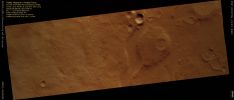
PSP_009706_2125_RED.jpgValley Network in Arabia Terra (Saturated and Enhanced Natural Colors; credits for the additional process. and color.: Dr Paolo C. Fienga - Lunexit Team)57 visiteThe central portion of this image includes a portion of a Valley Network in Arabia Terra. In lower resolution images, this meander (a bend in a valley) appeared discontinuous - hence its selection as a target for HiRISE. However, at HiRISE resolution the valley is visible throughout its course.
This is a mid-latitude scene where ground ice is believed to be stable relatively near the surface today. The mottled terrain visible throughout the image could be a sublimation texture. Sublimation occurs when ice goes directly to the gas phase.
When this happens, the space beneath the subsurface that the ice previously occupied is now empty, allowing the remaining surface to collapse and form the observed texture.
Several of the craters in this scene have flattened appearances, which may have resulted from ice-rich material being driven by gravity into the crater centers.MareKromium
|
|
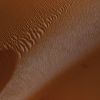
PSP_010221_1420_RED_abrowse-01.jpgAeolian Features (EDM - False Colors; credits for the additional process. and color.: Dr Paolo C. Fienga - Lunexit Team)57 visiteThis image is particularly interesting because of the occurrence of seasonal frost on the South-facing slopes (the image is relevant to the Southern Hemisphere, so South faces the Pole and gets little Winter light). This is particularly apparent in this natural colors view, as the frost forms pale, blue-grey-silver patterns. On the dunes, this highlights some of the regular patterns, as the frost forms only on parts of the ripples. The result is an intricately textured pattern of color.MareKromium
|
|

PSP_010334_1760_RED.jpgYardangs in Southern Amazonis Planitia (natural colors; credits: Lunexit)57 visiteThis image shows Yardangs, or Ridges formed from wind abrasion, in the Southern Amazonis Planitia, which is located between the Tharsis and Elysium Volcanic Provinces on Mars.
Yardangs typically form in dry, desert environments with strong prevailing winds that are unidirectional and carry an abrasive sediment load. Abrasive winds erode the surface into parallel elongate landforms, or ridges, that are often three or more times longer than they are wide. When viewed from above, these landforms resemble the hull of a boat. Yardangs typically form in easily-eroded material, most likely sedimentary rock or volcanic ash deposits that contain some amount of sand. Sometime after the formation of these landforms, they were covered by a relatively thin, uniform coating of dust giving the area a monotone appearance. Dark slope streaks, interpreted as forming by avalanching of the dry dust, are visible on several of the slopes.
Yardangs are found on both Earth and Mars and are common on Mars in the Regions West and South-West of Olympus Mons, such as the area in this image in the southern Amazonis Planitia.MareKromium
|
|
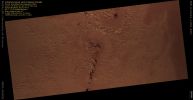
PSP_010269_1900_RED.jpgVolcanic Fissure Vent in Elysium Planitia (natural colors; credits: Lunexit)57 visiteThis observation shows lava-covered plains in the Elysium Planitia region of Mars, located near the equator.
Two distinct lavas are visible in this image. The darker lava to the north (top) is the edge of the youngest major lava flow on Mars; it was fed by a voluminous eruption that coursed through the Athabasca Valles channel system.
The lighter-toned lava that covers the remainder of this image is older and dustier. It has a striped appearance due to slender dunes or ripples composed of windblown materials that are oriented northwest-southeast.
The most prominent feature in this image is the discontinuous line of pits and troughs that cuts across its center. It is an ancient volcanic fissure vent. Lava once erupted through this fracture onto the surface. The irregular depressions around the troughs may either be due to near-vent erosion by the lava or to the ponding and drain-back of the lava around the vent.
MareKromium
|
|

PSP_002290_1585andPSP_001868_1585-MemnoniaFossae-Channel-CollapseFeatures.jpgChannel and Graben in Memnonia Fossae (Hi-Def-3D - Extremely Enhanced Natural Colors; credits: Dr M. Faccin & Lunar Explorer Italia)57 visiteLatitude (centered): 21,5° South
Longitude (East): 211,2 °
Range to target site: 261,1 Km (approx. 163,2 miles)
Original image scale range: 26,1 cm/pixel (with 1 x 1 binning) so objects ~78 cm across are resolved
Map projected scale: 25 cm/pixel and North is up
Map projection: EQUIRECTANGULAR
M.L.T.: 15:37 (middle afternoon)
Emission angle: 9,3°
Phase angle: 70,6°
Solar Incidence Angle: 63°, with the Sun about 27 ° above the Local Horizon
Solar Longitude: 153,1° (Northern Summer)MareKromium
|
|
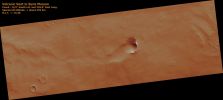
Psp_001840_1660_red.jpgVolcanic Vent in Syria Planum (natural colors; credits: Lunar Explorer Italia)57 visitePrevious images of this area by other space missions indicate that this is a shield volcano with very shallow slopes. What HiRISE reveals is that it is completely covered by a blanket of dust.
While volcanic featues remain obscure, the dust does exhibit some very strange patterns. As you zoom into the middle of the image, the ground appears covered with a fine network of light and dark polygons. But at full resolution, it can be seen that these polygons are actually the edges of small scallops.
The dust is apparently held together by some unknown means, giving it sufficient strength to be carved into this strange pattern.MareKromium
|
|
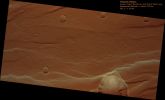
Psp_001840_2000_red.jpgTharsis' Plains (natural colors; credits: Lunar Explorer Italia)57 visiteThis HiRISE image samples the plains between the large shelf volcanoes in the Tharsis Region of Mars.
The long scarps in the area have been formed by faults as the ground was pulled apart. The large circular depression on the edge of the image is a giant collapse pit that appears to be related to the opening up of crust.
If you look at this image carefully, much of the plains appears blurry, as if the picture was out of focus. But HiRISE remains in perfect focus and it is Mars that is actually this blurry. Soft wind-blown dust mutes all the features in the area to create this effect.MareKromium
|
|

Psp_001860_1685_red.jpgLight-colored terrain in the Southern Highlands (possible True Colors; credits: Lunar Explorer Italia)57 visiteThis HiRISE image shows part of the floor of a large impact crater in the southern highlands, north of the giant Hellas impact basin. Most of the crater floor is dark, with abundant small ripples of wind-blown material. However, a pit in the floor of the crater has exposed light-toned, fractured rock.
The light-toned material appears fractured at several different scales. These fractures are called joints, and result from stresses on the rock after its formation.
Joints are similar to faults, but have undergone virtually no displacement. With careful analysis, joints can provide insight into the forces that have affected a unit of rock, and thus into its geologic history. The fractures appear dark; this may be due to trapping of dark, wind-blown sand in the crack, to precipitation of different minerals along the fracture, or both.MareKromium
|
|
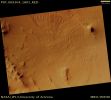
PSP_009304_1805_RED.jpgEquatorial Rocky Terrain (possible True Colors; credits: Lunar Explorer Italia)57 visiteMars Local Time: 15:25 (early afternoon)
Coord. (centered): 0,6° North Lat. and 223,9° East Long.
Spacecraft altitude: 269,2 Km (such as about 168,2 miles)
Original image scale range: 53,9 cm/pixel (with 1 x 1 binning) so objects ~1,62 mt across are resolved
Map projected scale: 50 cm/pixel
Map projection: EQUIRECTANGULAR
Emission Angle: 0,0°
Phase Angle: 55,1°
Solar Incidence Angle: 55° (meaning that the Sun is about 35° above the Local Horizon)
Solar Longitude: 101,7° (Northern Summer)
Credits: NASA/JPL/University of Arizona
Additional process. and coloring: Lunar Explorer ItaliaMareKromium
|
|

PSP_005514_1360_RED_abrowse~0.jpgDunefield inside Rabe Crater (False Colors - elab. Lunexit)57 visiteThis image shows part of the floor of Rabe Crater, a large (about 108 Km, or approx. 67 miles in diameter) impact crater in the Southern Highlands.
Dark dunes — accumulations of wind blown sand — cover part of crater's floor and contrast with the surrounding bright-colored outcrops. The extreme close-up view reveals a thumbprint-like texture of smaller ridges and troughs covering the surfaces of the larger dunes.
These smaller ripples are also formed and shaped by blowing wind in the thin atmosphere of Mars.
One puzzling question is why the dunes are dark compared with the relative bright layered material contained within the Crater.
The probable answer is that the source of the dark sand is not local to this Crater; rather, this topographic depression has acted as a sand trap that has collected material being transported by winds blowing across the plains outside the Crater. MareKromium
|
|

Psp_009342_2650_red.jpgNorthern Dunes (possible True Colors; credits: Lunar Explorer Italia)57 visiteMars Local Time: 13:43 (early afternoon)
Coord. (centered): 84,9° North Lat. and 234,4° East Long.
Spacecraft altitude: 319,4 Km (such as about 199,6 miles)
Original image scale range: 32,0 cm/pixel (with 1 x 1 binning) so objects ~96 cm across are resolved
Map projected scale: 25 cm/pixel
Map projection: EQUIRECTANGULAR
Emission Angle: 6,5°
Phase Angle: 55,9°
Solar Incidence Angle: 61° (meaning that the Sun is about 29° above the Local Horizon)
Solar Longitude: 103,0° (Northern Summer)
Credits: NASA/JPL/University of Arizona
Additional process. and coloring: Lunar Explorer ItaliaMareKromium
|
|
| 2237 immagini su 187 pagina(e) |
 |
|
|
|
|
157 | |
|
|
|
|





