| Piú viste - Mars Reconnaissance Orbiter (MRO) |
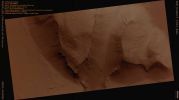
ESP_018075_1955_RED_abrowse-00.jpgAn Hill cut by Cerberus Fossae (Natural Colors; credits for the additional process. and color.: Dr Paolo C. Fienga - Lunexit Team)58 visitenessun commentoMareKromium
|
|
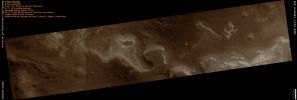
ESP_018487_1470_RED_abrowse.jpgHellas Planitia (Natural Colors; credits for the additional process. and color.: Dr Paolo C. Fienga - Lunexit Team)58 visitenessun commentoMareKromium
|
|
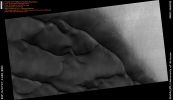
ESP_020797_1280_RED_abrowse-00.jpgPossible Active Gullies' Activity on a Southern Dunefield58 visiteCaption NASA:"The Dark Sand Dunes here are eroded in many places, forming Gullies. Some of these Gullies were not present in prior images of this spot or, if they were, they have now grown in size.
Monitoring of Dune Gullies by HiRISE has shown us when the Gullies are active: in the Winter or early Spring.
This was a surprise, because the Gullies look like ones on Earth that are formed by flowing water or wet debris. It is far too cold for water to be liquid in the Martian Winter, but there is Carbon Dioxide Frost (Dry Ice) on the ground, lasting through the Spring at high latitudes. This Frost may serve to reduce grain-to-grain friction, allowing the sand to flow on the steep slopes".MareKromium
|
|
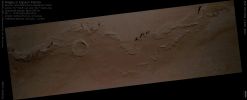
PSP_007896_1890_RED_abrowse-PCF-LXTT.jpgFeatures of Elysium Planitia: Ridges and "Fumes" (Saturated Absolute Natural Colors; credits for the additional process. and color: Dr Paolo C. Fienga - Lunexit Team)58 visitenessun commentoMareKromium
|
|

Q-pia08014-02-AEB1-full-reduced1.jpgMartian Southern Highlands (2) - HR57 visitenessun commento
|
|

Q-S-HalleyCrater-PIA08048_modest-2.jpgIn the vicinities of Halley Crater (2)57 visiteThis image was taken by the High Resolution Imaging Science Experiment (HiRISE) camera onboard NASA's Mars Reconnaissance Orbiter spacecraft on March 24, 2006. The image is centered at 47,14° South Latitude and 302,00° East Longitude. It is oriented such that north is 7° to the left of up. The range to the target was 1.699 Km (such as about 1.056 miles). At this distance the image scale is 1,70 mt (about 5,58 feet) per pixel in the center portion of the image, so objects as small as 5,1 meter (such as 16,7 feet) are resolved. In the side regions the pixels were binned 2x2 to a scale of 3,4 mt (such as 11,2 feet) per pixel. The camera has a total of 10 red-bandpass CCD detectors and in this image the first 4 CCDs on the left and the last 3 on the right were binned 2x2, while 3 in the middle returned data at full resolution. In total this image is 34,08 Km(21,18 miles) or 20.081 pixels wide and 8,50 Km (5,28 miles) or 5.164 pixels high. The image was taken at a MLT of 07:27 and the scene is illuminated from the upper right with a Solar Incidence Angle of 84,5° (this meaning that the Sun, at the time that the picture was taken, was about 5,5° above the local horizon).
|
|

R-PIA08788-2.jpgOlympia Undae (2)57 visiteThis image shows three representations of the 72 colors. The left panel is a nearly true-color composite in which the blue, green, and red planes are 0.44, 0.53, and 0.60 micrometer light -- nearly as the human eye would see. The contrast between the bright ice and dark dunes is so large that the dunes are barely seen. The middle panel is false color constructed from infrared wavelengths just beyond the range of the human eye. The blue, green, and red planes cover 0.80, 0.95, and 1.06 micrometer light. In this rendering of the data the differences between ice- and soil-rich regions are not as apparent because the colors of ice and dust are similar in this wavelength region. The right panel uses 1.15, 1.8, and 2.25 micrometer light in the blue, green and red planes and provides a dramatically different view of the scene. The areas of highest ice content appear in blue, and those with a mix of dust and ice -- most of the scene -- appear yellowish. The dunes are now visible against the ice because of their higher brightness at longer infrared wavelengths, and appear ruddy brown.
|
|

S-PIA08812.jpgCape Verde and Cabo Frio (1)57 visiteThis image from the High Resolution Imaging Science Experiment on NASA's Mars Reconnaissance Orbiter shows the Mars Exploration Rover Opportunity near the rim of "Victoria Crater." Victoria is an impact crater about 800 meters (half a mile) in diameter at Meridiani Planum near the equator of Mars. Opportunity has been operating on Mars since January, 2004. Five days before this image was taken, Opportunity arrived at the rim of Victoria, after a drive of more than 9 kilometers (over 5 miles). It then drove to the position where it is seen in this image.
Shown in the image are "Duck Bay," the eroded segment of the crater rim where Opportunity first arrived at the crater; "Cabo Frio," a sharp promontory to the south of Duck Bay; and "Cape Verde," another promontory to the north. When viewed at the highest resolution, this image shows the rover itself, wheel tracks in the soil behind it, and the rover's shadow, including the shadow of the camera mast. After this image was taken, Opportunity moved to the very tip of Cape Verde to perform more imaging of the interior of the crater.
This view is a portion of an image taken by the High Resolution Imaging Science Experiment (HiRISE) camera onboard the Mars Reconnaissance Orbiter spacecraft on Oct. 3, 2006. The complete image is centered at minus7.8 degrees latitude, 279.5 degrees East longitude. The range to the target site was 297 kilometers (185.6 miles). At this distance the image scale is 29.7 centimeters (12 inches) per pixel (with 1 x 1 binning) so objects about 89 centimeters (35 inches) across are resolved. North is up. The image was taken at a local Mars time of 3:30 PM and the scene is illuminated from the west with a solar incidence angle of 59.7 degrees, thus the sun was about 30.3 degrees above the horizon. At a solar longitude of 113.6 degrees, the season on Mars is northern summer.
Images from the High Resolution Imaging Science Experiment and additional information about the Mars Reconnaissance Orbiter are available online at: http://www.nasa.gov/mro or http://HiRISE.lpl.arizona.edu.
|
|
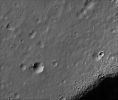
T-TRA_000866_1420_RED.jpgGorgonum Chaos57 visiteThis HiRISE image shows cratered plains along the edge of a large fracture to the south of Gorgonum Chaos. The wall of the fracture is in shadow and, at first glance, appears to reveal little detail about the geologic setting. In reality, the high quality of the HiRISE image, as shown in the stretched sub-image [below], demonstrates that considerable detail along the wall of the fracture can be discerned. A relatively dark layer extends along the upper wall of the fracture and approximately separates the exposed wall above from talus below. Some well defined talus chutes are also visible and are formed by the down slope movement of debris shed from higher along the fracture wall. The wind blown drifts of fine grained sediment accumulated along the base of the talus slope are relatively free of obvious talus. Hence, the wind likely accounts for much of the most recent modification of the scene in the sub image.
|
|
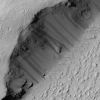
T-TRA_000853_1900_RED_MarteValles_01.jpgSeeps in Marte Vallis57 visiteMarte Vallis is a relatively young channel system on Mars that was carved by catastrophic floods of water. The HiRISE image samples just a small part of the valley system, but captures a variety of different landforms. The mesa in the eastern half of the image is a remnant of the pre-flood surface while the valley floor is covered by a surface with plates and ridges.
We highlight a piece from the southeastern portion of this HiRISE image, along the edge of the mesa. Some of the most striking features in this area are the dark streaks streaming down the cliff face. These mark locations where the layer of dust has been removed, exposing the darker surface underneath. The details of this cleaning process are not well-understood, but are thought to be driven by avalanches of dust. These avalanches appear to be more capricious than typical landslides or mudslides—they are sometimes able to surmount some large obstacles but in other cases are deflected by relatively small boulders. The darkness of the streaks vary, which suggests that they formed at different times. These streaks are expected to gradually fade as more dust will be deposited in the future. However, such fading has yet to be observed.
The role of dust is also clearly evident on the floor of the valley. The fluted mounds are characteristic of a thick dust deposit that is being gradually stripped away by wind. This extensive dust cover complicates any attempt to understand the details of the floods that carved the valley and the processes that formed the plates and ridges on the floor.
|
|

Craters-Becquerel_Crater_mound_6m-03.jpgBeautiful Becquerel Crater (4)57 visitenessun commento
|
|
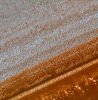
TRA_000825_2665_IRB-01.jpgNorth Polar Layers (2)57 visiteNOTA:
This color images cover only the center swath of the full image, and is composed of images acquired through infrared, red, and blue-green filters. The color has been enhanced to better show the subtle color differences.
It is NOT natural color or how it would appear to normal human vision.
|
|
| 2237 immagini su 187 pagina(e) |
 |
|
|
|
|
155 | |
|
|
|
|





