| Piú viste - Mars Reconnaissance Orbiter (MRO) |

PIA10141-AraneiformTerrain~0.jpgAraneiform and Lace Terrains (MULTISPECTRUM; credits: Lunexit)57 visiteThe South Polar Terrain on Mars contains landforms unlike any that we see on Earth, so much that a new vocabulary is required to describe them. The word "araneiform" means "spider-like".
There are radially organized channels on Mars that look spider-like, but we don't want to confuse anyone by talking about "spiders" when we really mean "channels", not "bugs."
This picture shows an example of "connected araneiform topography", such as terrain that is filled with spider-like channels whose arms branch and connect to each other. Gas flows through these channels until it encounters a vent, where is escapes out to the atmosphere, carrying dust along with it. The dark dust is blown around by the prevailing wind.
This image also shows a different Region where the channels are not radially organized. In this Region they form a dense tangled network of tortuous strands. We refer to this as "lace". MareKromium
|
|

PSP_008927_2010.jpgUnnamed Crater in Nili Fossae Region (True Colors; credits: Dr M. Faccin)57 visitenessun commentoMareKromium
|
|

PSP_008927_2010_RED-00.jpgPossible MSL Landing Site in Nili Fossae Trough (natural colors; credits: Lunexit)57 visiteNili Fossae Trough is a linear trough about 25 Km wide, formed in response to the creation of the Isidis Basin.
Nili Fossae has diverse deposits, some containing Phyllosilicates (Clay Deposits which typically form in the presence of water), and others with the minerals Olivine and Pyroxene.
This image is part of a series covering the 25 km Landing Ellipse; they are used to determine the safest possible Landing Site for the Mars Science Laboratory Rover. In this frame, relatively smooth rock exposures is visible, as well as sand ripples and some small knobs. There are few large rocks in the area, while the surface seems to be mostly flat, fractured rock.
This landscape is located in the South-Eastern part of the Landing Ellipse.MareKromium
|
|
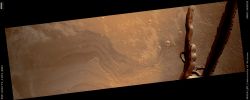
Psp_008779_1905_red.jpgThe Head of Athabasca Valles (natural colors; credits: Lunexit)57 visiteThis observation is located at the head of the Athabasca Valles Channel System, which lies just North of Mars’ Equator, in a low-elevation Region known as Elysium Planitia.
Athabasca Valles has an interesting geologic history. It was probably carved by one or more catastrophic floods of water, but more recently, a flood of lava coursed through the channel system. Both the water and the lava erupted from a few discrete points (or “vents”) along the Cerberus Fossae, a 1600-Km(1000-mile) long network of extensional (or “normal”) faults. The two prominent troughs that cut across the Southern end of this HiRISE image are part of the Cerberus Fossae. They are distinct fault segments that overlap at their tips, as one tapers in and the other pinches out.
They were not always as wide as they are today. Erosional processes have widened the troughs over time. Major eruptions occurred along both of the fault segments seen in this image, though they occurred to either side of the imaged area itself. Lava that erupted from the western vent covers the northern half of the image. The lava has raised, lobate margins and is slightly darker in tone than the older cratered plains it embays. The lava also has a banded appearance of subtly contrasting lighter and darker tones, that correspond to variations in surface roughness.
The bands are concentric to a vent located immediately west of the imaged area. Unfortunately, vents along the Cerberus Fossae are not well preserved.MareKromium
|
|
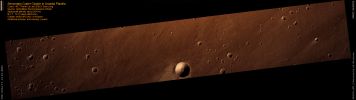
PSP_006271_2210_RED_abrowse.jpgPrimary and Secondary Craters in Arcadia Planitia (MULTISPECTRUM; credits: Lunexit)57 visiteThese unusual craters were spotted in Arcadia Planitia, which is part of an extensive region of Mars blanketed by a thick layer of bright dust.
Light southeasterly winds during southern spring and summer blow the dust towards the northwest (top left of the picture in the cutout above). The dust is trapped temporarily in the lee of crater rims, both inside the craters and along the outside rims where they form streamers that resemble St. Nick’s beard.
MareKromium
|
|

PSP_009162_1570.jpgFresh 5-Kilometer Diameter Rayed Crater (False Colors; credits: Dr M. Faccin)57 visiteThe crater featured in this scene formed on top of ejecta from a nearby rampart crater, located to the North.
The crater’s distinct rim indicates that it is relatively young. There is bright material on many of the crater walls that might be landslides of dust or another bright substance.
The mounds of material on the crater floor probably formed during late stages of crater’s own formation. The crater floor is speckled with even smaller craters.MareKromium
|
|
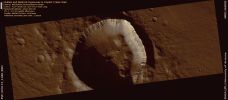
PSP_009155_1480_RED.jpgGullies and Bedrock Exposures in Impact Crater Wall (natural colors; credits: Lunexit)57 visiteThis image shows a rather pristine crater with Gullies and Bedrock Exposures. The Gullies are mostly on the South-Facing (such as the Poleward facing) wall. Some of the gully channels are very sharp, indicating that they have not been modified much since they formed.
Other channels criss-cross each other, demonstrating that there were multiple periods of activity. Scientists do not know how closely these were spaced in time.
The South and East walls of the Crater (upper right of the frame) have very distinct bright layers. These layers are possibly Ancient Bedrock. These walls also have what appear to be bright Landslides.MareKromium
|
|
PSP_009138_2025_RED-01.jpgMineralogical Diversity in Nili Fossae (edm - natural colors; credits: Lunexit)57 visitenessun commentoMareKromium
|
|
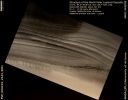
PSP_009293_2645_RED.jpgStructure of the North Polar Layered Deposits (natural colors; credits: Lunexit)57 visiteThe North Polar Layered Deposits on Mars are thought contain a record of global climate changes, similar to ice ages on Earth. This image shows that the geologic history of the NPLD has been complex enough to form angular unconformities.
An angular unconformity represents a gap in the geologic record, where erosion has removed material followed by deposition of more material on the eroded surface. In this image, the angular unconformities are recognized by the truncation, or cutting off of layers, for example right of center and at bottom center.
Also visible in this image are numerous streaks, perhaps caused by recent redistribution of frost by winds.MareKromium
|
|
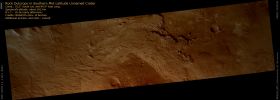
PSP_009151_1465_RED.jpgRock Outcrops in Southern Mid-Latitude Crater (natural colors; credits: Lunexit)57 visiteThis image shows part of the floor of a large Impact Crater in the Southern Hemisphere. The crater lies at the edge of the Hellas Impact Basin; although it is roughly 50 Km across, it is dwarfed by the giant Hellas structure, which has seen a varied and interesting geologic history.
This image captures a diverse range of rocks on the Crater Floor. A small cliff running across the middle of the image marks the edge of one rock unit, but variations in tone or texture in the northern part of the image suggest a varied history of deposition. Exposures of light, intermediate and dark materials may correspond to different types of deposition, or perhaps alteration after the rocks were laid down. Some units appear rich in boulders, suggesting that they are breaking up into blocks, while at other sites there are thin layers.
This diversity indicates a varied geologic history. Hellas Basin is a low Region, and may have once held lakes or seas where sediments could have been deposited.
This site is also just west of Hadriaca Patera, an old volcano. Sediment could also have been deposited by wind, or in streams on the surface. Unraveling the history of the region will require many images to illustrate the diversity of rocks and map out where they occur.MareKromium
|
|
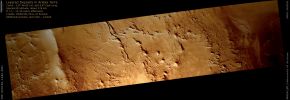
PSP_009180_1840_RED.jpgLayered Deposits within Unnamed Crater in Arabia Terra (natural colors; credits: Lunexit)57 visiteArabia Terra is an area of Mars that has an abundance of Layered Deposits within Impact Craters.
The Region of Arabia has plateau material that is thought to be part of the ancient highland crust that is Noachian in age according to Martian timescale. Thus, the layered deposits may represent some of the earliest eroded and infilled materials on Mars.
In this Unnamed Crater, we see layering exposed along the margins of a scarp-like bench.
The layering is of particular interest because on Earth, they may represent multiple sequences of deposited material or some geologic process (subaerial or subaqueous) that has modified and/or deposited material on the surface in some constant fashion.
If the layered sequences are consistently the same, we can infer that the conditions of their deposition were the same for some period of time. If the layers changed in some way (e.g., thickens and thins), then we can infer that some condition(s) caused this to happen.
From these observations and analyses, scientists can attempt to quantify and reconstruct what the ancient conditions were like in this Region of Mars.MareKromium
|
|
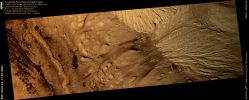
PSP_009149_1750_RED.jpgInverted Riverbed in Gale Crater (False Colors; credits: Lunexit)57 visiteGale Crater is a large, approximately 152 Km-diameter impact crater that lies near the Martian Equator. Contained within the crater is a massive central mound of layered material. With an average vertical thickness of almost 4 Km (about 2,4 miles), the Gale Crater Layered Deposits are twice as thick as the layers exposed along the Grand Canyon on Earth. Shown here is a portion of the mound with an inverted fluvial or river channel.
Topographic inversion occurs when sediments are cemented together, forming a harder layer that is resistant to later erosion. This later erosion has preferentially removed material outside the channel, leaving the former riverbed exposed as a ridge — such as a topographic high.
This inverted channel was originally detected by scientists using Mars Orbiter Camera (MOC) images onboard the Mars Global Surveyor Spacecraft.
Color variations visible in this image are mostly due to variable amounts of loose dark sediment that has accumulated unevenly across the scene.MareKromium
|
|
| 2237 immagini su 187 pagina(e) |
 |
|
|
|
|
153 | |
|
|
|
|





