| Piú viste - Mars Reconnaissance Orbiter (MRO) |
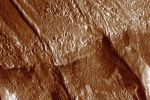
PSP_002620_1410_RED_browse-01.jpgGullies on the edge of Newton Basin (extra-detail mgnf)57 visiteThe gullies start near the top of the wall and can be traced across a break in slope partway down the wall (see here, 750 mt across). This break in slope occurs along the entire portion of the Crater wall in this image. The gullies appear shallower just above the break in slope, and deeper below the slope break.
This suggests that the fluid which eroded and carved out the wall materials forming the gullies, increased in velocity after the slope break, creating a deeper section of the gully.MareKromium
|
|
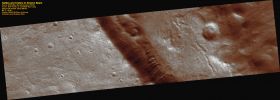
PSP_002620_1410_RED_browse-00.jpgGullies on the edge of Newton Basin (context image)57 visiteThis image shows a portion of two impact craters on the floor of Newton Basin where a smaller crater formed within a earlier larger one.
The larger crater's North rim can be seen diagonally (South-West/North-East) across the image and the smaller crater's north rim is near the right-side of the image.
Along the interior wall of the larger crater, several gullies have incised into the wall of the Crater. MareKromium
|
|

PSP_003252_1425_RED_browse-02.jpgBright Gully Deposit in Terra Sirenum (the "gully" - close-up; false colors)57 visiteThe bright gully deposit has a very fluid-like appearance, and has not been covered by other gullies or debris flows, indicating a young age. The brightness is a mystery; it could be due to minerals formed from water or ice.
Alternatively, the flow that made the gully may have removed a thin coating of relatively darker dust and soil, revealing a brighter substrate.
In any case, this feature is probably indicative of recent flow of water or water-rich material on Mars.MareKromium
|
|
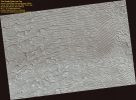
PSP_004820_0940_RED_browse.jpgFingerprint Terrain with Sawtooth Patterns in the South Polar Ice Cap (Natural Colors; credits for the additional process. and color.: Dr Paolo C. Fienga - Lunexit Team)57 visiteThis image shows a portion of the South Polar Ice Cap. The ice you see here is frozen CO2 rather than the frozen water you are used to here on Earth.
Even on Mars, where the temperatures are much lower than on Earth, CO2 ice is a volatile substance. As it is so unstable, large amounts can sublimate very quickly when heated. In this ice cap we can see icy features shrink in size by several meters per year as the ice that makes them up is removed by solar heating. Usually these icy features are almost circular as you get equal amounts of Sunlight from every direction when you are at the Pole.
However, in this location something strange has happened. Instead of the usual circular features we see features that are decidedly linear in shape. These sets of linear features have been dubbed "fingerprint terrain" by Planetary Scientists. They are seen in several locations in this ice cap and usually have a wavelength close to 90 mt (295 feet). It's hard to understand why linear features would form in this sort of environment by sublimation of ice alone.
It is possible that these features are formed instead by atmospheric processes. Either the features are sand dunes covered by a thin covering of frost or they might be made up of loose ice crystals that saltate like sand grains and have collected into ripples.
It would be a huge surprise to find sand dunes in this location, just as you wouldn't expect to see sand dunes on top of the Greenland ice sheet on Earth. To confirm that they are made of CO2 ice, HiRISE will image this location again at the end of the year and compare it to this image to look for changes.
Icy features should show large changes, but sand dunes move much more slowly. MareKromium
|
|
PSP_004847_1745_RED_browse-00.jpgThe "Martian Black Hole"...Again! (context frame)57 visiteVi invitiamo a leggere l'ultimo articolo sull'argomento (pubblicato su TruePlanets) dal titolo "Velvet Underground".MareKromium
|
|
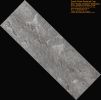
PSP_004739_0935_RED_browse.jpgSouth Pole Residual Cap - Swiss-Cheese Terrain Monitoring (Natural Colors; credits for the additional process. and color.: Dr Paolo C. Fienga - Lunexit Team)57 visitenessun commentoMareKromium
|
|
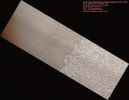
PSP_004778_0945_RED_browse.jpgSouth Pole Residual Cap - Swiss-Cheese Terrain Monitoring (Natural Colors; credits for the additional process. and color.: Dr Paolo C. Fienga - Lunexit Team)57 visitenessun commentoMareKromium
|
|

PSP_005155_1030_RED_browse.jpgExposure of South Polar Layered Deposits57 visiteA complex geologic history is on display in this image of the South Polar Layered Deposits. These layered deposits are a mixture of dust and water-ice. Each layer is thought to record information about the state of the Martian climate at the time of its deposition.
The original stack of layered ice has eroded to produce a scarp that exposes the internal layers. Smooth material was then deposited to cover this scarp before being in turn eroded. Deposition on top of an eroded surface like this produces what geologists call an "unconformity in the stratigraphic record". Remnants of this smooth material can be seen on the left of the image and draping the layered scarp near the image center.
Although it looks, at first glance, like this material has flowed down the scarp, that is unlikely to have happened. The extremely cold temperatures at the Martian Poles mean that ice in general does not flow like we see it do here on Earth. There are also no indications of some of the geomorphologic features that flowing ice typically acquires (such as crevasses, compressional ridges or moraines).
MareKromium
|
|

PSP_005194_1070_RED_browse.jpgFaulting in the South Polar Layered Deposits57 visiteThe scarp shown in this image marks the edge of the Polar Layered Deposits. These layered deposits are a mixture of dust and water-ice. Each layer is thought to record information about the state of the Martian climate at the time of its deposition.
The polar layered deposits were once more extensive, but have been eroded back to their current size. Most of this erosion takes places at inclined scarps (such as this one) which retreat as icy material is ablated away.
Other processes are also operating on these deposits as exemplified by the fault that is visible on the left of the image. Layers appear offset from one side of the fault to another indicating that the layered deposits have been fractured into large blocks that have moved relative to each other. The source of the stress that caused this fracturing is unknown; some possible examples are subsidence of the underlying terrain or perhaps melting of a portion of the base of the ice-sheet.
This particular Region of the Layered Deposits (Ultimi Lingula) contains many examples of this brittle fracture (which is otherwise rare in these Deposits). Another less obvious fault lies near the center of the image at the base of the scarp. This fault does not break through, or even deform, the upper layers which may indicate that the fault occurred when only half the layered deposits had accumulated. These observations point to a history of faulting in this region that at least spans the age range of these Layered Deposits. MareKromium
|
|

PSP_005346_1755_RED_abrowse-01.jpgLow-Order Inverted Streams near Juventae Chasma (extra-detail mgnf)57 visiteThis subimage (approx. 1120 meters across) shows a juncture of 2 of the "Inverted Channels".
It is likely that the water flowed from the left to the right of the scene, because channels usually join rather than divert unless there is an obvious obstacle in the way.
No such obstacle is seen here, but one might have been present when the stream originally flowed.
However, there is no way of knowing this.MareKromium
|
|

PSP_005346_1755_RED_abrowse-00.jpgLow-Order Inverted Streams near Juventae Chasma (context frame - elab. Lunexit)57 visiteThis image shows plains North-West of Juventae Chasma, one of the Martian canyons that are part of the equatorial Valles Marineris System. The two most noticeable features in this scene are craters on mesas (plateaux) and raised, winding ridges. The raised ridges are "Inverted Channels". It is likely that liquid water, either pure or salt water, flowed through these channels. The channels are raised because streams transport sediment as they flow, deposit the heavier sediment on the stream floor, and, eventually fill in once their water supply dwindles. Over time, wind erosion modifies a landscape, and this has played an important role on these plains. It eroded the land around the channels leaving the remnant channels exposed and standing high. The channels did not erode as much since they were more resistant, possibly because the deposited sediment had cemented together.
The craters on mesas are also evidence of active wind erosion: when craters form, they eject material out onto the surrounding landscape.
It appears that several of the craters’ ejecta visible here cemented, making the ejecta more resistant to erosion and leaving them standing high as craters on plateaux.MareKromium
|
|
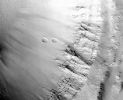
PSP_005343_2170_RED_abrowse-01.jpgScarp with Landslides and Boulder Tracks (extra-detail mgnf)57 visiteThis subimage - or extra-detail mgnf - (approx. 480 meters across) shows boulder tracks from the landslide scar on the left side of the image.
Some boulders can be seen forming trails along the slope at the top part of the subimage, while others can be seen at the end of their trails (...).MareKromium
|
|
| 2237 immagini su 187 pagina(e) |
 |
|
|
|
|
150 | |
|
|
|
|





